

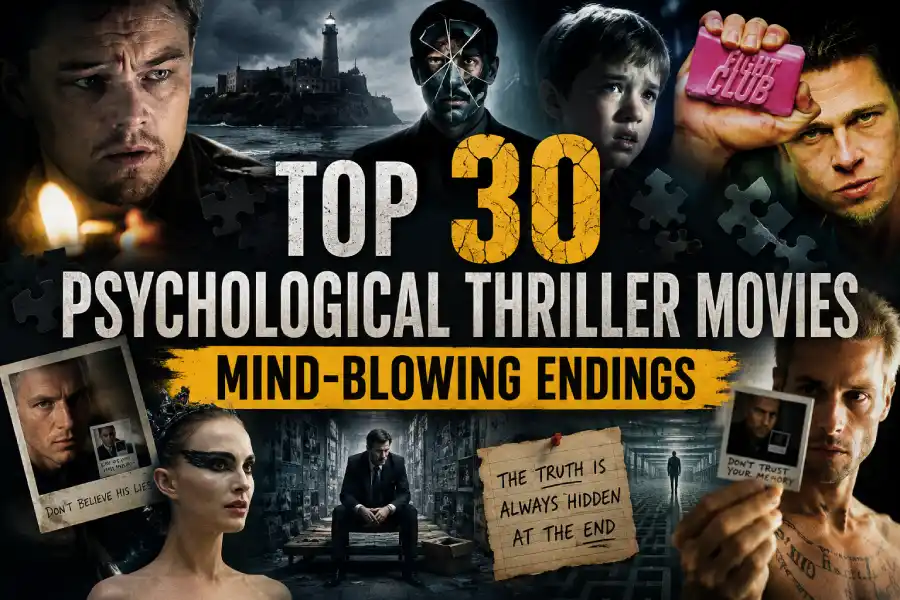
 If you love movies with mind-blowing endings, shocking plot twists, unreliable narrators, psychological deception, and mysteries that keep you guessing until the final frames, this curated guide is for you. We have evaluated, ranked, and detailed 30 of the finest psychological thrillers in cinema history.
Spoiler-Conscious Guarantee: To preserve the viewing experience for first-time watchers, the film analyses below discuss themes, structural setups, and the nature of the psychological puzzles without giving away the specific final surprises.
What Makes a Psychological Thriller Ending Truly Mind-Blowing?
There is a profound difference between a cheap “jump-scare” shock and a genuine narrative plot twist. A poor twist feels unearned—an arbitrary surprise inserted in the final five minutes that contradicts established character behavior purely for shock value.
In contrast, an exceptional psychological thriller ending adheres to specific storytelling principles:
- Fair-Play Clues: The director plants subtle visual, auditory, and dialogue clues throughout the film. The twist does not cheat the viewer; the evidence was present all along, disguised by clever misdirection.
- Total Narrative Recontextualization: The final reveal changes the fundamental meaning of every preceding scene. Actions that seemed heroic suddenly look tragic; characters who seemed innocent reveal darker layers.
- Unreliable Human Psychology: The mystery stems directly from human vulnerability—repressed trauma, grief, cognitive dissonance, mental illness, or calculated manipulation.
- Emotional Resonance: The ending delivers an emotional punch that stays with you long after the credits roll, challenging your beliefs about morality, justice, or reality.
- High Rewatch Value: The film becomes even more enjoyable on a second viewing, allowing you to appreciate the director’s craft, foreshadowing, and double-meaning dialogue.
Legendary Masterpieces & Classic Twists (#1 to #10)
1. Shutter Island (2010)
Director: Martin Scorsese | Runtime: 138 Minutes
Starring: Leonardo DiCaprio, Mark Ruffalo, Ben Kingsley, Michelle Williams, Max von Sydow
Core Theme: Grief, institutional paranoia, repressed trauma, and the fragility of sanity.
Set in 1954, Martin Scorsese’s atmospheric thriller follows U.S. Marshal Edward “Teddy” Daniels and his new partner Chuck Aule as they travel by ferry to Ashecliffe Hospital for the Criminally Insane on isolated Shutter Island. They are tasked with investigating the impossible disappearance of Rachel Solando, a patient who vanished from a locked room without a trace.
As a Category 4 hurricane cuts the island off from the mainland, Teddy’s investigation uncovers sinister clues pointing toward secret government experiments, psychiatric malpractice, and a mysterious hidden patient in Ward C. Plagued by severe migraines, vivid hallucinations of his deceased wife, and mounting distrust of the facility’s chief psychiatrist, Dr. Cawley, Teddy descends into a labyrinth where the boundary between objective reality and psychological defense mechanisms completely collapses.
Why the Ending Is Mind-Blowing: The final act forces viewers to completely re-evaluate Teddy’s investigation, turning a classic noir detective procedural into a heartbreaking look at trauma and the choices we make to survive our own minds.
2. The Sixth Sense (1999)
Director: M. Night Shyamalan | Runtime: 107 Minutes
Starring: Bruce Willis, Haley Joel Osment, Toni Collette, Olivia Williams
Core Theme: Unresolved trauma, communication barriers, emotional isolation, and closure.
Dr. Malcolm Crowe, a dedicated child psychologist in Philadelphia, is haunted by his failure to help a troubled former patient. Seeking redemption, he takes on the case of Cole Sear, a terrified eight-year-old boy who confesses a chilling secret: “I see dead people.”
As Malcolm works patiently to gain Cole’s trust, he helps the boy understand that these restless spirits seek help rather than harm. Meanwhile, Malcolm struggles with an increasing emotional distance from his wife, Anna. Shyamalan carefully constructs the narrative with quiet tension, delicate emotional beats, and symbolic uses of the color red.
Why the Ending Is Mind-Blowing: It remains one of the most famous twist endings in cinematic history. The final revelation fits every single scene together with mathematical precision, rewarding viewers who re-examine every interaction Malcolm had throughout the film.
3. Fight Club (1999)
Director: David Fincher | Runtime: 139 Minutes
Starring: Brad Pitt, Edward Norton, Helena Bonham Carter, Meat Loaf
Core Theme: Consumer alienation, toxic masculinity, disassociation, and anti-establishment rebellion.
An unnamed automobile recall coordinator suffers from chronic insomnia, finding temporary relief only by posing as a patient in support groups for diseases he does not have. His empty corporate lifestyle is disrupted when he meets Tyler Durden, an enigmatic, charismatic soap salesman who preaches anti-materialism and raw physical confrontation.
Together, they establish “Fight Club”—a bare-knuckle underground sanctuary in a bar basement where disaffected men release their frustrations. However, as the club rapidly expands across the country and evolves into “Project Mayhem,” an extremist anti-capitalist movement, the narrator loses control over Tyler’s escalating campaign of destruction.
Why the Ending Is Mind-Blowing: David Fincher embeds split-second single-frame flashes, subliminal props, and subtle dialogue cues throughout the film that make the third-act revelation an unmatched lesson in unreliable narration.
4. Gone Girl (2014)
Director: David Fincher | Runtime: 149 Minutes
Starring: Ben Affleck, Rosamund Pike, Neil Patrick Harris, Carrie Coon, Tyler Perry
Core Theme: Sociopathy, media sensationalism, performative marriage, and narrative manipulation.
On the morning of their fifth wedding anniversary in North Carthage, Missouri, Nick Dunne returns home to find the front door open, shattered glass in the living room, and his wife, Amy Elliott Dunne—the real-life inspiration for the beloved “Amazing Amy” children’s books—mysteriously missing.
Under intense police questioning and a relentless 24-hour cable news media circus, Nick’s flat demeanor, defensive lies, and secret financial troubles quickly make him the prime murder suspect. The narrative shifts between Nick’s present-day panic and Amy’s diary entries describing a marriage that deteriorated into fear and resentment.
Why the Ending Is Mind-Blowing: The mid-movie pivot and chilling final conclusion demolish traditional true-crime tropes, delivering a sharp critique of public media consumption and the terrifying compromises people make to maintain an image.
5. The Prestige (2006)
Director: Christopher Nolan | Runtime: 130 Minutes
Starring: Christian Bale, Hugh Jackman, Scarlett Johansson, Michael Caine, David Bowie
Core Theme: Destructive obsession, professional sacrifice, duality, and deceptive craft.
In Victorian London at the turn of the 20th century, stage magicians Robert Angier and Alfred Borden start as friends and assistants under the mentorship of an illusion engineer, Cutter. Following a tragic stage accident that results in the death of Angier’s wife, a bitter, lifelong rivalry ignites between the two illusionists.
When Borden invents an impossible teleportation illusion called “The Transported Man,” Angier becomes consumed with deciphering the secret. Angier’s obsession takes him to Colorado Springs to commission an electrical apparatus from inventor Nikola Tesla, setting off a dangerous cycle of espionage, sabotage, and murder.
Why the Ending Is Mind-Blowing: Structured explicitly around the three parts of a magic trick—The Pledge, The Turn, and The Prestige—Nolan tells the audience how the trick works in the opening monologue, yet the final twin reveals remain completely stunning.
6. Se7en (1995)
Director: David Fincher | Runtime: 127 Minutes
Starring: Brad Pitt, Morgan Freeman, Gwyneth Paltrow, Kevin Spacey
Core Theme: Moral decay, urban apathy, philosophical fanaticism, and inevitable wrath.
Set in an unnamed, rain-drenched city overwhelmed by decay, veteran homicide detective William Somerset, days away from retirement, is paired with hot-headed newcomer David Mills. Together, they investigate a string of murders where an unknown killer uses the seven deadly sins—Gluttony, Greed, Sloth, Lust, Pride, Envy, and Wrath—as moral justification for torture.
As the detectives follow the killer’s trail through classical literature and religious philosophy, the killer turns himself in at the police precinct covered in blood, offering to lead them to the final two bodies in a desolate desert landscape.
Why the Ending Is Mind-Blowing: The final desert climax—built around a mysterious delivery box—subverts typical Hollywood police procedural resolutions, delivering one of the most devastating, emotionally unforgettable endings in cinematic history.
7. Memento (2000)
Director: Christopher Nolan | Runtime: 113 Minutes
Starring: Guy Pearce, Carrie-Anne Moss, Joe Pantoliano
Core Theme: Anterograde amnesia, self-deception, manufactured purpose, and the unreliability of memory.
Leonard Shelby is on a relentless quest to find and kill the man who raped and murdered his wife. However, an injury sustained during the attack left Leonard with anterograde amnesia—the inability to form new short-term memories lasting longer than fifteen minutes.
To navigate his world and track his target, Leonard uses an elaborate system of Polaroid photographs, handwritten notes, and body tattoos. Nolan constructs the film using two intertwining timelines: a black-and-white sequence moving forward chronologically, and a color sequence moving backward in reverse time, placing the audience directly inside Leonard’s disoriented mental state.
Why the Ending Is Mind-Blowing: The point where the two timelines meet reveals an uncomfortable truth about how we manipulate our own memories to create meaning and avoid painful realities.
8. Black Swan (2010)
Director: Darren Aronofsky | Runtime: 108 Minutes
Starring: Natalie Portman, Mila Kunis, Vincent Cassel, Barbara Hershey, Winona Ryder
Core Theme: Destructive perfectionism, artistic obsession, somatic psychosis, and the shadow self.
Nina Sayers is a dedicated ballerina in a New York City ballet company, living under the smothering control of her retired ballerina mother. When artistic director Thomas Leroy plans to open the season with Swan Lake, Nina earns the lead role, which requires playing both the innocent, graceful White Swan and the sensual, dark Black Swan.
While Nina embodies the White Swan naturally, she struggles to unleash the uninhibited darkness required for the Black Swan. Under immense pressure and feeling threatened by a rival dancer, Lily, Nina’s grip on reality deteriorates into paranoia, physical delusions, and hallucinations.
Why the Ending Is Mind-Blowing: The climactic opening-night ballet performance merges reality and delusion, showing what happens when the relentless pursuit of artistic perfection consumes the artist entirely.
9. The Machinist (2004)
Director: Brad Anderson | Runtime: 101 Minutes
Starring: Christian Bale, Jennifer Jason Leigh, Aitana Sánchez-Gijón, John Sharian
Core Theme: Insomnia, subconscious guilt, psychological suppression, and somatic decay.
Trevor Reznik, an industrial lathe operator, has not slept in an entire year. Emaciated, socially withdrawn, and physically wasting away, Trevor’s life spirals into paranoia when he causes an accident at the factory that costs a coworker his arm.
Trevor claims he was distracted by a mysterious coworker named Ivan, whom no one else at the factory acknowledges exists. As mysterious post-it notes featuring a game of Hangman appear on his refrigerator door, Trevor becomes convinced an organized conspiracy is trying to drive him insane.
Why the Ending Is Mind-Blowing: Christian Bale’s extreme physical transformation supports a narrative that unpacks the psychological lengths the human mind will go to hide from guilt and past trauma.
10. Prisoners (2013)
Director: Denis Villeneuve | Runtime: 153 Minutes
Starring: Hugh Jackman, Jake Gyllenhaal, Viola Davis, Paul Dano, Terrence Howard, Melissa Leo
Core Theme: Vigilantism, parental desperation, moral boundaries, and generational evil.
On Thanksgiving Day in suburban Pennsylvania, two young girls vanish without a trace. Detective Loki leads the police investigation, quickly arresting Alex Jones, the driver of a suspicious RV parked nearby. However, due to Alex’s low cognitive capacity and a complete lack of forensic evidence, police are forced to release him after 48 hours.
Keller Dover, the father of one of the missing girls, believes Alex knows where the children are hidden. Convinced that the legal system is too slow, Keller kidnaps Alex, locking him in an abandoned building to interrogate him. Meanwhile, Detective Loki uncovers a dark web of mazes, priest confessions, and cold cases.
Why the Ending Is Mind-Blowing: The converging third act resolves a multi-layered mystery with chilling clarity, culminating in an open, suspenseful final shot that leaves audiences holding their breath.
Identity, Deception & Courtroom Puzzles (#11 to #20)
11. The Others (2001)
Director: Alejandro Amenábar | Runtime: 104 Minutes
Starring: Nicole Kidman, Fionnula Flanagan, Christopher Eccleston, Alakina Mann
Core Theme: Denial, religious guilt, isolation, and maternal grief.
In the immediate aftermath of World War II, Grace Stewart lives in an isolated country manor on the Channel Island of Jersey with her two young children, who suffer from a rare photosensitivity disease that prevents them from being exposed to direct sunlight. The house is kept in permanent darkness, with strict rules that no door may be opened before the previous one is locked.
When three mysterious servants arrive to help maintain the estate, strange occurrences begin disturbing the quiet home: unexplained piano music plays in locked rooms, footsteps echo on empty floors, and the children claim to see a family of intruders named “The Others.”
Why the Ending Is Mind-Blowing: Amenábar relies entirely on gothic atmosphere, shadow play, and psychological tension, culminating in an elegant revelation that completely redefines the relationship between the living, the dead, and the home.
12. Identity (2003)
Director: James Mangold | Runtime: 90 Minutes
Starring: John Cusack, Ray Liotta, Amanda Peet, John Hawkes, Alfred Molina
Core Theme: Dissociative identity disorder, psychological convergence, and Agatha Christie-style whodunit mechanics.
During a torrential rainstorm in the Nevada desert, flash floods trap ten disparate strangers at an isolated motel: a former cop turned limousine driver, a washed-up actress, a correctional officer transporting a convicted killer, a young couple, and a family involved in a car crash.
As the motel is cut off from outside communication, the guests are murdered one by one in brutal fashion, with each body left beside a numbered room key counting down from ten to one. Parallel to the motel killings, a late-night psychiatric hearing is taking place in a courtroom to determine the sanity of a death-row serial killer.
Why the Ending Is Mind-Blowing: The narrative ties the parallel storylines together with an inventive psychological concept that shifts the entire mystery from a traditional slasher into an internal battle for psychological dominance.
13. The Game (1997)
Director: David Fincher | Runtime: 129 Minutes
Starring: Michael Douglas, Sean Penn, Deborah Kara Unger, James Rebhorn
Core Theme: Control, existential disillusionment, corporate detachment, and psychological breaking points.
Nicholas Van Orton is a cold, wealthy San Francisco investment banker whose personal life is hollow and solitary. On his 48th birthday—the exact age his father committed suicide—his estranged, free-spirited brother Conrad gives him an unusual gift certificate for “Consumer Recreation Services” (CRS), a shadowy company that custom-tailors an immersive, real-world game for elite clients.
After undergoing psychological and physical testing, Nicholas finds his structured life systematically dismantled: his bank accounts are emptied, his mansion is vandalized, and he is hunted by armed mercenaries across the city.
Why the Ending Is Mind-Blowing: Fincher keeps the audience guessing at every turn. Is CRS an elaborate entertainment service designed to reawaken a man’s appreciation for life, or is it a malicious corporate conspiracy designed to rob him of everything?
14. American Psycho (2000)
Director: Mary Harron | Runtime: 102 Minutes
Starring: Christian Bale, Willem Dafoe, Chloë Sevigny, Jared Leto, Reese Witherspoon
Core Theme: Wall Street narcissism, consumerist conformity, emotional void, and surreal detachment.
Patrick Bateman is an affluent, handsome Wall Street investment banking executive in late-1980s Manhattan. Beneath his immaculate morning skincare routine, tailored Valentino suits, and obsession with business card typography, Bateman hides a psychopathic alter-ego driven by violent homicidal urges.
As Bateman’s violence escalates from stray animals to homeless men, colleagues, and sex workers, his grip on his surroundings begins to slip. Yet in a world defined by superficial conformity, everyone mistakes each other’s identities, and no one notices his confessions.
Why the Ending Is Mind-Blowing: Harron balances pitch-black satire with psychological ambiguity, leaving viewers to debate whether Bateman is a serial killer operating in an indifferent world, or a man whose fantasies play out entirely inside his own mind.
15. Oldboy (2003)
Director: Park Chan-wook | Runtime: 120 Minutes
Starring: Choi Min-sik, Yoo Ji-tae, Kang Hye-jung
Core Theme: Extreme vengeance, engineered guilt, tragic destiny, and the poison of obsession.
In 1988, ordinary businessman Oh Dae-su is kidnapped off the street and imprisoned in a private hotel-like room with a television as his only companion. He is held captive for fifteen years without knowing who took him or why. When he is abruptly released on a rooftop with cash and a suit, a mysterious phone call challenges him to uncover his captor’s identity within five days.
Armed with a hammer and driven by raw fury, Dae-su begins an investigation through the criminal underworld of Seoul, aided by a young sushi chef named Mi-do.
Why the Ending Is Mind-Blowing: Park Chan-wook crafts a devastating psychological trap where the mystery of why Dae-su was imprisoned turns into a calculated web of revenge that shocks viewers to their core.
16. The Invisible Guest (Contratiempo) (2016)
Director: Oriol Paulo | Runtime: 106 Minutes
Starring: Mario Casas, Ana Wagener, José Coronado, Bárbara Lennie
Core Theme: Perjury, narrative deception, parental retribution, and the mechanics of the locked-room mystery.
Adrián Doria, a successful young tech entrepreneur named European Businessman of the Year, wakes up in a mountain hotel room locked from the inside with the corpse of his lover, Laura, and a pile of cash scattered on the floor. Accused of murder and out on bail, Adrián hires Virginia Goodman, a veteran witness-preparation specialist who has never lost a trial.
With only three hours before the prosecutor introduces a surprise witness, Virginia forces Adrián to recount the complete truth about a past car accident on an isolated forest road.
Why the Ending Is Mind-Blowing: This Spanish thriller is a masterclass in puzzle-box writing. The conversation between client and lawyer shifts the story through multiple interpretations, culminating in a brilliant final reveal.
17. The Usual Suspects (1995)
Director: Bryan Singer | Runtime: 106 Minutes
Starring: Kevin Spacey, Gabriel Byrne, Chazz Palminteri, Benicio del Toro, Kevin Pollak
Core Theme: Myth-making, criminal storytelling, confidence games, and the illusion of truth.
Following a catastrophic explosion and fire aboard a freighter docked at the Port of Los Angeles that leaves 27 men dead and millions in drug money missing, U.S. Customs agent Dave Kujan interrogates one of only two survivors: Roger “Verbal” Kint, a con artist with cerebral palsy.
Verbal recounts how five career criminals—brought together during a police lineup—were recruited by Kobayashi, the enigmatic attorney for Keyser Söze, a legendary Hungarian underworld kingpin whose existence is treated as a ghost story.
Why the Ending Is Mind-Blowing: The final coffee cup scene, the bulletin board pan, and the changing physical gait of a character deliver a masterclass in narrative misdirection that changed cinema forever.
18. Primal Fear (1996)
Director: Gregory Hoblit | Runtime: 129 Minutes
Starring: Richard Gere, Edward Norton, Laura Linney, John Mahoney, Frances McDormand
Core Theme: Courtroom manipulation, dissociative identity defenses, hubris, and perceived vulnerability.
When the beloved Archbishop of Chicago is murdered in his home, police capture Aaron Stampler, an altar boy found covered in blood. Flamboyant, publicity-hungry defense attorney Martin Vail volunteers to represent Aaron pro bono, convinced that the stuttering, terrified young man is innocent.
As psychiatric evaluations uncover deep childhood trauma and corruption within the church, Aaron displays a violent alter-ego named “Roy” during a prison interview. Vail builds his defense around multiple personality disorder to secure an acquittal.
Why the Ending Is Mind-Blowing: Edward Norton’s breakout debut performance powers a final courtroom cell conversation that completely humbles the arrogant defense attorney and shocks the viewer.
19. The Girl on the Train (2016)
Director: Tate Taylor | Runtime: 112 Minutes
Starring: Emily Blunt, Rebecca Ferguson, Haley Bennett, Justin Theroux, Luke Evans
Core Theme: Alcoholic blackout amnesia, gaslighting, domestic deception, and voyeurism.
Rachel Watson is an unemployed, clinically depressed alcoholic reeling from a bitter divorce. Every day, she rides the commuter train to Manhattan, staring out the window at her former marital home and the neighboring house of an attractive couple, Megan and Scott Hipwell, whom she idealizes as living a perfect life.
One morning, Rachel witnesses something shocking on the Hipwells’ balcony. Shortly after, Megan goes missing, and Rachel wakes up with no memory of the previous night, covered in blood and bruises, pulling her directly into the police investigation.
Why the Ending Is Mind-Blowing: The film uses fragmented memories and shifting perspectives to show how emotional abuse and gaslighting can convince an innocent person of their own guilt.
20. A Beautiful Mind (2001)
Director: Ron Howard | Runtime: 135 Minutes
Starring: Russell Crowe, Jennifer Connelly, Ed Harris, Paul Bettany, Christopher Plummer
Core Theme: Paranoid schizophrenia, brilliant intellect vs. delusion, enduring partnership, and triumph of will.
John Forbes Nash Jr. is an eccentric, brilliant mathematical prodigy at Princeton University who develops the revolutionary game-theory concept of “governing dynamics.” His breakthrough lands him a teaching post at MIT, where he is recruited by a Department of Defense agent, William Parcher, to decipher encrypted Soviet telecommunications.
As Cold War espionage threats close in on his family, Nash’s behavior grows erratic. The audience experiences the high-stakes espionage world entirely through Nash’s perspective.
Why the Ending Is Mind-Blowing: The mid-film psychiatric intervention reframes everything the audience accepted as fact, turning a spy thriller into a moving drama about mental illness, love, and intellectual perseverance.
Mind-Bending Realities, Time Loops & Dark Mysteries (21 to 30)
21. Coherence (2013)
Director: James Ward Byrkit | Runtime: 89 Minutes
Starring: Emily Baldoni, Maury Sterling, Nicholas Brendon, Lorene Scafaria
Core Theme: Quantum decoherence, Schrödinger’s cat paradox, paranoia, and moral collapse across alternate realities.
Eight close friends gather for a dinner party in a suburban California home on the night Miller’s Comet passes close to Earth. When the power goes out across the neighborhood, the group notices one house down the street still has lights on.
Two friends walk over to investigate and return with a box containing items from their own house. The group quickly realizes that the passing comet has caused quantum realities to overlap, creating an infinite maze of identical houses occupied by alternate versions of themselves.
Why the Ending Is Mind-Blowing: Filmed without a traditional script using improvisational actor prompts, the tension builds from natural conversation to a chilling climax that explores the darkest choices an individual will make to survive.
22. Predestination (2014)
Directors: Michael Spierig & Peter Spierig | Runtime: 97 Minutes
Starring: Ethan Hawke, Sarah Snook, Noah Taylor
Core Theme: The Bootstrap paradox, temporal identity, fate, and deterministic self-creation.
Based on Robert A. Heinlein’s classic sci-fi short story *”—All You Zombies—”*, the film follows a Temporal Agent who travels through time using a violin-case device to prevent major crimes before they happen. On his final assignment, he works undercover as a bartender in 1970s New York.
He engages in conversation with a customer who writes confessional stories under the pen name “The Unmarried Mother.” The customer tells an extraordinary life story involving orphanages, intersex biology, heartbreak, and identity shifts.
Why the Ending Is Mind-Blowing: The narrative layers multiple timelines together into a closed causal loop where every major character’s origin connects in a mind-bending revelation.
23. Enemy (2013)
Director: Denis Villeneuve | Runtime: 90 Minutes
Starring: Jake Gyllenhaal, Mélanie Laurent, Sarah Gadon, Isabella Rossellini
Core Theme: The subconscious, commitment anxiety, dual identity, and psychological entrapment.
Adam Bell is a quiet history professor in Toronto whose life is defined by monotonous routines. On a colleague’s recommendation, he rents an indie film and notices a minor actor named Anthony Claire who looks physically identical to him.
Unsettled, Adam tracks down Anthony. When the two men meet in a hotel room, they discover they share the exact same voice, height, and scars, but possess completely opposite personalities: Adam is timid, while Anthony is aggressive and volatile.
Why the Ending Is Mind-Blowing: Villeneuve frames Toronto in a yellow-brown haze filled with recurring spider imagery, leading to one of the most famously shocking and symbolic final jump-cuts in modern psychological cinema.
24. Get Out (2017)
Director: Jordan Peele | Runtime: 104 Minutes
Starring: Daniel Kaluuya, Allison Williams, Bradley Whitford, Catherine Keener, Lil Rel Howery
Core Theme: Systemic racism, microaggressions, modern body commodification, and hypnosis.
Chris Washington, a young Black photographer from Brooklyn, travels to upstate New York with his white girlfriend, Rose Armitage, to meet her parents for the first time. While Rose’s neurosurgeon father Dean and psychiatrist mother Missy appear welcoming, Chris notices strange, detached behavior from the family’s Black domestic workers.
During the family’s annual estate gathering, Chris experiences a series of uncomfortable encounters with elderly white guests. When Missy offers to cure Chris’s smoking habit using tea-cup hypnosis, she sends him into the paralyzing mental void of the “Sunken Place.”
Why the Ending Is Mind-Blowing: Jordan Peele balances social satire with psychological terror, revealing an insidious, methodical operation that reframes every single interaction from the weekend.
25. Triangle (2009)
Director: Christopher Smith | Runtime: 99 Minutes
Starring: Melissa George, Liam Hemsworth, Michael Dorman, Emma Lung
Core Theme: Maternal guilt, Sisyphus myth, inescapable causal time loops, and punishment.
Jess, a stressed single mother caring for an autistic son, joins a group of friends for a sailing trip off the coast of Miami. After an unseasonal storm capsizes their yacht, the survivors drift until they discover a 1930s ocean liner, the *Aeolus*, appearing out of the mist.
Boarding the vessel, they find it abandoned, yet Jess experiences strong feelings of déjà vu: she knows the layout of the corridors and finds fresh blood on the mirrors. Soon, a masked figure armed with a shotgun begins hunting them down.
Why the Ending Is Mind-Blowing: The film creates a multi-layered time-loop puzzle where past, present, and future iterations of characters intersect on the ship, leading to an ending inspired by Greek mythology.
26. Mulholland Drive (2001)
Director: David Lynch | Runtime: 147 Minutes
Starring: Naomi Watts, Laura Harring, Justin Theroux, Ann Miller, Robert Forster
Core Theme: The Hollywood dream, repressed guilt, fantasy defense mechanisms, and fragmented identity.
Following a car crash on Mulholland Drive in Los Angeles, a woman suffers amnesia and hides inside an apartment. She meets Betty Elms, a cheerful aspiring actress from Ontario who has just arrived in Hollywood. Adopting the name “Rita,” the mysterious woman and Betty work together to uncover Rita’s true identity, aided by a blue key and a purse full of cash.
As their investigation deepens, the narrative takes a surreal turn at the midnight theater *Club Silencio*. The story fractures, reversing character identities and showing a dark reality of jealousy, failed ambition, and unrequited love.
Why the Ending Is Mind-Blowing: Ranked by critics worldwide as one of the greatest films of the 21st century, Lynch crafts a dream-logic puzzle that rewards viewers who analyze how fantasy masks trauma.
27. The Vanishing (Spoorloos) (1988)
Director: George Sluizer | Runtime: 107 Minutes
Starring: Gene Bervoets, Johanna ter Steege, Bernard-Pierre Donnadieu
Core Theme: The obsession for closure, the banality of evil, and psychological curiosity.
While on a holiday road trip through France, young Dutch couple Rex and Saskia stop at a busy highway gas station. Saskia enters the convenience store to buy drinks and never returns. Rex spends the next three years searching for her, putting up flyers and making television appeals.
The kidnapper, Raymond Lemorne—an ordinary chemistry teacher and family man who calculated how to commit a crime purely to test his own morality—contacts Rex. Raymond offers to reveal what happened to Saskia on one condition: Rex must experience the exact same fate.
Why the Ending Is Mind-Blowing: The Dutch original remains famous for its chilling realism and refusal to give into typical Hollywood rescue tropes, culminating in an unforgettable final shot.
28. The Wailing (Goksung) (2016)
Director: Na Hong-jin | Runtime: 156 Minutes
Starring: Kwak Do-won, Hwang Jung-min, Chun Woo-hee, Jun Kunimura
Core Theme: Faith, doubt, xenophobia, demonic deception, and parental desperation.
In the remote, misty mountain village of Gokseong in South Korea, a mysterious illness breaks out, causing villagers to develop violent rashes and murder their families. Police officer Jong-goo investigates the incidents, but rumors quickly point to an elderly Japanese stranger living in a secluded forest hut.
When Jong-goo’s daughter begins displaying the same violent symptoms, he hires a shaman, Il-gwang, to perform an exorcism. Meanwhile, a mysterious woman in white appears, warning Jong-goo that the shaman cannot be trusted.
Why the Ending Is Mind-Blowing: Na Hong-jin builds a masterclass in psychological dread, placing the audience alongside the desperate father in a battle between conflicting stories where trust is a fatal choice.
29. Jacob’s Ladder (1990)
Director: Adrian Lyne | Runtime: 113 Minutes
Starring: Tim Robbins, Elizabeth Peña, Danny Aiello, Matt Craven, Macaulay Culkin
Core Theme: Post-traumatic stress, chemical military testing, spiritual transition, and acceptance.
Jacob Singer is a postal worker in New York City haunted by fractured memories of his service in the Vietnam War and the death of his young son. Jacob’s daily life begins unraveling as he experiences terrifying hallucinations: subway cars carrying reptilian demons, strangers with distorted faces, and visions of military experiments.
When other veterans from his unit reveal they are suffering from the same horrific hallucinations, Jacob investigates whether the U.S. Army dosed their battalion with an experimental aggression-inducing drug called “The Ladder.”
Why the Ending Is Mind-Blowing: The film inspired psychological horror classics like the *Silent Hill* video game series. The final revelations bring deep emotional closure, reframing the terrifying imagery through a profound spiritual lens.
30. Incendies (2010)
Director: Denis Villeneuve | Runtime: 131 Minutes
Starring: Lubna Azabal, Mélissa Désormeaux-Poulin, Maxim Gaudette, Rémy Girard
Core Theme: Intergenerational trauma, the horrors of sectarian war, reconciliation, and devastating truth.
Following the death of their mother Nawal Marwan in Montreal, twins Jeanne and Simon meet with a notary to hear her last will. Nawal leaves behind two sealed envelopes: one to be delivered to the father they believed was dead, and another to a brother they never knew existed.
Jeanne travels to their mother’s war-torn homeland in the Middle East to retrace her past, uncovering Nawal’s history as an activist, political prisoner, and survivor of the notorious Deressa prison. As Simon joins her to uncover their origins, their search leads to a mathematical paradox.
Why the Ending Is Mind-Blowing: The climactic revelation connects past and present with devastating power, delivering a profound message on breaking generational cycles of hatred.
Master Comparison Matrix: 30 Thrillers at a Glance
The table below summarizes all 30 psychological thrillers, detailing their release year, director, primary narrative mechanism, and main theme:
| # | Movie Title | Year | Director | Primary Narrative Mechanism | Core Psychological Theme |
|---|---|---|---|---|---|
| 1 | Shutter Island | 2010 | Martin Scorsese | Isolated Asylum Investigation | Grief & Repression |
| 2 | The Sixth Sense | 1999 | M. Night Shyamalan | Supernatural Child Psychology | Trauma & Resolution |
| 3 | Fight Club | 1999 | David Fincher | Underground Counter-Culture | Dissociative Alter-Ego |
| 4 | Gone Girl | 2014 | David Fincher | Dual Diary Deception | Performative Marriage |
| 5 | The Prestige | 2006 | Christopher Nolan | Stage Magic Rivalry | Obsessive Self-Sacrifice |
| 6 | Se7en | 1995 | David Fincher | Seven Deadly Sins Murders | Moral Apathy & Wrath |
| 7 | Memento | 2000 | Christopher Nolan | Reverse Non-Linear Timeline | Anterograde Memory Loss |
| 8 | Black Swan | 2010 | Darren Aronofsky | Ballet Performance Obsession | Somatic Perfectionism |
| 9 | The Machinist | 2004 | Brad Anderson | Severe Chronic Insomnia | Subconscious Guilt |
| 10 | Prisoners | 2013 | Denis Villeneuve | Missing Child Investigation | Vigilantism & Morality |
| 11 | The Others | 2001 | Alejandro Amenábar | Gothic Manor Confinement | Maternal Guilt & Denial |
| 12 | Identity | 2003 | James Mangold | Motel Whodunit Countdown | Dissociative Identity Convergence |
| 13 | The Game | 1997 | David Fincher | Immersive Corporate Service | Control & Paranoia |
| 14 | American Psycho | 2000 | Mary Harron | Wall Street Narcissism | Satirical Psychosis |
| 15 | Oldboy | 2003 | Park Chan-wook | 15-Year Private Confinement | Engineered Revenge |
| 16 | The Invisible Guest | 2016 | Oriol Paulo | Locked-Room Defense Prep | Narrative Perjury |
| 17 | The Usual Suspects | 1995 | Bryan Singer | Interrogation Room Flashbacks | Criminal Misdirection |
| 18 | Primal Fear | 1996 | Gregory Hoblit | High-Profile Murder Trial | Split Personality Defense |
| 19 | The Girl on the Train | 2016 | Tate Taylor | Commuter Train Voyeurism | Alcoholic Blackout Gaslighting |
| 20 | A Beautiful Mind | 2001 | Ron Howard | Cold War Codebreaking | Schizophrenic Delusion |
| 21 | Coherence | 2013 | James Ward Byrkit | Comet Quantum Splitting | Alternate Reality Paranoia |
| 22 | Predestination | 2014 | The Spierig Brothers | Temporal Bureau Time Travel | Bootstrap Causal Loop |
| 23 | Enemy | 2013 | Denis Villeneuve | Actor Doppelgänger Stalking | Subconscious Dual Identity |
| 24 | Get Out | 2017 | Jordan Peele | Upstate Family Visit | Hypnotic Racial Exploitation |
| 25 | Triangle | 2009 | Christopher Smith | Ghost Ocean Liner Storm | Mythic Sisyphus Time Loop |
| 26 | Mulholland Drive | 2001 | David Lynch | Amnesiac Hollywood Mystery | Dream vs. Reality Guilt |
| 27 | The Vanishing | 1988 | George Sluizer | Gas Station Abduction | Obsession for Closure |
| 28 | The Wailing | 2016 | Na Hong-jin | Rural Village Affliction | Demonic Doubt & Xenophobia |
| 29 | Jacob’s Ladder | 1990 | Adrian Lyne | Hallucinatory Post-War NYC | PTSD & Spiritual Acceptance |
| 30 | Incendies | 2010 | Denis Villeneuve | Middle East Will Search | Intergenerational War Trauma |
Best Psychological Thrillers Categorized by Sub-Genre
If you want to pick a film that matches your mood or preference, explore these curated sub-genre categories:
1. Masterclass Unreliable Narrators
- Fight Club (1999): The ultimate study in split identity and social disaffection.
- Memento (2000): Experience memory loss through a backward-moving timeline.
- The Machinist (2004): Watch guilt decay physical and mental reality.
- American Psycho (2000): Black satire questioning if violence is real or imagined.
2. Locked-Room & Contained Mysteries
- The Invisible Guest (2016): A locked hotel room and shifting versions of the truth.
- The Others (2001): A dark Victorian manor holding an unforgettable secret.
- Identity (2003): Strangers murdered one by one in an isolated desert motel.
- Coherence (2013): A suburban dinner party fractured by quantum physics.
3. Dark Investigative Crime & Vengeance
- Se7en (1995): A bleak hunt for a killer weaponizing the seven deadly sins.
- Prisoners (2013): How far a desperate father will go outside the law.
- Oldboy (2003): A 15-year imprisonment and an engineered cycle of revenge.
- Incendies (2010): Retracing a mother’s footsteps through war to find truth.
4. Mind-Bending Sci-Fi & Time Paradoxes
- Predestination (2014): The ultimate bootstrap paradox of time-travel identity.
- Triangle (2009): An inescapable, repeating time loop aboard a ghost ship.
- Jacob’s Ladder (1990): Hallucinations bridging war trauma and reality.
The Art of the Rewatch: Why Clues Matter
The mark of an average thriller is that once you know the ending, you have no reason to watch it again. The mark of a legendary psychological thriller is that knowing the ending makes the second viewing even more enjoyable.
When rewatching films like The Prestige, The Sixth Sense, or Shutter Island, your perspective shifts:
- Double-Meaning Dialogue: Statements that sounded like casual small talk on your first watch reveal themselves as clear admissions of truth.
- Camera Blocking & Eyelines: Notice how directors frame characters so they never directly interact with specific people in the room.
- Color & Costume Symbolism: Directors use specific color palettes—like the red doorknobs in The Sixth Sense or the yellow-brown haze in Enemy—to signal moments where reality is slipping.
- Background Audio Cues: Faint sound effects, distorted voices, and musical motifs often hint at character fates long before they are spoken aloud.
Frequently Asked Questions (FAQ)
What is the best psychological thriller movie with a twist ending?
Shutter Island, The Sixth Sense, Fight Club, Memento, and The Prestige are widely considered the benchmark psychological thrillers featuring masterfully crafted twist endings that completely reframe the story.
Which psychological thriller features the most shocking twist?
Films like Oldboy, Incendies, Se7en, Primal Fear, and The Others deliver emotionally devastating, deeply disturbing revelations that shock first-time viewers and permanently alter the meaning of earlier scenes.
What is an unreliable narrator in psychological thrillers?
An unreliable narrator is a protagonist whose credibility is compromised by mental illness, memory loss, psychological trauma, or deliberate deception (such as in Fight Club, Memento, or American Psycho), forcing the audience to experience a distorted version of reality.
Which mind-bending thrillers are best for fans of complex puzzles?
Predestination, Coherence, Triangle, Enemy, and Mulholland Drive are ideal for viewers who enjoy non-linear timelines, quantum multiverse paradoxes, time loops, and surreal psychological symbolism.
Why are psychological thrillers so rewarding to rewatch?
Great psychological thrillers hide subtle visual clues, double-meaning dialogue, and background foreshadowing that only make complete sense once you know the final twist, making a second viewing feel like a completely new movie.
Final Thoughts on Cinematic Psychological Puzzles
Psychological thrillers continue to captivate audiences because they respect the viewer’s intelligence. Instead of offering predictable answers, they challenge you to decipher clues, question character motivations, and examine the boundaries of truth and perception.
Whether you choose the mind-bending reality shifts of Shutter Island, the non-linear timeline of Memento, the dark morality of Se7en, or the quantum mystery of Coherence, each of the 30 films on this list delivers an unforgettable cinematic experience.
Pick a title from this guide, avoid spoilers, pay attention to the background details, and enjoy the ride as the story unfolds toward its mind-blowing conclusion!
Editor’s Note: Movie streaming availability varies by country and platform. Check your preferred streaming services for current regional licensing.