
Modern indoor life is largely sedentary, climate-controlled, and dominated by glowing digital screens. While traditional gym workouts offer controlled physical conditioning, running on a treadmill facing a mirrored wall or lifting weights under fluorescent lights often feels repetitive. In contrast, the best outdoor sports combine physical exertion with natural movement, fresh air, changing terrain, and genuine adventure. Moving your body through forests, across lakes, over coastal surf, and up rocky mountain trails makes exercise feel less like a chore and more like an exploration.
The spectrum of outdoor sports is extraordinarily broad. You do not need to be an extreme athlete or invest thousands of dollars in technical hardware to enjoy being active outdoors. An afternoon spent hiking through local nature reserves, paddling a kayak along a quiet estuary, or playing a round of disc golf in a city park provides substantial physical and mental benefits. Conversely, for those who thrive on adrenaline and technical mastery, mountain biking, rock climbing, whitewater kayaking, and alpine skiing push balance, endurance, and mental grit to their limits.
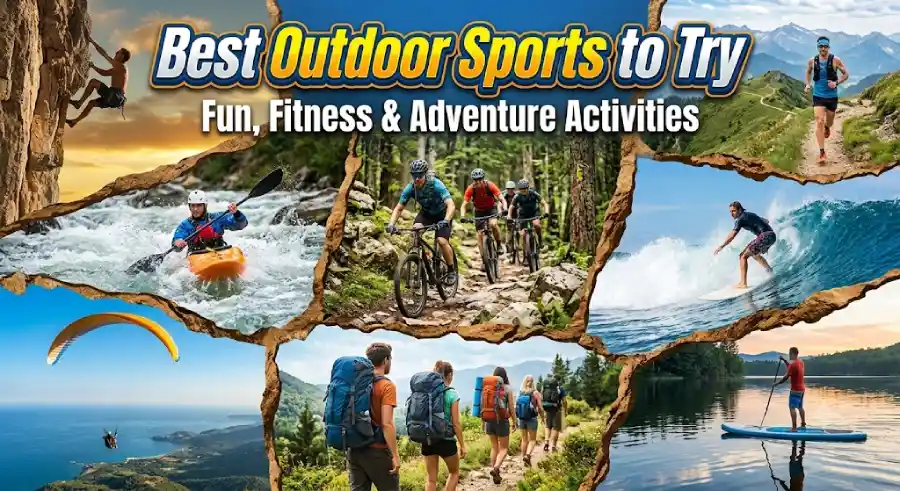 Engaging in outdoor sports connects you directly with natural seasonal cycles. A forest trail transforms completely from spring wildflower blooms to autumn foliage; an alpine ridge shifts from summer hiking to winter ski touring; and coastal bays offer glassy sunrise paddleboarding before midday sea breezes kick up rolling surf.
This comprehensive 5,000+ word master guide explores the 30 best outdoor sports to try. Each sport is broken down in detail, examining primary physical benefits, essential equipment, skill progression, safety protocols, and top American and global destinations to help you find the perfect active pursuit for your lifestyle.
The Philosophy of Outdoor Movement: Why Nature Changes Fitness
Outdoor sports encompass any physical activity performed primarily in open natural environments—forests, mountains, coastlines, lakes, rivers, canyons, and designated outdoor recreation corridors. Unlike traditional indoor sports played inside climate-controlled gyms with standardized, flat floors, outdoor sports require continuous physical adaptation to natural elements:
- Dynamic, Reactive Ground Surfaces: Moving across dirt trails, loose gravel, wet granite, packed snow, and uneven sand forces your feet, ankles, and stabilizing core muscles to micro-adjust with every stride. This natural instability builds stabilizing tendon strength and proprioception (spatial body awareness) that flat treadmills and gym floors cannot replicate.
- Micro-Climate Adaptation: Outdoor athletes encounter shifting environmental conditions: headwinds, tailwinds, direct solar radiation, cooling breezes, ambient humidity, and elevation changes. These factors elevate metabolic rate and challenge cardiovascular thermoregulation.
- Three-Dimensional Spatial Problem Solving: Navigating a rock face, picking a line through a mountain bike rock garden, reading ocean swells on a surfboard, or choosing a river route through moving water demands constant visual focus and rapid cognitive decision-making, keeping your mind fully engaged in the present moment.
The Evidence-Based Physical & Mental Benefits of Green Exercise
Decades of exercise physiology and environmental psychology research demonstrate that physical activity conducted in natural outdoor settings—frequently referred to as “green exercise”—delivers benefits superior to identical workouts performed indoors:
1. Accelerated Cortisol Reduction & Stress Relief
Immersion in natural outdoor environments activates the human parasympathetic nervous system. Clinical studies show that exercising outdoors significantly lowers circulating salivary cortisol (the body’s primary stress hormone), stabilizes blood pressure, and reduces systemic markers of inflammation compared to indoor gym sessions of equal duration and intensity.
2. Elevated Endorphin & Dopamine Response
The visual variety of outdoor landscapes—panoramic vistas, moving water, swaying trees, and changing sunlight—triggers natural dopamine release. Outdoor athletes consistently report lower rates of perceived exertion (RPE); running five miles along a forest trail feels faster and less fatiguing than running five miles on a stationary indoor machine.
3. Vitamin D Synthesis & Circadian Rhythm Alignment
Natural sunlight exposure during daytime outdoor sports stimulates cutaneous synthesis of Vitamin D3, essential for bone mineral density, immune function, and hormonal balance. Furthermore, direct exposure to morning and early afternoon daylight regulates the pineal gland’s melatonin production, resulting in deeper, more restorative sleep cycles at night.
4. Functional, Multi-Planar Muscle Development
Traditional gym machines isolate muscle groups along fixed, linear two-dimensional tracks. Outdoor sports like rock climbing, surfing, kayaking, and trail running require multi-planar movement: twisting, balancing, lateral lunging, and pulling. This develops functional kinetic chain strength, protecting joints from chronic repetitive strain injuries.
How to Select the Right Outdoor Sport for Your Goals
Selecting an outdoor sport that becomes a sustainable, lifelong habit requires honest assessment across four core dimensions:
1. Geographic Accessibility & Proximity
Choose a primary sport that fits where you live. If you live in an urban coastal city, surfing, sea kayaking, and open-water swimming are accessible weekday activities. If you reside near foothills, trail running, mountain biking, and bouldering should be your core pursuits. Reserve long-distance sports (like alpine mountaineering or downhill skiing) for weekend trips and vacations.
2. Baseline Physical Demands vs. Learning Curves
Some sports allow immediate enjoyment on Day 1 with zero prior training (such as hiking, recreational canoeing, and disc golf). Other sports carry a steep initial learning curve where basic balance, safety mechanics, and muscle memory must be developed over several weeks (such as surfing, mountain biking, skateboarding, and alpine skiing). Pick a sport whose initial learning curve matches your patience and fitness level.
3. Financial Investment & Equipment Requirements
Sports like running and hiking require minimal hardware beyond good footwear and water bottles. Equipment-intensive pursuits like mountain biking, whitewater kayaking, and ski touring involve significant upfront capital for protective armor, certified helmets, composite hardware, and maintenance tools. When exploring gear-heavy sports, always start by renting equipment or taking guided lessons before buying.
Sports 1 to 10: Trail Classics, Human-Powered Paddling & Waves
1. Hiking & Day Trekking
Primary Environment: Forest Footpaths, Alpine Ridges, Canyon Trails & National Parks
Fitness Focus: Cardiovascular Aerobic Endurance, Glute & Quadriceps Strength, Joint Stability
Skill Level: 100% Beginner Friendly | Pace: Self-Regulated
Hiking is the foundational human outdoor sport. Requiring no specialized mechanical components or engineered playing fields, hiking involves walking along natural, unpaved trails across varying terrain and elevations. It scales naturally from gentle, flat nature walks around scenic lakes to strenuous mountain ascents gaining thousands of vertical feet.
Hiking engages the major muscle groups of the lower body: the quadriceps and glutes power uphill climbs, while the hamstrings, calves, and stabilizing ankle ligaments manage the deceleration forces of downhill descents. Carrying a daypack adds functional resistance, strengthening the spinal erectors and core. Beyond physical conditioning, hiking immerses you in natural landscapes, offering viewpoints, wildlife encounters, and peaceful solitude.
- Premier National Destinations: Zion National Park (Utah); White Mountain National Forest (New Hampshire); Shenandoah National Park (Virginia); Yosemite Valley (California); Mount Rainier National Park (Washington).
- Core Technical Gear: Trail runners or mid-cut waterproof hiking boots with Vibram lug outsoles, moisture-wicking merino wool socks, 20L daypack, dual adjustable trekking poles, and offline GPS maps.
- Essential Safety Tip: Never hike without the “Ten Essentials” in your pack, even on short local day hikes. Weather in mountain valleys can deteriorate rapidly, making a waterproof shell, extra water, headlamp, and trail snacks essential.
2. Road & Gravel Cycling
Primary Environment: Paved Rural Roads, Dedicated Rail Trails, Mountain Passes & Unpaved Gravel Byways
Fitness Focus: High Cardiovascular Output, Quadriceps & Hamstring Power, Zero-Impact Endurance
Skill Level: Accessible with Basic Bicycle Balance
Cycling allows human beings to travel self-propelled across vast landscapes with mechanical efficiency. Riding a lightweight drop-bar road bike on smooth asphalt or a wide-tire gravel bike over packed dirt fire roads, cyclists can cover 20 to 60+ miles in a single morning workout, combining long-distance exploration with intense cardiovascular training.
Because cycling is a closed-chain, non-impact sport, it places minimal stress on the knees, hips, and ankles compared to distance running. It develops aerobic lung capacity, functional leg power, and core endurance while navigating winding country roads and challenging mountain ascents. The explosion of gravel cycling has opened up remote logging roads and farm routes far away from motor vehicle traffic.
- Premier National Destinations: Blue Ridge Parkway (North Carolina/Virginia); Flint Hills Gravel Roads (Emporia, Kansas); Going-to-the-Sun Road (Glacier National Park, Montana); Natchez Trace Parkway (Tennessee/Mississippi); Sonoma County Backroads (California).
- Core Technical Gear: Drop-bar gravel or endurance road bicycle, MIPS-certified road helmet, padded cycling bib shorts (chamois), clip-in pedals and shoes, front/rear daytime running lights, and a mini tire repair kit with CO2 inflator.
- Beginner Tip: Proper saddle height is critical. When your pedal is at the bottom of the stroke (6 o’clock position), your knee should retain a slight 25- to 30-degree bend. A saddle that is too low causes anterior knee pain, while a saddle set too high strains the hamstrings.
3. Trail Running
Primary Environment: Dirt Singletrack, Rocky Ridgelines, Forest Loam & Mountain Paths
Fitness Focus: High-Intensity Aerobic Capacity, Reactive Ankle Agility, Explosive Leg Power
Skill Level: Intermediate (Requires Baseline Running Fitness)
Trail running moves the continuous cardiovascular rhythm of running off hard, repetitive concrete roads and onto soft, unpredictable natural singletrack. Because trail surfaces shift with every footstrike—over exposed tree roots, loose gravel, granite slabs, and mud—trail runners must maintain high cadence, sharp visual focus, and reactive core balance.
Running on trails significantly reduces the repetitive impact shock transmitted through the knees and lower back compared to asphalt running, while the varied terrain engages stabilizer muscles throughout the calves and hips. Climbing steep trail switchbacks builds anaerobic strength, while descending technical trails sharpens quick footwork and spatial agility.
- Premier National Destinations: Marin Headlands & Mount Tamalpais (California); Boulder Mountain Parks (Colorado); Superior Hiking Trail (Minnesota); Forest Park Wildwood Trail (Portland, Oregon); Pisgah National Forest (North Carolina).
- Core Technical Gear: Trail-running shoes with aggressive 4mm–6mm rubber lugs and a rock-plate midsole, hydration running vest with dual chest flasks, anti-blister running socks, and lightweight polarized sunglasses.
- Pacing Strategy: Forget your road running split times. Trail running is governed by effort, not pace. Power-hike steep uphill grades with your hands pressed against your thighs, and focus on short, quick strides on technical descents.
4. Sea & Whitewater Kayaking
Primary Environment: Ocean Sounds, Glacial Fjords, Tidal Marshes & Rushing Mountain Rapids
Fitness Focus: Upper-Body Lat & Shoulder Endurance, Torso Rotational Strength, Core Balance
Skill Level: Flatwater (Beginner) to Whitewater (Technical/Advanced)
Kayaking uses a low-profile boat and a double-bladed paddle, placing you directly at water level. The sport divides into two distinct pursuits: Sea/Touring Kayaking, which involves paddling long, narrow boats across open ocean bays, sounds, and lakes; and Whitewater Kayaking, where paddlers pilot short, maneuverable plastic boats through turbulent river rapids, drops, and boulder gardens.
Contrary to common belief, effective kayaking power does not come from pulling with your arms. Efficient paddle strokes originate from torso rotation, using the large muscles of your back (latissimus dorsi), abdominals, and legs pushing against foot braces to drive the boat forward. It provides a comprehensive upper-body workout while exploring pristine coastlines and remote river canyons.
- Premier National Destinations: San Juan Islands (Washington); Arkansas River (Colorado); Florida Keys National Marine Sanctuary (Florida); Gauley River (West Virginia); Pictured Rocks National Lakeshore (Michigan).
- Core Technical Gear: Touring or whitewater kayak, double-bladed carbon paddle, USCG-approved Type III/V life jacket (PFD), neoprene spray skirt, and a whistle.
- Safety Standard: Always dress for the water temperature rather than the air temperature. If the combined air and water temperature is under 120°F (49°C), wear a neoprene wetsuit or drysuit to prevent cold-water shock in the event of a capsize.
5. Wilderness Canoeing
Primary Environment: Interconnected Boreal Lakes, Calm Riverways & Cypress Swamps
Fitness Focus: Aerobic Endurance, Upper Back & Forearm Stamina, Joint Mobility
Skill Level: Beginner Friendly for Flatwater
Wilderness canoeing is the classic open-boat paddling sport of the North American interior. Featuring an open-top hull and single-bladed paddles, canoes carry substantial cargo weight—including multi-day camping gear, food barrels, and fishing equipment—making them the premier vehicle for multi-day wilderness lake expeditions.
Canoeing emphasizes synchronization between bow and stern paddlers. The stern paddler steers using corrective strokes (like the J-stroke and rudder sweep), while the bow paddler provides forward momentum and watches for shallow obstacles. In canoe country, paddling is paired with “portaging”—carrying the canoe and packs overland between lakes—providing a strenuous functional workout.
- Premier National Locations: Boundary Waters Canoe Area Wilderness (Minnesota); Northern Forest Canoe Trail (New York to Maine); Okefenokee National Wildlife Refuge (Georgia); Buffalo National River (Arkansas); Allagash Wilderness Waterway (Maine).
- Core Technical Gear: 16- to 17-foot Kevlar or aluminum canoe, contoured wooden canoe paddles, portage yoke with shoulder pads, waterproof portage packs, and comfortable PFDs.
- Paddling Hack: Master the “J-stroke.” By turning your paddle blade outward into a subtle ‘J’ shape at the finish of your forward stroke, you keep the canoe tracking in a straight line without switching paddle sides.
6. Open-Water Swimming
Primary Environment: Clear Mountain Lakes, Ocean Bays, Calm Sounds & Coastal Coves
Fitness Focus: High Cardiovascular Conditioning, Lat & Tricep Strength, Lung Capacity
Skill Level: Intermediate to Advanced (Strong Swimming Foundation Required)
Open-water swimming leaves the tiled lane lines and chlorinated confines of the pool behind, taking swimmers into oceans, bays, and lakes. Without lane dividers or bottom lines, open-water swimmers navigate natural surface chop, ocean swells, variable water temperatures, and depth visibility.
The sport demands strong cardiovascular endurance and rhythmic bilateral breathing. Swimmers use “sighting” techniques, lifting their eyes forward during the breathing cycle to align with distant shore landmarks or buoys. Gliding through clear mountain lakes or calm ocean coves provides a sensory, meditative connection with the water.
- Premier National Locations: La Jolla Cove, San Diego (California); Lake Tahoe (California/Nevada); Kailua Bay (Kona, Hawaii); Lake Champlain (Vermont/New York); Walden Pond (Concord, Massachusetts).
- Core Technical Gear: Buoyant open-water swimming wetsuit, wide-angle anti-fog polarized swim goggles, brightly colored silicone swim cap, and a waist-attached inflatable orange swim safety buoy.
- Safety Mandate: Never swim alone in open water. Always swim alongside a partner, choose lifeguarded coastal zones, or have a companion accompany you in a kayak or stand-up paddleboard.
7. Ocean Surfing
Primary Environment: Ocean Point Breaks, Sandy Beach Breaks & Outer Reef Passes
Fitness Focus: Explosive Anaerobic Paddling, Core Balance & Fast Agility
Skill Level: High (Demands Dedicated Time & Water Comfort)
Surfing is an athletic discipline and global ocean culture. Balancing on a surfboard powered only by the energy of an ocean wave, surfers drop down the wave face, using rail pressure and foot weight to carve turns across breaking water.
Surfing provides a strenuous workout. Over an average two-hour surf session, roughly 80% of your time is spent paddling against ocean currents, diving under breaking waves (“duck diving”), and positioning yourself in the lineup. This builds broad back strength, shoulder endurance, and core stability. Catching and riding a wave delivers a rush of speed and connection with marine energy.
- Premier National Locations: Waikiki & North Shore (Oahu, Hawaii); Huntington Beach & Lower Trestles (California); Cocoa Beach (Florida); Cape Hatteras (North Carolina); Santa Cruz (California).
- Core Technical Gear: High-volume soft-top foam longboard (for beginners), epoxy or fiberglass board, urethane ankle leash, surf wax, and appropriate thickness wetsuit.
- Lineup Etiquette: Understand the golden rule of surf etiquette: the surfer closest to the breaking peak has priority. Never “drop in” on a wave that another surfer is already riding.
8. Stand-Up Paddleboarding (SUP)
Primary Environment: Calm Lakes, Sheltered Harbors, Tidal Creeks & Slow Rivers
Fitness Focus: Core Abdominal Strength, Isometric Leg Stability, Balance
Skill Level: 100% Beginner Friendly
Stand-up paddleboarding provides a peaceful, low-impact way to spend time on the water. Standing upright on a wide, stable board (10 to 12 feet long) and paddling with a single long blade, paddleboarders cruise across calm lakes, coastal harbors, and winding rivers with ease.
Standing up gives you an unobstructed downward view through the water, making it easy to spot fish, turtles, and aquatic vegetation. Balancing on the board engages the core, quadriceps, and stabilizer muscles, while forward paddling strengthens the shoulders, arms, and upper back. Inflatable SUP boards roll into a backpack, making paddleboarding portable for road trips and camping adventures.
- Premier National Locations: Emerald Bay, Lake Tahoe (California); Lady Bird Lake (Austin, Texas); Sunset Beach (Oahu, Hawaii); Weeki Wachee Springs (Florida); Mission Bay (San Diego, California).
- Core Technical Gear: Inflatable or rigid 30–32 inch wide SUP board, adjustable paddle, coiled leash (for flatwater) or breakaway waist belt leash (for rivers), and low-profile PFD.
- Pro Tip: Hold the paddle correctly: the logo on the blade should face forward, and the elbow of your top arm should maintain a slight bend as your top hand grips the T-handle.
9. Outdoor Rock Climbing (Sport & Traditional)
Primary Environment: Granite Domes, Sandstone Cliffs, Limestone Canyons & Quartzite Crags
Fitness Focus: Grip Strength, Upper-Body Pulling Power, Core Tension & Flexibility
Skill Level: Technical (Requires Certified Instruction & Safety Knowledge)
Outdoor rock climbing takes physical conditioning and turns it into a vertical puzzle. Securely tied into a dynamic climbing rope and wearing sticky rubber climbing shoes, climbers ascend natural rock faces, using subtle cracks, edges, and rock features to support their weight.
Climbing divides into Sport Climbing, where climbers clip quickdraw carabiners into pre-drilled permanent expansion bolts in the rock for fall protection; and Traditional (Trad) Climbing, where the lead climber places removable mechanical cams and nuts into rock cracks as they ascend. Climbing demands full-body strength, footwork precision, hip flexibility, and mental composure high above the ground.
- Premier National Locations: Red River Gorge (Kentucky); Yosemite Valley (California); Red Rock Canyon (Nevada); New River Gorge (West Virginia); Joshua Tree National Park (California).
- Core Technical Gear: Certified climbing helmet, dynamic climbing rope (9.5mm–9.8mm), climbing harness, sticky rubber climbing shoes, chalk bag, locking carabiners, and an assisted-braking belay device (like a Petzl Grigri).
- Critical Safety: Always conduct mutual “buddy checks” before leaving the ground: verify your figure-8 tie-in knot is dressed correctly, ensure the belayer’s device is threaded properly, and check that harness buckles are double-backed.
10. Mountain Biking (Cross-Country, Enduro & Downhill)
Primary Environment: Technical Forest Singletrack, Slickrock Plateaus & Lift-Served Bike Parks
Fitness Focus: High Cardiovascular Output, Dynamic Leg Power, Arm Shock Absorption & Balance
Skill Level: Intermediate (Requires Off-Road Cycling Mechanics)
Mountain biking combines off-road trail cycling with technical terrain features. Riding a specialized bicycle equipped with wide knobby tires, hydraulic disc brakes, and front and rear air suspension (full suspension), riders navigate trails filled with rocks, exposed tree roots, berms, and natural drop-offs.
The sport spans multiple styles: Cross-Country (XC) focuses on long endurance rides and steep, technical trail climbs; Enduro balances self-pedaled climbs with fast, aggressive downhill descents; and Downhill (DH) uses ski resort chairlifts to access high-speed gravity trails with jumps and drops. Mountain biking provides a demanding cardiovascular workout while delivering the thrill of flowing through winding forest singletrack.
- Premier National Locations: Moab Slickrock & Mag 7 (Utah); Bentonville Trail System (Arkansas – “Mountain Biking Capital of the World”); Whistler Mountain Bike Park (British Columbia); Crested Butte (Colorado); Kingdom Trails (East Burke, Vermont).
- Core Technical Gear: Full-suspension mountain bike, certified trail or full-face mountain bike helmet, padded cycling gloves, knee pads, flat-pedal riding shoes, and a hydration pack with multi-tool and tubeless tire plugs.
- Body Positioning Rule: Never sit on your saddle while descending technical terrain. Stand up in the “attack position”: pedals level, knees and elbows slightly bent, weight centered over the bottom bracket, and eyes looking 15 to 20 feet ahead down the trail.
Sports 11 to 20: Alpine Snow, Court Disciplines & Field Games
11. Downhill Alpine Skiing
Primary Environment: Groomed Mountain Slopes, Deep Alpine Bowls & Forest Glades
Fitness Focus: Quadriceps Strength, Core Balance, Joint Stability
Skill Level: Beginner Slopes to Expert Double-Black Diamonds
Downhill skiing is the classic mountain winter sport. Securely locked into two parabolic skis via mechanical release bindings and wearing stiff boots, skiers carve down snow-covered mountain slopes, using edge control and weight transfer to manage speed.
Skiing engages the lower body through sustained muscle contractions, strengthening the quadriceps, glutes, and calves while challenging balance at high speeds. Modern ski resorts offer carefully managed terrain, from wide, gentle green beginner trails to steep ungroomed powder bowls, making it accessible to beginners and seasoned experts alike.
- Premier National Locations: Vail and Breckenridge (Colorado); Park City and Alta (Utah); Jackson Hole (Wyoming); Palisades Tahoe (California); Stowe Mountain Resort (Vermont).
- Core Technical Gear: All-mountain carving skis, fitted ski boots, poles, MIPS-certified winter helmet, anti-fog dual-pane ski goggles, and waterproof Gore-Tex outerwear.
12. Snowboarding
Primary Environment: Deep Powder Bowls, Groomed Trails & Freestyle Terrain Parks
Fitness Focus: Core Agility, Calve Endurance, Rotational Balance
Skill Level: Moderate Initial Learning Curve
Snowboarding offers a dynamic, surf-inspired way to descend snowy mountains. Secured to a single composite board with strap-in bindings, riders carve down slopes using heel-and-toe edge pressure and upper-body rotation.
Riding fresh powder on a snowboard delivers a floating, frictionless sensation. Snowboarding engages the abdominal core and calves while building balance. Terrain parks featuring jumps, halfpipes, and rail features give freestyle riders space for athletic tricks and aerial creativity.
- Premier National Locations: Mammoth Mountain (California); Mount Baker (Washington); Snowbird (Utah); Breckenridge (Colorado); Mount Snow (Vermont).
- Core Technical Gear: Freestyle or all-mountain snowboard, supportive snowboard boots, ratchet bindings, wrist guards, impact shorts, and a certified helmet.
13. Outdoor Golf
Primary Environment: 18-Hole Championship Links, Park Courses & Coastal Fairways
Fitness Focus: Low-Impact Walking Endurance, Rotational Torso Flexibility, Hand-Eye Precision
Skill Level: Accessible with Technique Practice
Golf combines physical movement, mental focus, and strategic course management in manicured outdoor settings. Players navigate an 18-hole course, using a selection of drivers, irons, wedges, and putters to strike a small ball into each hole in as few swings as possible.
While riding a motorized golf cart is common, walking an 18-hole round turns golf into an effective low-impact workout: you will walk five to six miles, burn 1,000+ calories, and challenge rotational core muscles on every full swing. The sport demands patience, focus, and strategic thought across changing wind, elevation, and grass conditions.
- Premier National Locations: Pebble Beach Golf Links (California); Bandon Dunes Golf Resort (Oregon); Pinehurst Resort (North Carolina); Whistling Straits (Wisconsin); Bethpage Black (New York).
- Core Technical Gear: Complete set of fitted golf clubs (woods, irons, wedges, putter), golf bag, soft-spiked golf shoes with traction, golf glove, and weather-appropriate golf polo.
14. Freshwater & Saltwater Fishing
Primary Environment: Alpine Trout Streams, Deep Ocean Canyons, Shallow Flats & Inland Lakes
Fitness Focus: Wading Balance, Upper Body Casting Coordination, Mental Patience
Skill Level: Beginner Friendly to Expert Fly Tying
Fishing is one of the world’s most popular outdoor pastimes. Whether wading mountain rivers sight-casting dry flies to wild trout, poling shallow flats for bonefish, or dropping live bait for offshore pelagic game fish, fishing combines patience, outdoor observation, and active technique.
Fly fishing in particular is an active, physical sport: wading across rocky river currents requires balance and leg strength, while continuous casting works the shoulders, wrists, and core. Fishing encourages quiet observation of natural waterways, insect hatches, and aquatic life.
- Premier National Locations: Madison and Yellowstone Rivers (Montana); Florida Keys (Florida); Kenai River (Alaska); San Juan River (New Mexico); Outer Banks (North Carolina).
- Core Technical Gear: Rod and reel matched to target species (fly, spin, or baitcasting), non-lead tackle or hand-tied flies, polarized sunglasses (essential for seeing into the water), and breathable chest waders with wading boots.
15. Equestrian Trail Riding
Primary Environment: Mountain Forest Passes, Desert Plateaus, Grassland Trails & Coastal Beaches
Fitness Focus: Core Postural Stability, Inner Thigh Grip, Pelvic Balance & Coordination
Skill Level: Beginner Friendly with Guided Trail Horses
Horseback riding allows you to explore rugged wilderness trails from an elevated vantage point while connecting with an animal partner. Guiding a 1,000-pound horse across uneven mountain trails, switchbacks, and stream crossings requires balance, calm focus, and gentle communication through your reins, legs, and seat.
Riding is physically demanding: absorbing the horse’s gait engages the deep abdominal core, lower back, and inner thigh muscles (adductors) to maintain an upright, centered seat. Trail riding lets you cover miles of scenic backcountry trails with minimal trail impact.
- Premier National Locations: Bryce Canyon National Park (Utah); Shenandoah National Park (Virginia); Black Hills (South Dakota); Bighorn Mountains (Wyoming); Big Bend National Park (Texas).
- Core Technical Gear: ASTM/SEI-certified equestrian riding helmet, riding boots with a distinct 1-inch heel to prevent foot slippage in stirrups, durable long pants, and leather riding gloves.
16. Skateboarding & Longboarding
Primary Environment: Concrete Skateparks, Paved Urban Plazas & Smooth Coastal Paths
Fitness Focus: Fast Ankle Coordination, Quadriceps Power, Balance & Agility
Skill Level: Accessible Flat Pushing to Technical Park Acrobatics
Skateboarding blends urban athleticism with personal creative expression. Riding a wooden deck mounted on aluminum trucks and urethane wheels, skateboarders use foot-pushing momentum to cruise paths or perform technical tricks like ollies, kickflips, and grinds in concrete parks.
For fitness and relaxed outdoor travel, longboarding offers a smoother alternative: long, flexible decks with large, soft wheels absorb rough road vibrations, allowing you to carve down hills and cruise along beach paths with surf-like flowing turns. Skateboarding develops balance, leg power, and spatial agility.
- Premier National Locations: Venice Beach Skatepark (Los Angeles, California); Burnside Skatepark (Portland, Oregon); Louisville Extreme Park (Kentucky); Des Moines Skatepark (Iowa).
- Core Technical Gear: Complete skateboard or drop-through longboard, certified multi-sport skate helmet, knee pads, elbow pads, and flat-bottom suede skate shoes with grippy vulcanized rubber soles.
17. Outdoor Tennis
Primary Environment: Municipal Hard Courts, Har-Tru Clay Courts & Public Park Facilities
Fitness Focus: High-Intensity Interval Sprinting, Rotational Shoulder Power, Court Agility
Skill Level: Accessible with Basic Racket Skills
Playing tennis outdoors on municipal hard or clay courts delivers an intense cardiovascular and agility workout under the open sky. Moving across the court to return shots requires rapid sprint acceleration, split-second direction changes, and rotational torso power on forehand and backhand swings.
An hour of singles tennis burns over 600 calories while sharpening reaction time and hand-eye coordination. Public park courts across the country make tennis an accessible, social outdoor sport that can be enjoyed throughout life.
- Premier Public Tennis Hubs: Public park courts nationwide (Central Park, NYC; Balboa Park, San Diego; Crandon Park, Miami).
- Core Technical Gear: Balanced tennis racket strung to appropriate tension, non-marking herringbone court shoes (essential for lateral ankle support), sweat-wicking headbands, and a pressurized can of tennis balls.
18. Outdoor Soccer
Primary Environment: Natural Grass Playing Fields, Turf Parks & Sand Pitches
Fitness Focus: Sustained Aerobic Running, Sprint Acceleration, Footwork Coordination
Skill Level: Accessible to All Ages
Soccer is the world’s most popular sport, requiring nothing more than a ball and an open patch of grass. Players run continuously over 90 minutes, tracking ball movements, making passes, and sprinting into open space.
An outdoor soccer match combines endurance running with explosive sprinting, agility, and foot-eye coordination. Joining a recreational outdoor adult league or a weekend pickup game in a local park is an excellent way to build cardiovascular fitness and make friends in a team environment.
- Premier Playing Grounds: Community soccer fields, city parks, and recreational sports complexes nationwide.
- Core Technical Gear: Firm-ground (FG) molded cleat soccer shoes, shin guards, moisture-wicking jersey, and a durable size-5 soccer ball.
19. Outdoor Street Basketball
Primary Environment: Urban Asphalt Courts, Beachfront Parks & Community Centers
Fitness Focus: Vertical Jump Power, Rapid Defensive Shuffling, Upper Body Shooting Accuracy
Skill Level: Accessible from Solo Shooting to Pickup Games
Outdoor basketball—played on urban asphalt courts with chain-link nets—is an American sporting tradition. Whether shooting free throws alone in the morning sun or jumping into a fast-paced 3-on-3 pickup game at a city park, street basketball provides an intense aerobic and anaerobic workout.
The sport combines sprinting, defensive sliding, jumping, and quick hand-eye coordination. Iconic public courts—like Rucker Park in Harlem, New York, and the Venice Beach courts in California—serve as vibrant outdoor community gathering spots where players of all backgrounds meet to play.
- Premier Iconic Courts: Rucker Park & The Cage (West 4th St, New York City); Venice Beach Boardwalk Courts (California); Jackson Park (Chicago, Illinois).
- Core Technical Gear: High-traction outdoor basketball shoes with durable rubber outsoles and ankle support, and an all-surface composite rubber basketball.
20. Beach & Grass Volleyball
Primary Environment: Coastal Sand Beaches, Lake Shorelines & Flat Grassy Park Lawns
Fitness Focus: Explosive Sand Jumping, Core Balance, Shoulder Hitting Power
Skill Level: Accessible for Fun; Demanding for 2-on-2 Competition
Volleyball moves outdoors onto deep sand beaches and sunny park lawns. Teams of two (doubles) or six (recreational) work together to pass, set, and spike the ball over an eight-foot net without letting it touch the ground.
Playing on deep sand increases the physical intensity significantly: sand absorbs jumping force and makes running difficult, forcing your calf, glute, and core stabilizer muscles to work twice as hard as on an indoor gym floor. Beach volleyball provides an intense cardiovascular workout in a relaxed, seaside environment.
- Premier National Locations: Manhattan Beach & Hermosa Beach (California); Fort Lauderdale Beach (Florida); North Avenue Beach, Lake Michigan (Chicago, Illinois); Waikiki Beach (Hawaii).
- Core Technical Gear: Weather-resistant outdoor composite volleyball, portable boundary line kit, UV-blocking sunglasses, and sand socks (to protect feet from burning sand).
Sports 21 to 30: Precision Targets, Navigation, Bouldering & High Peaks
21. Ultimate Frisbee
Primary Environment: Open Grassy Park Lawns, Turf Fields & Sandy Beaches
Fitness Focus: Sprint Intervals, Rotational Throwing Power, Lung Capacity
Skill Level: Easy to Learn, Fun to Play
Ultimate Frisbee is a fast-paced, non-contact team sport played with a flying disc. Teams score points by passing the disc down the field to a teammate stationed inside the opponent’s end zone. Players cannot run while holding the disc, requiring fast movement and passing under pressure.
The sport involves continuous sprinting, diving catches (“layouts”), and quick changes of direction. Governed by the “Spirit of the Game”—a sportsmanship philosophy where players self-referee fouls and rule calls without external officials—Ultimate Frisbee is one of the most welcoming and community-driven outdoor sports in existence.
- Premier Venues: Open municipal parks and college campus lawns nationwide.
- Core Technical Gear: Official 175-gram Discraft Ultra-Star disc, lightweight athletic cleats, and comfortable running shorts.
22. Outdoor Badminton
Primary Environment: Wind-Sheltered Grassy Backyards, Forest Clearings & Sandy Coves
Fitness Focus: Reactive Agility, Wrist Snap Acceleration, Low-Impact Cardio
Skill Level: Accessible Family & Social Game
While competitive badminton is played in windless indoor arenas, recreational outdoor badminton is a delightful backyard and park sport. Players use lightweight rackets to volley a feathered or synthetic shuttlecock over a high net, using quick reflexes to keep the shuttle in the air.
Outdoor badminton provides a gentle workout that challenges hand-eye coordination, balance, and quick direction changes without heavy joint impact. When played on calm, windless summer afternoons, it offers an engaging game for family gatherings and picnics.
- Premier Locations: Shaded public parks, grassy open spaces, and summer campgrounds.
- Core Technical Gear: Portable outdoor net system, lightweight graphite rackets, and durable wind-resistant outdoor shuttlecocks.
23. Disc Golf
Primary Environment: Forested Public Parks, Nature Reserves & Rolling Hillsides
Fitness Focus: Low-Impact Walking, Torso Rotational Torque, Concentration
Skill Level: 100% Beginner Friendly & Budget-Conscious
Disc golf adapts traditional golf rules to outdoor flying discs. Players traverse a scenic 18-hole course, throwing specialized plastic discs from tee pads toward metal elevated targets called “baskets” fitted with hanging chains that catch the disc in midair.
A typical round involves walking two to four miles across rolling woodland terrain, combining low-impact cardiovascular exercise with strategic shot-making. Unlike traditional golf, the vast majority of the 9,000+ disc golf courses in the United States are located in public municipal parks and are 100% free to play, making it one of the most affordable outdoor sports available.
- Premier National Courses: Maple Hill (Leicester, Massachusetts); Milo McIver State Park (Estacada, Oregon); Flip City Disc Golf Park (Shelby, Michigan); Idlewild (Burlington, Kentucky).
- Core Technical Gear: Starter 3-disc set (Driver, Midrange, and Putter disc), comfortable trail shoes, and a shoulder bag.
24. Field & Target Archery
Primary Environment: Outdoor Forest Ranges, Open Target Ranges & Archery Parks
Fitness Focus: Upper-Back Lat Engagement, Scapular Control, Mental Focus
Skill Level: Technique-Driven with Proper Coaching
Archery is an ancient discipline of precision, focus, and muscle memory. Standing at a fixed distance from target bales, archers draw a bowstring back to an anchor point on their jaw, align their sights, and release an arrow toward a circular target.
Beyond traditional target archery on flat ranges, Field Archery and 3D Archery take participants along wooded hiking courses, shooting at lifelike foam targets positioned at unknown distances, uphill angles, and through forest trees. Drawing a 40- to 60-pound bow repeatedly builds upper back, shoulder, and core strength, while aiming requires quiet breathing and mental focus.
- Premier Facilities: Public outdoor archery parks, state conservation ranges, and dedicated archery clubs nationwide.
- Core Technical Gear: Recurve or compound bow suited to your draw weight, carbon arrows, finger tab or mechanical release aid, arm guard, and quiver.
25. Orienteering & Land Navigation
Primary Environment: Dense Forest Wilderness, Rolling Terrain & State Parks
Fitness Focus: Trail Running Stamina, Spatial Problem Solving Under Fatigue
Skill Level: Accessible with Basic Map-Reading Skills
Often described as “the thinking sport,” orienteering combines cross-country trail running or hiking with competitive wilderness navigation. Participants receive a detailed topographic map showing the locations of hidden orange-and-white marker checkpoints (controls) scattered across unfamiliar forest terrain.
Using only their map and a magnetic compass (no GPS or smartphone devices allowed), athletes must choose the fastest route between points: should you scramble straight over a steep rocky hill, or run the longer, flatter route along a trail? Orienteering delivers an engaging mental and physical workout, building real-world backcountry navigation confidence.
- Premier Locations: State and national parks hosting local Orienteering USA club meets nationwide.
- Core Technical Gear: Baseplate orienteering compass, topographic map, trail shoes with deep lugs, durable long pants (to protect legs from brush), and a digital timing punch.
26. Outdoor Bouldering
Primary Environment: Massive Granite Boulders, Sandstone Blocks & Forest Rock Fields
Fitness Focus: Explosive Grip Strength, Core Tension, Finger Tendon Power
Skill Level: Beginner to Elite Problem Solver
Bouldering strips climbing down to its purest, most minimalist form. Leaving ropes, harnesses, and hardware behind, climbers tackle short, difficult routes on natural boulders (typically 10 to 18 feet tall) called “problems.” Fall safety is managed by placing portable, high-density foam crash pads beneath the boulder and using alert partners (“spotters”) to guide a falling climber safely onto the pads.
Bouldering is an intensely social and athletic discipline. Climbers spend hours gathered around a boulder, working out the “beta” (the specific sequence of body movements, heel hooks, and finger placements needed to complete the climb). It provides an intense full-body strength workout with a focus on finger grip, upper back power, and core compression.
- Premier National Locations: Hueco Tanks State Park (Texas – birthplace of modern bouldering); Joe’s Valley (Utah); Bishop (California); The Gunks (New York); Stone Fort / Little Rock City (Tennessee).
- Core Technical Gear: High-friction downturned climbing shoes, chalk bag with climbing chalk, portable folding foam crash pads, and a boars-hair brush to clean chalk off holds.
27. Open-Water Rowing & Coastal Sculling
Primary Environment: Navigable River Basins, Wide Lakes & Sheltered Ocean Bays
Fitness Focus: Complete Full-Body Aerobic & Anaerobic Power, Leg Drive Endurance
Skill Level: Technical Instruction Required
On-water rowing—whether in a single scull with two oars or as part of a multi-person sweep crew—is one of the most demanding and biomechanically efficient endurance sports in existence. Sitting on a sliding seat with feet secured in foot stretchers, rowers push with their legs, swing their backs, and pull their arms to drive long, narrow shells across the water.
Every rowing stroke engages roughly 85% of the body’s muscle mass. The stroke begins with explosive leg drive (quadriceps and glutes), transfers power through the core and lower back, and finishes with a clean arm pull (lats, biceps, and shoulders). Rowing along a river at sunrise delivers an unmatched rhythm of power and glide.
- Premier National Locations: Charles River (Boston, Massachusetts); Schuylkill River (Philadelphia, Pennsylvania); Lake Washington (Seattle, Washington); Nathan Benderson Park (Sarasota, Florida).
- Core Technical Gear: Single or double coastal/open-water sculling boat, carbon-fiber oars with hatchet blades, form-fitting unrestrictive rowing trou (shorts), and a life jacket.
28. Outdoor Inline Skating & Rollerblading
Primary Environment: Smooth Asphalt Greenways, Paved Coastal Bike Paths & Urban Parks
Fitness Focus: Low-Impact Cardiovascular Training, Glute & Adductor Power, Balance
Skill Level: Accessible with Basic Balance
Inline skating on smooth, paved outdoor trails delivers the cardiovascular and muscular benefits of ice skating without needing an ice rink. Rolling on four polyurethane wheels arranged in a single line, skaters push outward in a side-to-side stride, gliding along paved greenways and beach paths.
Inline skating generates roughly the same cardiovascular workout as distance running, but with up to 50% less impact shock on the knees and hips. The skating stride targets the outer glutes, inner thighs, and core, while cruising downhill challenges balance and braking skills.
- Premier National Locations: Venice Beach & Santa Monica Strand (California); Minneapolis Chain of Lakes Trails (Minnesota); Chicago Lakefront Trail (Illinois); Pinellas Trail (St. Petersburg, Florida).
- Core Technical Gear: Supportive hardshell inline skates with 80mm–90mm outdoor wheels, certified helmet, wrist guards (the most critical piece of protective skate gear), and knee and elbow pads.
29. Outdoor Parkour & Natural Movement
Primary Environment: Urban Architectural Plazas, Natural Boulders & Forest Obstacles
Fitness Focus: Explosive Plyometric Power, Upper-Body Grip Strength, Spatial Agility
Skill Level: Demands Progressive Bodyweight Mastery
Parkour is the discipline of moving through your environment as efficiently, quickly, and creatively as possible using only the human body. Practitioners (“traceurs”) climb over walls, vault railings, balance along narrow ledges, and absorb landing forces through rolls.
Practiced outdoors in urban plazas or natural rock landscapes, parkour turns the everyday world into an athletic obstacle course. It develops explosive leg power (plyometrics), upper body pulling strength, spatial awareness, and safe landing mechanics, building functional movement confidence that benefits every other sport.
- Premier Locations: Designated outdoor parkour fitness parks, urban public plazas, and natural boulder gardens.
- Core Technical Gear: Flexible, cushioned running or training shoes with a flat, one-piece sticky rubber outsole (no plastic arch bridges), and breathable athletic clothing.
- Safety Standard: Master the “Parkour Roll” on soft grass before attempting drops. Dispersing downward kinetic energy into forward rotational momentum protects knees and ankles from injury.
30. High-Altitude Mountain Trekking & Mountaineering
Primary Environment: Glaciated High Peaks, Exposed Alpine Ridges & Wilderness Summits
Fitness Focus: High-Altitude Cardiovascular Endurance, Heavy-Load Carrying Capacity, Mental Resilience
Skill Level: Advanced (Demands Mountaineering & Glacier Travel Instruction)
Mountain trekking and mountaineering take the sport of hiking to high-elevation peaks. Ascending high-altitude routes—such as California’s 14,505-foot Mount Whitney, Washington’s glaciated Mount Rainier, or Colorado’s 14,000-foot peaks—requires navigating steep scree fields, snow slopes, and thin air while carrying an expedition pack.
Mountaineering tests your mental grit and physical endurance. Climbing thousands of vertical feet with a heavy pack in freezing temperatures demands strong cardiovascular conditioning and leg power. Standing on an alpine summit at sunrise, looking out over mountain ranges stretching to the horizon, is one of the most rewarding experiences in all of outdoor adventure.
- Premier National Locations: Mount Whitney & High Sierra (California); Mount Rainier & North Cascades (Washington); Colorado Fourteeners (San Juan & Sawatch Ranges, CO); Presidential Range (New Hampshire); Grand Teton (Wyoming).
- Core Technical Gear: Rigid mountaineering boots, steel crampons, walking ice axe, climbing helmet, layered expedition clothing, and satellite GPS messenger (Garmin inReach).
- Altitude Preparation: Acclimatization is essential. Spend at least 24 to 48 hours at base elevation (7,000–9,000 feet) before pushing for summits above 12,000 feet, drink plenty of water, and descend immediately if you experience symptoms of acute mountain sickness (AMS).
Master Comparison Matrix: 30 Outdoor Sports at a Glance
Use the cross-reference table below to compare primary terrain, physical demand, initial equipment cost, and beginner accessibility across all 30 outdoor sports:
| # | Outdoor Sport | Primary Environment | Physical Fitness Focus | Equipment Cost | Beginner Accessibility |
|---|---|---|---|---|---|
| 1 | Hiking | Forests, Parks & Mountains | Aerobic Leg & Core Endurance | Low ($50–$150) | 100% Beginner Friendly |
| 2 | Cycling (Road/Gravel) | Paved Roads & Gravel Paths | High Cardio & Quadriceps Power | High ($800–$2,500+) | Accessible (Basic Balance) |
| 3 | Trail Running | Singletrack Trails & Ridges | High Cardio & Reactive Agility | Low ($120–$200) | Intermediate |
| 4 | Kayaking | Ocean, Lakes & Rivers | Torso Rotation & Upper Body | Moderate ($400–$1,200) | Beginner (Flatwater) |
| 5 | Wilderness Canoeing | Lakes & Calm Riverways | Upper Body & Core Stamina | Moderate ($600–$1,500) | Beginner Friendly |
| 6 | Open-Water Swimming | Ocean Coves & Alpine Lakes | Full-Body Cardio & Lats | Low ($100–$300) | Advanced Swimming Required |
| 7 | Ocean Surfing | Coastal Wave Breaks | Explosive Paddling & Balance | Moderate ($400–$800) | Challenging Learning Curve |
| 8 | Stand-Up Paddleboarding | Calm Bays, Lakes & Rivers | Core Stability & Balance | Moderate ($350–$800) | 100% Beginner Friendly |
| 9 | Rock Climbing | Cliffs, Domes & Crags | Grip Strength & Core Tension | High ($500–$1,200) | Technical (Instruction Req.) |
| 10 | Mountain Biking | Forest Trails & Bike Parks | High Cardio & Shock Absorption | Very High ($1,500–$4,000+) | Intermediate |
| 11 | Alpine Skiing | Resort Slopes & Bowls | Quadriceps Strength & Balance | High ($800–$2,000) | Accessible via Lessons |
| 12 | Snowboarding | Mountain Slopes & Parks | Core Agility & Edge Balance | High ($700–$1,800) | Moderate Initial Learning |
| 13 | Outdoor Golf | 18-Hole Links & Fairways | Walking Endurance & Rotational Swing | High ($500–$1,500) | Technique Practice Required |
| 14 | Fishing | Streams, Lakes & Deep Sea | Wading Balance & Casting | Low to High ($100–$1,000) | Beginner Friendly |
| 15 | Horseback Riding | Backcountry Trails & Beaches | Core Posture & Thigh Grip | Rental / Outfitter Based | Beginner Friendly (Guided) |
| 16 | Skateboarding | Skateparks & Paved Paths | Ankle Agility & Board Balance | Low ($100–$250) | Accessible |
| 17 | Outdoor Tennis | Hard & Clay Public Courts | Interval Sprinting & Agility | Low ($100–$300) | Accessible |
| 18 | Outdoor Soccer | Grass & Turf Playing Fields | Sustained Aerobic Running | Low ($80–$150) | Accessible |
| 19 | Street Basketball | Asphalt Courts & Parks | Jump Power & Lateral Agility | Low ($50–$150) | Accessible |
| 20 | Beach Volleyball | Deep Sand Ocean Beaches | Sand Jumping & Core Power | Low ($50–$100) | Accessible |
| 21 | Ultimate Frisbee | Grassy Lawns & Turf Parks | Sprint Intervals & Throwing | Very Low ($20–$50) | Beginner Friendly |
| 22 | Outdoor Badminton | Sheltered Lawns & Parks | Quick Agility & Wrist Snap | Low ($40–$100) | 100% Beginner Friendly |
| 23 | Disc Golf | Wooded Public Parks | Walking & Torso Rotation | Very Low ($30–$60) | 100% Beginner Friendly |
| 24 | Field Archery | Forest Archery Ranges | Back Lat Strength & Focus | Moderate ($300–$800) | Instruction Recommended |
| 25 | Orienteering | Wilderness Forests | Trail Running & Navigation | Low ($50–$100) | Accessible |
| 26 | Outdoor Bouldering | Natural Boulders | Finger Strength & Core Tension | Moderate ($300–$600) | Accessible |
| 27 | Open-Water Rowing | Lakes & River Basins | Total-Body Cardio & Leg Drive | Club / Outfitter Based | Technical Instruction Req. |
| 28 | Inline Skating | Smooth Paved Greenways | Low-Impact Cardio & Glutes | Low ($150–$300) | Accessible |
| 29 | Outdoor Parkour | Plazas & Natural Boulders | Explosive Plyometrics & Grip | Very Low ($80–$120) | Progressive Mastery Req. |
| 30 | Mountain Trekking | Glaciated High Summits | High-Altitude Cardio Endurance | High ($1,000–$2,500+) | Advanced / Technical |
Sports Categorized by Primary Fitness & Lifestyle Objective
Match your personal lifestyle, fitness goals, and social preferences to the ideal outdoor sport:
1. Best for Cardiovascular Conditioning & Weight Loss
- Trail Running & Cross-Country Skiing: Engage large lower-body muscle groups continuously, burning 700 to 1,000+ calories per hour while building aerobic capacity.
- Road & Gravel Cycling: High-cadence pedaling burns significant calories across multi-hour rides with zero joint impact on knees and ankles.
- Open-Water Swimming & Rowing: Complete full-body workouts that engage upper-body pulling and leg drives under continuous aerobic demand.
2. Best for Low-Impact Recreation & Peaceful Stress Relief
- Day Hiking & Walking: Gentle, rhythmic exercise that lowers cortisol, provides scenic views, and allows easy conversation.
- Stand-Up Paddleboarding (SUP): Gliding over calm water engages the core isometrically while offering peaceful contemplation.
- Disc Golf & Traditional Golf: Combines miles of walking across manicured parks with strategic focus and friendly social competition.
- Fly & Shore Fishing: Connects you directly with rivers, lakes, and oceans without physical exhaustion.
3. Best for High-Adrenaline & Technical Skill Mastery
- Mountain Biking (Enduro/Downhill): High-speed trail descents, berms, and drops demand full focus and fast reflexes.
- Rock Climbing & Bouldering: Demands physical strength, finger grip power, and spatial problem-solving high above the ground.
- Ocean Surfing: Riding the power of breaking ocean waves provides an exhilarating connection with marine energy.
- Whitewater Kayaking: Reading rapids and navigating drops requires swift decision-making and river-rescue skills.
4. Best for Social Connection, Friends & Team Fun
- Beach Volleyball & Soccer: High-energy games in the fresh air where communication and teamwork drive the action.
- Ultimate Frisbee: An accessible, self-officiated sport that combines running with a welcoming community spirit.
- Wilderness Canoeing: Tandem paddling and shared campfire meals build lasting bonds on multi-day lake trips.
Environmental Safety: Weather Awareness, Terrain Hazards & Leave No Trace
Outdoor sports bring you into dynamic, uncontrolled environments. Prioritize these fundamental safety practices:
1. Dynamic Weather Monitoring & Flash Floods
Check updated local meteorological forecasts before heading out, paying close attention to radar, wind speed, lightning risk, and temperature swings. In mountain environments, afternoon thunderstorms frequently develop above treeline by 1:00 PM; plan early-morning departures to descend peaks before lightning risk peaks. In desert canyons, distant rainfall miles upstream can trigger sudden, life-threatening flash floods in dry slot canyons.
2. Hydration & Electrolyte Balance
Outdoor exertion under direct sunlight and wind leads to rapid dehydration. Carry a minimum of 0.5 to 1 liter of water per hour of moderate outdoor activity, increasing that amount in high heat. On excursions lasting longer than two hours, supplement plain water with electrolyte drink mixes (sodium, potassium, magnesium) to prevent cramping, hyponatremia, and heat exhaustion.
3. The Seven Principles of Leave No Trace (LNT)
Protecting natural spaces ensures outdoor sports access remains open for future generations:
- Plan Ahead and Prepare: Know local regulations, seasonal closures, and trail permit requirements.
- Travel and Camp on Durable Surfaces: Stay centered on established dirt singletrack; never cut trail switchbacks, which triggers severe hillside soil erosion.
- Dispose of Waste Properly: Pack out all trash, food scraps, energy gel wrappers, and orange peels. When no toilets are available, bury human waste in a 6- to 8-inch deep cathole dug at least 200 feet from all natural water sources.
- Leave What You Find: Leave rocks, wildflowers, and natural artifacts untouched.
- Minimize Campfire Impacts: Use established fire rings and verify local fire restrictions.
- Respect Wildlife: Observe wild animals from safe distances; never feed wildlife, and secure food in bear-resistant containers in bear country.
- Be Considerate of Other Visitors: Yield trail right-of-way (bicyclists yield to hikers and horses; hikers yield to equestrians), keep voice and speaker noise low, and use headphones rather than external Bluetooth speakers on trails.
The Universal Outdoor Sports Gear & Layering Checklist
Whatever sport you choose, building an adaptable outdoor layering system and safety kit keeps you comfortable and prepared:
| Layer / Gear Category | Recommended Materials & Purpose | Key Items to Pack |
|---|---|---|
| Base Layer (Moisture Management) | Synthetic polyester or lightweight merino wool. Wicks sweat away from skin to prevent chilling. | Short-sleeve or long-sleeve technical athletic shirt, performance underwear, seamless running socks. |
| Insulating Mid-Layer (Warmth) | Breathable grid fleece, high-loft down, or synthetic fill. Traps warm body heat in air pockets. | Lightweight fleece zip pullover, packable 800-fill down jacket, or insulated vest. |
| Weather Shell (Protection) | Waterproof, windproof, breathable membrane (Gore-Tex, Pertex). Shields from rain and freezing wind. | Seam-sealed hooded rain shell jacket with pit zips, lightweight windbreaker jacket. |
| Sun Protection | Physical and mineral barriers against UV radiation at high altitudes and on reflective water. | Broad-spectrum SPF 50+ mineral sunscreen, polarized UV400 sunglasses with strap, wide-brim sun hat. |
| Hydration & Nutrition | Portable fluid and caloric replenishment for multi-hour exertion. | Insulated stainless water bottle or hydration bladder pack, electrolyte tablets, energy bars, trail mix. |
| Navigation & Emergency | Preparedness for unexpected trail delays or backcountry emergencies. | Charged smartphone with downloaded offline maps, 10,000 mAh battery bank, compact headlamp, mini first-aid kit. |
Frequently Asked Questions (FAQ)
What are the best outdoor sports for beginners?
Hiking, recreational road or gravel cycling, stand-up paddleboarding (SUP) on calm water, disc golf, and flatwater canoeing are among the most accessible outdoor sports for beginners because they require low baseline technical skills and allow participants to scale intensity gradually.
Which outdoor sports provide the best full-body workout?
Cross-country skiing, open-water rowing, rock climbing, trail running, and lap swimming engage the greatest number of major muscle groups simultaneously while building cardiovascular stamina and functional core stability.
What outdoor sports can be practiced safely alone?
Day hiking on well-traveled trails, road cycling, running, disc golf, and flatwater paddleboarding in designated recreation areas can be enjoyed solo. High-consequence disciplines—such as rock climbing, backcountry skiing, open-water distance swimming, and whitewater kayaking—should always be practiced with a partner or certified guide.
How do outdoor sports benefit mental health compared to gym workouts?
Exercising in natural environments (“green exercise”) significantly lowers cortisol (stress hormone) levels, reduces cognitive fatigue, and elevates mood more effectively than indoor workouts by combining physical exertion with natural sunlight, visual landscape variation, and fresh air.
Do you need expensive equipment to start outdoor sports?
No. Many sports, including hiking, trail running, ultimate frisbee, and bodyweight parkour, require minimal gear beyond supportive athletic shoes and weather-appropriate clothing. For equipment-heavy activities like kayaking, skiing, or climbing, renting gear or booking introductory group lessons is the most economical way to test the sport before investing in hardware.
Final Thoughts: Step Outside and Begin Your Journey
The natural world offers an expansive playground for physical fitness and personal renewal. Whether you find joy in the quiet rhythm of walking along a sun-dappled mountain path, feel the adrenaline surge of riding a wave along the Pacific coastline, or share an afternoon of laughter playing beach volleyball with friends, outdoor sports provide experiences that no indoor gym can replicate.
You do not need to master all 30 activities at once. Pick one sport from this guide that sparks your curiosity, find a local trail, lake, or park, gather the basic safety essentials, and step outside into the fresh air. Your next adventure is waiting right outside your door!
Editorial Advisory & Outdoor Safety Notice: Outdoor sports carry inherent environmental risks including changing weather, wildlife encounters, and technical terrain hazards. Always check local trail conditions, wear appropriate safety gear and personal flotation devices, carry adequate hydration, and recreate within your personal physical capabilities.