
Few geographical regions on the planet match the sheer aquatic diversity of the United States. Spanning two oceanic coastlines, bordered by the world’s largest freshwater lake system, and crisscrossed by hundreds of wild mountain rivers, the American continent offers a nearly limitless variety of aquatic environments. Whether you dream of carving legendary Pacific ocean swells along the sun-drenched beaches of Hawaii and Southern California, paddling an open canoe across the misty glacial lakes of northern Minnesota, or running Class V rapids through deep Appalachian canyons, the waterways of the United States provide some of the world’s most rewarding outdoor adventures.
The appeal of the best water sports in the USA is rooted in accessibility and variety. Modern aquatic recreation accommodates every comfort level, athletic ambition, and travel itinerary. On any given weekend, you can watch beginners rent stand-up paddleboards in calm coastal lagoons, while technical divers descend into historic ocean shipwrecks, and hydrofoil surfers glide silently above mountain lakes without touching the surface chop.
 However, getting the most out of your water sports journey requires thoughtful preparation. Conditions on open water can change within minutes. A glassy morning lake can turn into dangerous whitecaps as thermal winds build in the afternoon, and tranquil coastal coves can harbor powerful rip currents and submerged rocky ledges. Understanding local hydrology, seasonal weather windows, gear requirements, and safety protocols is essential to transforming an ambitious vacation idea into a safe, unforgettable experience.
This comprehensive 5,000+ word master guide explores the 25 best water sports in the USA. Each discipline is examined in full detail, covering the premier national waterways, required technical gear, physical fitness demands, seasonal timing, safety considerations, and beginner advice to help you navigate your next outdoor adventure with confidence.
Quick Answer: Top Water Sports Across the United States
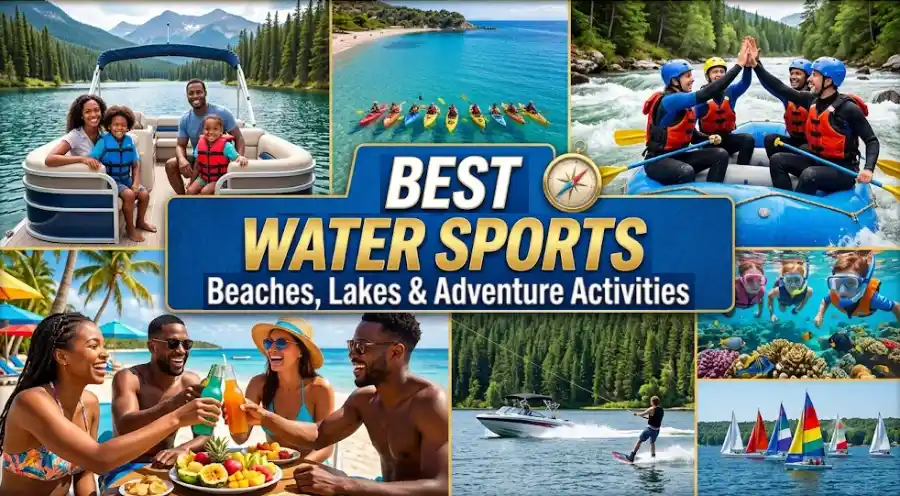
The spectrum of American water sports spans three distinct environmental domains, each offering unique physical rewards and tactical challenges:
- Ocean & Coastal Surf: Surfing, bodyboarding, kitesurfing, windsurfing, sea kayaking, freediving, and coastal sailing dominate coastlines from Hawaii and California to North Carolina’s Outer Banks and the Florida Keys.
- Inland Lakes & Reservoirs: Stand-up paddleboarding (SUP), wakeboarding, water skiing, wake surfing, personal watercraft (jet skiing), and pontoon/power boating rule massive freshwater systems like Lake Tahoe, Lake Powell, Lake of the Ozarks, and the Great Lakes.
- Rivers & Moving Water: Whitewater rafting, whitewater kayaking, flatwater canoeing, inner tubing, and inflatable kayaking thrive along mountain waterways such as the Arkansas, Colorado, Gauley, Snake, and Salmon rivers.
For low-impact, scenic family outings, choose stand-up paddleboarding, recreational touring kayaking, or freshwater spring snorkeling. For speed, adrenaline, and athletic challenge, prioritize whitewater rafting, wake surfing, hydrofoiling, and kitesurfing.
America’s Aquatic Geography: Coastlines, Lakes, Rivers & Springs
To appreciate the breadth of American water sports, one must first understand the vast hydrological systems that define the continent:
1. The Pacific Rim & Hawaiian Archipelago
The western edge of the continent features dramatic coastal drop-offs, rugged headlands, and deep oceanic trenches. Fed by continuous Aleutian winter storms in the North Pacific and southern hemisphere swells in the summer, California, Oregon, Washington, and Hawaii provide the country’s most powerful ocean surf breaks. Water temperatures range from cold northern waters requiring thick neoprene to tropical Hawaiian reef passes bathed in 80°F sunshine year-round.
2. The Atlantic Seaboard & Gulf of Mexico
The East Coast offers a gentler continental shelf, expansive barrier island sounds, and warm tropical currents. North Carolina’s Outer Banks act as a natural catching mitt for Atlantic hurricane swells and steady thermal winds, making it the wind-sport capital of the Eastern Seaboard. Further south, the Gulf of Mexico delivers shallow, warm, emerald-green waters that provide ideal environments for jet skiing, parasailing, and family beach paddling.
3. The Great Lakes: Inland Seas
Lakes Superior, Michigan, Huron, Erie, and Ontario contain one-fifth of the world’s surface freshwater. Spanning hundreds of miles across, these vast inland seas produce oceanic conditions—complete with 15-foot storm swells for freshwater surfers, expansive blue water for long-distance sailing regattas, and intricate island archipelagos like Wisconsin’s Apostle Islands for wilderness sea kayakers.
4. The Continental River Systems
From the snowpack of the Continental Divide flow thousands of roaring mountain tributaries. The Rocky Mountains, the Pacific Northwest Cascades, and the ancient Appalachian range carve deep granite and sandstone gorges that provide the highest concentration of commercial whitewater rafting and technical river kayaking on the planet.
5. Subterranean Karst Springs
In central and northern Florida, millions of gallons of crystal-clear freshwater emerge daily from underground limestone caverns at a constant 72°F (22°C). These natural spring basins create underwater sanctuaries with hundreds of feet of horizontal visibility, offering a peaceful environment for paddleboarders, snorkelers, and cave divers.
How to Select the Right Water Sport for Your Travel Style
Before booking equipment rentals or guided tours, consider these fundamental factors to match the activity to your physical ability and travel goals:
1. Physical Conditioning & Upper-Body Endurance
Human-powered water sports differ dramatically in their cardiovascular and muscular demands. Disciplines like whitewater kayaking, open-water swimming, and kitesurfing require strong core stability, shoulder flexibility, and swimming endurance. Conversely, recreational lake canoeing, tandem sea kayaking, and boat-towed tubing offer gentle learning curves that accommodate diverse fitness levels and multi-generational families.
2. Thermal Protection Realities
Air temperature can be deceptive. A sunny 80°F day in San Francisco or Lake Tahoe can easily mask water temperatures hovering in the mid-50s°F. Immersion in cold water rapidly drains physical strength through cold-water shock. Always check regional water temperatures before your trip and budget for properly fitted 3/2mm, 4/3mm, or 5/4mm neoprene wetsuits when visiting the Pacific Coast, northern lakes, or snowmelt rivers.
3. The Guided Outfitter Advantage
For technical disciplines like scuba diving, kitesurfing, hydrofoiling, and Class IV-V whitewater rafting, hiring a licensed commercial outfitter is essential. Professional guides supply commercial-grade safety gear, handle complex rigging, and bring years of river-reading and marine navigation experience that keep you safe on the water.
Sports 1 to 8: Premier Board Sports, Ocean Diving & Paddling Classics
1. Surfing
Primary Water Environments: Pacific Ocean Point Breaks, Atlantic Sandbar Beach Breaks & Tropical Reef Passes
Physical Demand: High (Cardiovascular Stamina, Core Stability & Explosive Paddling Power)
Skill Progression: Beginner (Foam Longboard) to Expert (Shortboard Barrel Riding)
Surfing is the definitive ocean board sport, combining physical athleticism with an intuitive understanding of marine physics. The surfer lies prone on the board, paddled vigorously by hand to match the forward speed of an approaching ocean wave, before executing a rapid “pop-up” to stand and carve along the breaking face of the water.
The United States is home to some of the world’s most historic and diverse surf territory. In Hawaii, the sport remains an integral cultural tradition; the world-famous North Shore of Oahu (home to the Banzai Pipeline, Waimea Bay, and Sunset Beach) challenges the planet’s most fearless surfers every winter with hollow, heavy waves breaking over shallow volcanic reefs. Along mainland California, Huntington Beach (“Surf City USA”), San Onofre, Malibu, and Santa Cruz’s Steamer Lane offer point breaks and peeling waves for longboarders. On the East Coast, the shifting sandbars of Cape Hatteras in North Carolina produce clean, barrel-riding conditions during late-summer tropical swells.
- Premier National Locations: North Shore & Waikiki Beach (Oahu, Hawaii); Huntington Beach & Trestles (California); Cape Hatteras (North Carolina); Cocoa Beach (Florida); Narragansett (Rhode Island).
- Equipment Requirements: 8- to 9-foot soft-top foam longboard (for beginners), fiberglass or epoxy shortboard (for advanced waves), high-tensile urethane leash, temperature-rated surf wax, and appropriate wetsuit thickness.
- Expert Advice: Never start learning on a shortboard. Rent a wide, high-volume soft-top foam longboard (such as a Wave Storm) and practice at a mellow, sandy beach break like Waikiki or Doheny State Beach. Master the mechanics of the pop-up on dry sand before paddling into the surf lineup.
2. Sea & Recreational Touring Kayaking
Primary Water Environments: Glacial Ocean Fjords, Coastal Archipelagos, Mangrove Estuaries & Deep Lakes
Physical Demand: Low to Moderate (Rhythmic Aerobic Paddling)
Skill Progression: Accessible to Complete Beginners
Kayaking offers one of the most intimate ways to experience aquatic wilderness. Sitting low to the water’s surface inside a molded cockpit or atop a self-bailing open hull, paddlers use double-bladed paddles to propel and steer through narrow sea caves, mangrove channels, and rocky coastal passages inaccessible to motorized watercraft.
The United States features exceptional kayaking routes. In Washington State’s San Juan Islands, sea kayakers paddle alongside resident orca pods and harbor seals beneath coastal cliffs. In Maine’s Acadia National Park, paddlers explore granite islands in Frenchman Bay, while Florida’s Everglades National Park and Ten Thousand Islands feature hundreds of miles of designated wilderness paddling trails through dense mangrove forests.
- Premier National Locations: San Juan Islands (Washington); Everglades National Park Wilderness Waterway (Florida); Pictured Rocks National Lakeshore, Lake Superior (Michigan); Prince William Sound (Alaska); Lake Tahoe (California/Nevada).
- Equipment Requirements: 14- to 17-foot sea kayak with sealed bulkheads and foot-controlled rudder, neoprene spray skirt (for cold/open water), lightweight fiberglass paddle, and USCG Type III life vest.
- Safety Essentials: When sea kayaking on open ocean waters, always carry a handheld marine VHF radio, a bilge pump, and a paddle float for self-rescue, and check daily tide charts to avoid fighting strong outgoing tidal currents.
3. Stand-Up Paddleboarding (SUP)
Primary Water Environments: Sheltered Coastal Bays, Mirror-Calm Alpine Lakes, Harbors & Slow Rivers
Physical Demand: Moderate (Core Balance, Quadriceps Stability & Shoulder Endurance)
Skill Progression: Beginner Friendly within 30 Minutes
Originally developed in Hawaii as a way for surf instructors to oversee their students, stand-up paddleboarding (SUP) has rapidly become one of the most popular recreational water sports in the country. Standing upright on a buoyant board (typically 10 to 12 feet long) gives paddlers a clear, high vantage point to look down through the water’s surface, making it ideal for spotting marine life, submerged structure, and underwater vegetation.
On alpine waters like Lake Tahoe, paddlers glide above turquoise water with visibility reaching 70 feet down to massive granite boulders. In urban centers, SUP routes thrive: paddlers navigate Lady Bird Lake against the Austin skyline or tour Chicago’s river architecture. In Florida, freshwater springs like Weeki Wachee and Silver Springs allow paddlers to drift peacefully over manatees and freshwater turtles.
- Premier National Locations: Emerald Bay, Lake Tahoe (California/Nevada); Lady Bird Lake, Austin (Texas); Sunset Beach, Oahu (Hawaii); Weeki Wachee Springs State Park (Florida); Mission Bay, San Diego (California).
- Equipment Requirements: Inflatable or solid epoxy-composite SUP board (minimum 30–32 inches wide for beginners), single-blade adjustable paddle, coiled leash (for flatwater) or quick-release belt leash (for rivers), and low-profile PFD.
- Pro Technique: Resist the urge to paddle using only your arms. Engage your core by planting the paddle blade fully in the water and pulling your body past the blade using your abdominal and torso muscles.
4. Snorkeling
Primary Water Environments: Living Coral Barrier Reefs, Subtropical Atolls, Clear Springs & Rocky Marine Reserves
Physical Demand: Low (Relaxed Surface Swimming)
Skill Progression: Basic Swimming Comfort Required
Snorkeling is an easy, family-friendly way to explore marine life without the certifications or heavy gear of scuba diving. Floating on the water’s surface with a low-volume silicone mask, dry-top breathing tube, and flexible swim fins, anyone comfortable in the water can view vibrant coral gardens and marine life.
Florida and Hawaii are the premier snorkeling destinations in the country. Key Largo’s John Pennekamp Coral Reef State Park protects living barrier reefs filled with sea turtles, eagle rays, and brain coral. In Maui, the sunken volcanic caldera of Molokini Crater provides over 100 feet of water visibility, while Oahu’s Hanauma Bay Nature Preserve is a protected marine haven teeming with schools of parrotfish, tangs, and green sea turtles.
- Premier National Locations: John Pennekamp Coral Reef State Park & Looe Key (Florida Keys); Molokini Crater & Honolua Bay (Maui, Hawaii); Hanauma Bay (Oahu, Hawaii); Crystal River (Florida – winter manatee sanctuary); Buck Island Reef National Monument (US Virgin Islands).
- Equipment Requirements: Tempered-glass dive mask with soft silicone skirt, dry-top snorkel with purge valve, open-heel adjustable fins, and non-nano zinc oxide reef-safe mineral sunscreen.
- Conservation Rule: Never touch, stand on, or kick live coral with your fins. Coral reefs are fragile living colonies; stepping on them causes damage that can take decades to recover.
5. Scuba Diving
Primary Water Environments: Submerged Shipwrecks, Deep Coral Drop-Offs, Giant Kelp Forests & Cavern Springs
Physical Demand: Moderate (Mental Calmness & Controlled Buoyancy)
Skill Progression: Technical (Mandatory PADI, SSI, or NAUI Open Water Certification)
Scuba diving allows humans to breathe underwater and explore deeper ocean environments. Utilizing a pressurized air cylinder, demand regulator, and Buoyancy Control Device (BCD), divers achieve neutral buoyancy, floating weightlessly through underwater terrain.
The United States offers world-class diving variety. Off the Southern California coast, Channel Islands National Park features towering forests of giant bladder kelp that sway in the swell, providing habitat for harbor seals and bright orange Garibaldi. In North Carolina, the “Graveyard of the Atlantic” offers deep shipwreck diving among sand tiger sharks. The Florida Keys feature artificial reef shipwrecks like the massive 510-foot USS *Spiegel Grove*, while north Florida’s freshwater limestone spring basins (such as Ginnie Springs) draw cave divers from around the globe.
- Premier National Locations: The Florida Keys Shipwreck Trail (Florida); Kona Coast (Hawaii – famous for the pelagic night manta ray dive); Channel Islands National Marine Sanctuary (California); Morehead City (North Carolina); Ginnie Springs Cave System (Florida).
- Equipment Requirements: Buoyancy compensator vest (BCD), primary and backup second-stage regulators, submersible pressure gauge, digital dive computer, thermal wetsuit or drysuit, mask, split fins, and certified air cylinder.
- Safety Protocol: Always dive with a certified buddy, plan your dive and dive your plan, monitor your air supply, and perform a mandatory 3-minute safety stop at 15 feet before surfacing.
6. Jet Skiing & Personal Watercraft (PWC)
Primary Water Environments: Open Freshwater Reservoirs, Protected Coastal Bays & Intracoastal Waterways
Physical Demand: Moderate (Core Balance, Grip Strength & Thigh Shock Absorption)
Skill Progression: Beginner Friendly with Certified Boater Safety Orientation
Personal watercraft (PWC)—commonly referred to by brand names like Sea-Doo, WaveRunner, and Jet Ski—deliver thrilling acceleration and agile handling across open water. Powered by internal marine engines driving high-pressure water-jet impellers, modern PWCs produce between 90 and 300 horsepower, cruising effortlessly across open lakes and coastal bays at speeds from 40 to 65+ mph.
Lake Havasu, spanning the desert border of Arizona and California, is a premier national hub for PWC riding, featuring miles of open water and winding red rock canyon passages. Across South Florida, guided jet ski eco-tours explore the Ten Thousand Islands and Miami’s Biscayne Bay, offering high-speed cruising paired with dolphin and manatee spotting.
- Premier National Locations: Lake Havasu (Arizona/California); Lake Powell (Utah/Arizona); Biscayne Bay & Key West (Florida); Lake of the Ozarks (Missouri); Lake Mead (Nevada).
- Equipment Requirements: USCG-approved Type III high-impact neoprene life jacket, engine kill-switch safety lanyard attached to wrist or vest, polarized eye protection with a secure head strap, and neoprene riding shorts.
- Boating Regulations: Operators must observe local boater education requirements, respect posted “No Wake” harbor zones, and maintain minimum safety distances (typically 100 to 200 feet) from swimmers, docks, and non-motorized vessels.
7. Whitewater Rafting
Primary Water Environments: Mountain River Canyons, Boulder-Strewn Rivers & Snowmelt Basins
Physical Demand: High (Team Paddling, Core Strength & Fast Reflexes)
Skill Progression: Beginner (Class II–III) to Extreme Athlete (Class V+)
Whitewater rafting is an exhilarating team sport that takes paddlers through river rapids, drops, and canyons. Crews of four to eight paddlers sit along the perimeter of heavy-duty hypalon or PVC inflatable rafts, following the commands of a professional stern guide to power through turbulent waves and navigate around hydraulic obstacles.
River rapids are classified internationally from Class I (moving water with small ripples) to Class VI (unrunnable commercial limits). The Colorado River through the Grand Canyon in Arizona represents the pinnacle of multi-day wilderness river expeditions, featuring massive roller-coaster wave trains. In Colorado, the Arkansas River through Browns Canyon delivers scenic Class III-IV family-friendly rapids, while West Virginia’s Gauley River unleashes technical Class V rapids every autumn during scheduled reservoir dam releases.
- Premier National Locations: Grand Canyon, Colorado River (Arizona); Arkansas River (Colorado); Gauley River & New River Gorge (West Virginia); Middle Fork of the Salmon River (Idaho); Rogue River (Oregon); Chattooga River (Georgia/South Carolina).
- Equipment Requirements: High-buoyancy commercial whitewater PFD, impact-resistant river helmet, neoprene wetsuit or splash jacket, and composite T-grip river paddle.
- Seasonality: Western mountain river flows peak during spring snowmelt (May through June); East Coast dam-controlled rivers run through late summer and autumn.
8. Wakeboarding
Primary Water Environments: Calm Freshwater Lakes, Sheltered Reservoirs & Cable Wake Parks
Physical Demand: High (Explosive Leg Power, Upper Body Grip & Aerobic Conditioning)
Skill Progression: Intermediate (Requires Tow Sports Instruction)
Combining elements of snowboarding, surfing, and gymnastics, wakeboarding requires a rider to stand sideways with both feet secured into high-top supportive boot bindings on a wide, buoyant board. Towed behind a specialized tournament wake boat traveling at 18 to 24 mph, the rider carves across the water, using the boat’s wake as a ramp to launch into the air for spins, flips, and grabs.
Central Florida—anchored by Orlando’s chain of lakes and advanced full-size cable wake parks—serves as the world capital for professional wakeboarding. Across Texas and California, expansive reservoirs provide glassy early-morning water conditions ideal for progressive wakeboard riding.
- Premier National Locations: Lake Austin and Lake Travis (Texas); Orlando Watersports Complex and Chain of Lakes (Florida); Lake Shasta (California); Lake Norman (North Carolina); Lake Lanier (Georgia).
- Equipment Requirements: Rocker-bottom wakeboard with fitted bindings, non-stretch Dyneema tow rope (65–75 feet), USCG-approved competition impact vest, and water sports helmet.
- Rider Technique: Maintain relaxed, slightly bent knees and keep your arms straight during deep-water starts. Let the boat’s engine torque lift you onto the surface rather than trying to pull yourself up with your arms.
Sports 9 to 17: High-Speed Towables, Wind Disciplines & River Floats
9. Water Skiing & Slalom
Primary Water Environments: Mirror-Smooth Freshwater Lakes & Flat River Bays
Physical Demand: High (Grip Endurance, Back and Core Strength & Leg Power)
Skill Progression: Beginner (Dual Combo Skis) to Advanced (Single Slalom Ski)
Invented in 1922 on Lake Pepin, Minnesota, water skiing is the classic American towed water sport. Beginners start on dual combo skis connected by stabilizing trainer bars, while experienced athletes ride a single tapered slalom ski fitted with dual front-and-rear rubber boot bindings.
Towed at speeds between 28 and 36 mph behind specialized direct-drive tournament ski boats, slalom skiers cut hard across the wake at sharp angles, generating lateral G-forces and throwing high walls of spray as they carve through regulation 6-buoy ski courses.
- Premier National Locations: Lake Pepin (Minnesota/Wisconsin); Lake Havasu (Arizona); Lake Placid (New York); Winter Haven Chain of Lakes (Florida); Lake Berryessa (California).
- Equipment Requirements: Slalom ski with concave tunnel bottom and rear tracking fin, tournament-grade ski rope with tractor-grip handle, and high-impact segmented life vest.
10. Coastal & Offshore Sailing
Primary Water Environments: Coastal Harbors, Sounds, Island Passages & Great Lakes
Physical Demand: Low (Cruising) to High (Racing) | Skill Progression: Technical Knowledge Required
Harnessing natural wind power across canvas sails, sailing encompasses everything from maneuvering small, single-handed 14-foot Sunfish dinghies in sheltered bays to navigating 45-foot ocean cruising catamarans and competitive America’s Cup racing yachts.
Newport, Rhode Island, stands as the historic sailing capital of the East Coast, featuring classic wooden schooners and elite regattas in Narragansett Bay. On the Pacific coast, San Francisco Bay delivers world-famous heavy-wind conditions with dramatic views of Alcatraz and the Golden Gate Bridge, while the turquoise waters of the Florida Keys and US Virgin Islands provide idyllic trade-wind cruising grounds.
- Premier National Locations: Newport (Rhode Island); San Francisco Bay (California); Annapolis (Maryland – home of the US Naval Academy); Key West (Florida); San Diego Bay (California); Lake Michigan (Chicago waterfront).
- Equipment Requirements: Deck shoes with non-marking razor-siped rubber soles, sailing gloves to prevent rope burns, polarized sunglasses, and foul-weather waterproof bibs.
11. Parasailing
Primary Water Environments: Coastal Ocean Beaches & Wide Recreational Resort Lakes
Physical Demand: Very Low | Skill Progression: Zero (Passenger Experience)
Parasailing delivers the panoramic sensation of flight without requiring pilot training or skydiving licenses. Passengers sit securely in a tandem or triple padded harness suspended beneath an aerodynamic parachute canopy, connected to a specialized hydraulic winch boat by an 800- to 1,200-foot towline.
As the vessel accelerates into the wind, the hydraulic winch smoothly unspools the line, lifting riders 400 to 500 feet into the air above the water. Parasailing offers peaceful, bird’s-eye views of coastlines, barrier islands, and marine life like dolphins and rays swimming below, concluding with a fun toe-dip into the water before landing gently on the boat’s rear flight deck.
- Premier National Locations: Key West and Miami Beach (Florida); Waikiki Beach and Maui (Hawaii); Lake Tahoe (California/Nevada); Myrtle Beach (South Carolina); Gulf Shores (Alabama).
- Safety Check: Only book with commercial operators licensed by the USCG that hold current Water Sports Industry Association (WSIA) safety accreditations and adhere to strict maximum wind limits (under 18–20 mph).
12. Wilderness & Lake Canoeing
Primary Water Environments: Protected Boreal Forest Lakes, Lazy Rivers & Inland Swamps
Physical Demand: Moderate | Skill Progression: Beginner Friendly
The open-hull Canadian canoe remains the traditional choice for multi-day wilderness expeditions, fishing, and peaceful family lake paddling. With high load capacities capable of carrying two adults, camping gear, and coolers, canoes are designed for relaxed forward touring.
Minnesota’s Boundary Waters Canoe Area Wilderness (BWCAW) contains over one million acres of interconnected glacial lakes and portage trails with no motorized boats permitted, offering an authentic backcountry canoeing experience. In the South, canoeing the Okefenokee Swamp in Georgia takes paddlers through cypress forests and Spanish moss reflecting in blackwater.
- Premier National Locations: Boundary Waters Canoe Area Wilderness (Minnesota); Adirondack Park Canoe Route (New York); Okefenokee National Wildlife Refuge (Georgia); Buffalo National River (Arkansas); Current and Jacks Fork Rivers (Missouri).
- Equipment Requirements: Royalex or lightweight Kevlar tandem canoe, single-blade wooden canoe paddles, portage yoke, dry bags, and Type III PFD.
13. Windsurfing
Primary Water Environments: High-Wind Inland Gorges, Ocean Sounds & Wide Bays
Physical Demand: High (Core Strength, Balance & Upper Body Endurance)
Skill Progression: Intermediate to Advanced
Windsurfing bridges the gap between sailing and surfing. The rider stands on a wide board connected to a fully articulating universal joint that anchors a flexible mast, sail, and wishbone boom. Controlling the board requires manually tilting and rotating the rig to catch wind energy, balancing foot pressure to steer and plane across open water at speeds exceeding 30 knots.
The Columbia River Gorge—straddling Hood River between Oregon and Washington—serves as the windsurfing capital of North America. Thermal winds funnel through the mountain canyon against rushing river currents, creating consistent heavy-wind conditions and rolling swell ramps for aerial freestyle jumps.
- Premier National Locations: Hood River, Columbia River Gorge (Oregon/Washington); Cape Hatteras and Pamlico Sound (North Carolina); San Francisco Bay (California); Kanaha Beach, Maui (Hawaii); South Padre Island (Texas).
- Equipment Requirements: Wide-body beginner board with daggerboard, monofilm wave/freeride sail, carbon mast and boom, and supportive waist or seat harness.
14. Kitesurfing & Kiteboarding
Primary Water Environments: Coastal Lagoons, Flatwater Sounds & Open Ocean Surf
Physical Demand: High (Whole-Body Coordination & Fast Core Adjustments)
Skill Progression: Advanced (Certified Instruction Mandatory)
Kitesurfing utilizes a massive inflatable leading-edge kite flown on 20- to 24-meter lines, connected directly to the rider’s waist harness via a control bar. The immense lifting power of the wind allows riders on small twin-tip or directional surfboards to plane at high speeds, carve ocean waves, and launch into the air, hanging for seconds before landing smoothly.
Cape Hatteras on North Carolina’s Outer Banks is the undisputed premier kitesurfing destination in the Eastern Hemisphere. The narrow barrier island provides flat, waist-deep waters on the Pamlico Sound side for practicing freestyle tricks, while the Atlantic ocean side delivers world-class surf breaks just across the highway.
- Premier National Locations: Cape Hatteras / Waves / Rodanthe (North Carolina); South Padre Island (Texas); Crissy Field and Sherman Island (California); Kailua Beach, Oahu (Hawaii); Jupiter and St. Petersburg (Florida).
- Equipment Requirements: Inflatable 4-line Leading Edge Inflatable (LEI) kite, bar and lines, twin-tip kiteboard with footstraps, harness, and water helmet.
- Crucial Warning: Never attempt to fly a power kite or kitesurf without certified IKO/PASA professional instruction. Kites generate hundreds of pounds of lift and can loft an untrained person into obstacles.
15. River Tubing & Lazy River Floating
Primary Water Environments: Spring-Fed Shallow Rivers & Gentle Moving Waterways
Physical Demand: Minimal | Skill Progression: Beginner Friendly
Few summer pastimes capture regional American relaxation quite like river tubing. Armed with a heavy-duty commercial vinyl inner tube, sunglasses, and a floating cooler tube, friends and families spend warm afternoons drifting down clear, spring-fed rivers under shady forest canopies.
The Texas Hill Country reigns supreme for river tubing culture: the crystal-clear, spring-fed Comal and Guadalupe rivers in New Braunfels draw thousands of floaters every weekend. In Florida, Rainbow Springs and Ichetucknee Springs offer natural river floats over sandy limestone riverbeds where freshwater fish and turtles swim directly beneath your tube.
- Premier National Locations: Guadalupe and Comal Rivers (New Braunfels, Texas); Ichetucknee and Rainbow Rivers (Florida); Salt River (Mesa, Arizona); Apple River (Wisconsin); Saco River (Maine/New Hampshire).
- Equipment Requirements: 44- to 48-inch heavy-duty river tube with mesh bottom, floating cooler caddy, water shoes (for rocky riverbeds), and waterproof dry bag.
- River Etiquette: Respect local “Can Bans” and litter laws. Many popular tubing rivers prohibit single-use plastic, glass bottles, and foam coolers to preserve natural water clarity.
16. Sport & Big-Game Fishing
Primary Water Environments: Deep Ocean Canyons, Coral Reefs, Coastal Flats & Mountain Streams
Physical Demand: Moderate to High | Skill Progression: Beginner to Advanced
Sport fishing spans a diverse range of American outdoor recreation: sight-casting crab flies to tailing bonefish across shallow flats in the Florida Keys, drifting salmon roe down glacial Alaskan rivers, dropping live bait for giant yellowfin tuna around deep-water Gulf of Mexico oil platforms, or trolling heavy lures for blue marlin off Hawaii’s volcanic coastlines.
Whether hiring a private offshore sportfishing yacht or wading mountain trout streams in Montana, fishing connects travelers directly with aquatic ecosystems.
- Premier National Locations: Islamorada and Key West, Florida Keys (Florida); Kenai River and Bristol Bay (Alaska); Kona Coast (Hawaii); Venice (Louisiana); Outer Banks (North Carolina); Madison and Yellowstone Rivers (Montana).
- Equipment Requirements: Species-specific spinning, conventional trolling, or fly-fishing tackle, polarized sunglasses (copper or amber lenses for sight-fishing), and local state fishing licenses.
17. Inflatable Kayaking (“Duckies”)
Primary Water Environments: Rocky Class II–III Mountain Rivers & Scenic Wilderness Canyons
Physical Demand: Moderate | Skill Progression: Beginner to Intermediate
Inflatable kayaks—affectionately known among river guides as “duckies”—offer the thrilling autonomy of river kayaking combined with the forgiving stability of a whitewater raft. Constructed from rugged, puncture-resistant PVC with self-bailing floor drains, inflatable kayaks bounce off boulders and slide through river rapids without the dangerous roll-over pinning risks associated with traditional hard-shell plastic kayaks.
They are an ideal stepping-stone for adventurous travelers who want to pilot their own craft down moving mountain rivers like Oregon’s Deschutes River or Colorado’s Roaring Fork under the supervision of a guide team.
- Premier National Locations: Deschutes River (Oregon); Salmon River (Idaho); Green River (Utah); Nantahala River (North Carolina); Flathead River (Montana).
- Equipment Requirements: Self-bailing inflatable kayak, high-volume barrel pump, whitewater helmet, Type III/V PFD, and neoprene booties.
Sports 18 to 25: Modern Hydrofoils, Motorized Cruising & Endurance Disciplines
18. Freediving
Primary Water Environments: Clear Tropical Reefs, Deep Volcanic Walls & Freshwater Springs
Physical Demand: High (Breath Control, Relaxation & Equalization)
Skill Progression: Specialized Training Required (FII / AIDA / PADI)
Freediving strips away noisy scuba tanks and bubbles, allowing divers to descend silently into the marine depths on a single breath of air. Relying on relaxation, diaphragmatic breathing control, efficient equalization, and streamlined fin technique, freedivers experience a peaceful connection with marine life.
Kona, Hawaii, is an international training hub for freediving, featuring steep drop-offs protected from ocean swell with vertical depths exceeding 300 feet just yards from shore. In Florida, limestone freshwater springs like Peacock Springs and Troy Springs provide year-round 72°F clear water basins for practicing depth and line training.
- Premier National Locations: Kona Coast (Hawaii); Molasses Reef, Key Largo (Florida); Ginnie Springs and Vortex Spring (Florida); Channel Islands (California).
- Equipment Requirements: Ultra-low volume freediving mask, silicone J-snorkel, long carbon-fiber or fiberglass freediving bi-fins, rubber weight belt, and 3mm open-cell wetsuit.
- Critical Safety Rule: Never freedive alone. Shallow-water blackout (hypoxia) occurs without warning. Always practice the “One Up, One Down” buddy safety protocol where a trained partner watches you throughout every descent and ascent.
19. Bodyboarding & Boogie Boarding
Primary Water Environments: Coastal Shorebreaks, Punchy Beach Breaks & Pier Bowls
Physical Demand: Moderate (Kick Stamina & Wave Timing)
Skill Progression: Beginner to Advanced
Bodyboarding is an accessible, high-performance wave-riding discipline. Resting your chest against a short, flexible rectangular board crafted from high-density polypropylene foam, riders drop into steep, hollow shorebreak waves that break too shallow for traditional surfboards.
Armed with short, stiff swim fins on their feet for quick kicking acceleration, bodyboarders execute rolls, 360-degree flat spins, and forward loops off breaking wave lips. From the shorebreak of Sandy Beach on Oahu to the sandy breaks of Southern California and the Jersey Shore, bodyboarding provides immediate wave-riding fun for all ages.
- Premier National Locations: Sandy Beach and Makapu’u (Oahu, Hawaii); The Wedge, Newport Beach (California); Salt Creek Beach, Dana Point (California); Cape Hatteras (North Carolina); Belmar (New Jersey).
- Equipment Requirements: High-density polypro (PP) core bodyboard with crescent tail, coiled bicep leash, and short, stiff asymmetrical swim fins with heel pads.
20. Hydrofoil Surfing & Electric eFoiling
Primary Water Environments: Open Ocean Swells, Coastal Bays & Deep Calm Lakes
Physical Demand: Moderate to High (Precision Balance & Stance Modulation)
Skill Progression: Advanced (Steep Learning Curve)
Foiling represents the modern frontier of water sports technology. A hydrodynamic airplane-like wing (hydrofoil) is mounted beneath a board on a vertical aluminum or carbon-fiber mast. As the board gathers speed across the water, the underwater wing generates hydrodynamic lift, elevating the board and rider completely out of the water.
Riding a foil eliminates surface water friction and chop, delivering a silent, flying sensation across the water. Riders can foil behind small boat wakes, catch rolling open-ocean ocean swells before they break, or ride battery-powered eFoils equipped with handheld Bluetooth throttle remotes that cruise above mirror-calm lakes at 25 mph without requiring any wind or waves.
- Premier National Locations: Maui and Oahu (Hawaii); San Diego and Santa Barbara (California); Lake Tahoe (California/Nevada); Biscayne Bay, Miami (Florida); Hood River (Oregon).
- Equipment Requirements: Carbon-fiber front wing, stabilizer, fuselage, and mast, dedicated foil board, impact safety vest, and multi-sport water helmet.
21. Whitewater Kayaking
Primary Water Environments: Technical Class III–V River Canyons & Whitewater Parks
Physical Demand: Very High (Explosive Core, Rotational Power & Anaerobic Fitness)
Skill Progression: Expert (Roll & River Rescue Certified)
Whitewater kayaking is a demanding individual water sport. Sealed inside a tight roto-molded polyethylene river kayak using a neoprene spray skirt, the paddler becomes one with the boat. Maneuvering through technical river drops, carving into turbulent eddies, and punching through churning hydraulic holes demands lightning-fast paddle bracing, precise hip-snap edge control, and a bombproof “Eskimo roll” to right oneself after capsizing in rapids.
The Green River Narrows in North Carolina, the Gauley River in West Virginia, and Colorado’s Arkansas River provide steep technical boulder gardens that draw the world’s best kayakers. Many cities have built urban whitewater parks—like the US National Whitewater Center in Charlotte, North Carolina—where artificial pump-powered rivers provide safe, controlled environments to learn whitewater kayaking skills.
- Premier National Locations: Green River Gorge (North Carolina); Gauley and Meadow Rivers (West Virginia); Arkansas River, Salida/Buena Vista (Colorado); Payette River (Idaho); Hood River and Little White Salmon River (Washington/Oregon).
- Equipment Requirements: Creek boat or playboat, drysuit or semi-dry top, neoprene spray skirt, carbon-shaft whitewater paddle, whitewater-certified helmet, and rescue PFD with quick-release harness.
22. Recreational Power Boating & Deck Boats
Primary Water Environments: Wide Navigable Lakes, Coastal Intercoastal Channels & Large Bays
Physical Demand: Low | Skill Progression: Boater Education Certified
Powerboating is a cornerstone of American summer leisure. Whether piloting a twin-engine bowrider, a family deck boat, or a luxury pontoon boat, recreational powerboating serves as a moving basecamp for multiple water sports.
Boaters drop anchor inside sheltered coves for afternoon swimming, pull children on inflatable tubes, tow water skiers at sunrise across glassy waters, and cruise to waterfront dining. Lake Powell—spanning the red rock sandstone canyons of Utah and Arizona—features 2,000 miles of shoreline where houseboats and powerboats explore remote desert canyons.
- Premier National Locations: Lake Powell (Utah/Arizona); Lake of the Ozarks (Missouri); Lake Norman (North Carolina); Lake Cumberland (Kentucky); Lake Havasu (Arizona); Lake Lanier (Georgia).
- Safety Check: Complete your state’s NASBLA-approved Boating Safety Course, carry required safety flares, fire extinguishers, a sound signaling horn, and ensure a fitted life jacket is onboard for every passenger.
23. Wake Surfing
Primary Water Environments: Deep Freshwater Lakes & Wake-Boat Friendly Reservoirs
Physical Demand: Moderate (Leg Endurance & Ankle Pressure Modulation)
Skill Progression: Intermediate (Accessible with Tow-Boat Setup)
Wake surfing has surged in popularity across American lakes, offering the sensation of ocean wave riding without needing an ocean. Specialized inboard tournament wake boats use internal ballast tanks, computerized hull tabs, and ballast bags to tilt the boat, shaping a tall, curling endless wave along one side of the stern at speeds of 10 to 12 mph.
The rider starts with a short tow rope to get up onto the wave’s sweet spot. Once balance is achieved, the rider tosses the rope into the boat and surfs freely on the boat’s clean wake, carving up and down the face and executing 360-degree spins without being attached to the boat.
- Premier National Locations: Lake Travis and Lake Austin (Texas); Lake Tahoe (California/Nevada); Lake Norman (North Carolina); Lake Coeur d’Alene (Idaho); Table Rock Lake (Missouri).
- Equipment Requirements: Skim-style or surf-style wake surfboard, 25-foot thick braided wake surf tow rope with padded handle, and Coast Guard-approved wake-impact life vest.
- Critical Boat Safety: Never wake surf behind an outboard or sterndrive (I/O) boat. Surfing is conducted within 10 to 15 feet of the boat’s stern. It can only be safely performed behind specialized V-drive inboard boats where the propeller is located safely under the hull, far away from the rider.
24. Water Tubing (Boat-Towed)
Primary Water Environments: Large Open Water Lakes & Wide Coastal Bays
Physical Demand: Moderate (Grip Endurance & Upper Body Bracing)
Skill Progression: Beginner Friendly
Unlike relaxing, slow-moving river tubing, boat-towed water tubing is a high-speed, action-packed thrill ride. One to four riders hold tightly onto nylon-wrapped foam handles on a durable, heavy-duty inflatable tube connected to a ski boat by a 50- to 60-foot tow rope.
As the boat weaves across the lake at speeds of 15 to 25 mph, the tube whips across the boat’s wakes, delivering bouncing air time and fast hydroplaning turns across the water. Tubing is popular for families with children because it requires no balance, board skills, or prior training.
- Premier National Locations: Lake Michigan (Michigan/Wisconsin); Lake of the Ozarks (Missouri); Lake George (New York); Lake Lanier (Georgia); Lake Chelan (Washington).
- Safety Check: Always have an alert spotter in the boat watching the tubers. Driver speed should match the rider’s age and comfort level, never exceeding 20 mph for young children.
25. Open-Water Endurance Swimming
Primary Water Environments: Ocean Bays, Alpine Glacial Lakes & Clean Reservoir Basins
Physical Demand: Very High (Continuous Aerobic Capacity & Mental Focus)
Skill Progression: Advanced Swimming Proficiency
Open-water swimming leaves the tiled lane lines of indoor swimming pools behind to take on the raw elements of open water. Swimmers navigate natural currents, surface wind chop, changing water temperatures, and depth visibility, relying on rhythmic bilateral breathing and sighting techniques.
The United States hosts prestigious open-water swims: San Francisco’s historic “Escape from Alcatraz” swim challenges athletes to cross the cold, 55°F bay currents from the prison island to the city shore. In Southern California, La Jolla Cove in San Diego provides a protected marine sanctuary where swimmers glide above leopard sharks and garibaldi in clean ocean water.
- Premier National Locations: La Jolla Cove, San Diego (California); San Francisco Bay (California); Waikiki Roughwater Swim course (Hawaii); Lake Tahoe (California/Nevada); Lake Champlain (Vermont/New York).
- Equipment Requirements: Open-water swimming wetsuit (sleeveless or full), high-visibility brightly colored silicone swim cap, wide-view anti-fog swim goggles, and a brightly colored inflatable swim safety buoy strapped to your waist.
- Safety Rule: Never swim alone in open ocean or deep lake waters. Always swim along guarded beaches, follow marked buoy lines, or have a partner paddle beside you in a kayak or SUP.
Master Comparison Matrix: 25 Water Sports at a Glance
Use the cross-reference table below to compare the physical difficulty, typical environments, equipment investment, and ideal destinations across all 25 American water sports:
| # | Water Sport | Primary Water Environment | Skill & Fitness Level | Best U.S. Travel Destination |
|---|---|---|---|---|
| 1 | Surfing | Ocean Surf Breaks & Points | High (Balance / Stamina) | Oahu (Hawaii) & Huntington Beach (CA) |
| 2 | Sea & Rec Kayaking | Coastal Bays, Lakes & Fjords | Low to Moderate | San Juan Islands (WA) & Florida Keys (FL) |
| 3 | Stand-Up Paddleboarding | Calm Bays, Lakes & Springs | Low to Moderate | Lake Tahoe (CA/NV) & Austin (TX) |
| 4 | Snorkeling | Shallow Coral Reefs & Springs | Low (Basic Swimming) | Key Largo (FL) & Molokini Crater (HI) |
| 5 | Scuba Diving | Deep Ocean Reefs & Wrecks | Technical (Certified) | Florida Keys & Kona Coast (HI) |
| 6 | Jet Skiing (PWC) | Open Lakes & Coastal Bays | Moderate | Lake Havasu (AZ) & Biscayne Bay (FL) |
| 7 | Whitewater Rafting | Mountain River Rapids | High (Team Paddling) | Arkansas River (CO) & Gauley River (WV) |
| 8 | Wakeboarding | Freshwater Lakes & Cable Parks | High (Acrobatic) | Orlando (FL) & Lake Austin (TX) |
| 9 | Water Skiing & Slalom | Glassy Freshwater Lakes | High (Core & Grip) | Lake Pepin (MN) & Lake Lanier (GA) |
| 10 | Coastal Sailing | Bays, Sounds & Open Coasts | Technical | Newport (RI) & San Francisco Bay (CA) |
| 11 | Parasailing | Ocean Beaches & Resort Lakes | Zero (Passenger) | Key West (FL) & Waikiki (HI) |
| 12 | Canoeing | Quiet Lakes & Gentle Rivers | Low to Moderate | Boundary Waters (MN) & Adirondacks (NY) |
| 13 | Windsurfing | High-Wind Inland Canyons | High (Technical Rigging) | Columbia River Gorge (OR/WA) |
| 14 | Kitesurfing | Flatwater Sounds & Ocean Surf | Very High (Instruction Req.) | Cape Hatteras (NC) & South Padre (TX) |
| 15 | River Tubing | Spring-Fed Shallow Rivers | Minimal (Relaxing) | New Braunfels (TX) & Rainbow River (FL) |
| 16 | Sport Fishing | Deep Sea, Flats & Rivers | Low to High | Florida Keys (FL) & Kenai River (AK) |
| 17 | Inflatable Kayaking | Class II–III Scenic Rivers | Moderate | Deschutes River (OR) & Salmon River (ID) |
| 18 | Freediving | Deep Reef Walls & Springs | High (Breath Control) | Kona Coast (HI) & Ginnie Springs (FL) |
| 19 | Bodyboarding | Shorebreaks & Pier Bowls | Moderate | Sandy Beach (HI) & Newport Beach (CA) |
| 20 | Hydrofoiling / eFoiling | Open Ocean & Deep Lakes | High (Balance / Lift) | Maui (HI) & Lake Tahoe (CA/NV) |
| 21 | Whitewater Kayaking | Class III–V Technical Canyons | Very High (Expert Roll) | Green River (NC) & Gauley River (WV) |
| 22 | Power Boating | Navigable Lakes & Channels | Boater Safety Certified | Lake Powell (UT/AZ) & Lake of the Ozarks (MO) |
| 23 | Wake Surfing | Tournament Boat Wakes | Moderate | Lake Travis (TX) & Lake Tahoe (CA/NV) |
| 24 | Water Tubing (Towed) | Open Freshwater Lakes | Low to Moderate | Lake Michigan & Lake George (NY) |
| 25 | Open-Water Swimming | Ocean Bays & Deep Lakes | Very High (Endurance) | La Jolla Cove (CA) & Lake Tahoe (CA/NV) |
Regional Guide: Top States for Water Sports Expeditions
Different regions of the United States deliver completely different water sports experiences based on climate, terrain, and coastal geology:
1. Hawaii & Pacific Islands
The undisputed global capital for warm saltwater board sports, ocean swells, and volcanic coral reefs. Unrivaled for world-class surfing (Waikiki, North Shore), crystal-clear volcanic snorkeling (Molokini Crater), deep-water freediving along the Kona coast, outrigger canoeing, and ocean hydrofoiling.
2. California & Pacific Northwest
A dynamic outdoor playground spanning cold-water coastal surfing, high-wind kiteboarding in the Columbia River Gorge, sea kayaking among the San Juan Islands, and alpine freshwater sports on Lake Tahoe. High-quality neoprene wetsuits (3/2mm to 4/3mm) are essential year-round for coastal outings.
3. Florida & Gulf Coast
America’s subtropical water sports paradise. Celebrated for warm, calm Gulf waters, the living coral reef barrier of the Florida Keys, hundreds of natural limestone springs, world-class inshore sport fishing, and year-round parasailing, jet skiing, and paddleboarding.
4. The Mountain West & Desert Southwest
Defined by snowmelt-fueled whitewater river canyons and massive desert reservoirs. Colorado, Idaho, and Utah lead the nation in whitewater rafting and technical river kayaking, while Lake Powell and Lake Havasu deliver premier desert powerboating, jet skiing, and wakeboarding.
5. Midwest & The Great Lakes
A vast freshwater paradise offering ocean-scale boating, sailing, and distance sea kayaking across the Great Lakes, alongside world-renowned wilderness canoe tripping in Minnesota’s Boundary Waters.
Seasonal Planning: Understanding River Melt, Lake Warmth & Ocean Swells
Timing your water sports excursion properly ensures you encounter optimal water levels, wind patterns, and comfortable temperatures:
- Spring (April through June): The prime national season for whitewater rafting and river kayaking across the Rocky Mountains, Pacific Northwest, and California Sierra Nevada as winter snowpack melts into river canyons. This is also the ideal window for avoiding extreme summer heat on Southwest reservoirs like Lake Powell.
- Summer (July through August): The peak national season for lake recreation, boating, wakeboarding, water skiing, paddleboarding, and family river tubing across the Midwest, Northeast, and mountain lakes when water temperatures warm up.
- Autumn (September through October): The sweet spot for wind sports and Atlantic surfing. Late-summer hurricane season creates large ocean groundswells along the East Coast and Outer Banks, while scheduled dam releases trigger “Gauley Season” whitewater in West Virginia.
- Winter (November through March): Prime season for tropical water sports in Hawaii and South Florida, alongside world-class giant big-wave surfing on northern Hawaiian and California coastlines.
Critical Water Safety: Rip Currents, Cold Shock & PFD Laws
Open water is dynamic and demands respect. Always adhere to these fundamental safety protocols:
1. The Life Jacket Mandate (Wear Your PFD)
According to US Coast Guard statistics, over 80% of all recreational boating and paddling drowning victims were not wearing a life jacket. Modern Coast Guard-approved Type III foam vests and compact inflatable waist-packs are comfortable, low-profile, and non-restrictive. Put it on before launching; putting on a life jacket while struggling in open water or heavy rapids is nearly impossible.
2. Understanding Ocean Rip Currents
Rip currents are powerful, narrow channels of fast-moving water that pull swimmers away from the beach. If caught in a rip current:
- Do not fight the current: Never attempt to swim straight back to shore against the flow; you will exhaust yourself and risk drowning.
- Swim parallel to the shoreline: Swim sideways, parallel to the beach, to escape the narrow neck of the current. Once out of the pull, swim diagonally back toward the breaking waves and shore.
- Float and signal: If you cannot escape, tread water calmly, conserve your energy, and wave your arms to alert lifeguards on the beach.
3. Cold-Water Shock Defense
Immersion in water under 60°F (15°C) triggers an involuntary gasping reflex, hyperventilation, and rapid muscle incapacitation within minutes. If engaging in water sports on cold alpine lakes or Pacific coastal waters, always wear a properly fitted 3mm–5mm neoprene wetsuit or waterproof drysuit with thermal under-layers.
The Ultimate Water Sports Gear & Apparel Packing List
Ensure you have the right gear packed before heading out on the water:
- Thermal & Sun Apparel: UPF 50+ long-sleeve quick-dry rashguard, 3/2mm or 4/3mm neoprene wetsuit (for cold-water regions), and comfortable boardshorts or swimsuits.
- Foot Protection: Grippy rubber-soled neoprene water shoes or river sandals with secure heel straps (essential for walking on slippery river rocks and sharp coral).
- Sun Defense: Broad-spectrum, water-resistant SPF 50+ mineral sunscreen (non-nano zinc oxide that complies with reef-protection laws in Hawaii and Key Largo), polarized sunglasses with a floating retaining strap, and a wide-brim sun hat.
- Waterproof Storage: A 10L to 20L heavy-duty roll-top waterproof dry bag to keep clothes, car keys, and towels dry, and an IPX8-rated submersible phone pouch.
- Hydration: An insulated stainless-steel water bottle (paddling in the hot sun leads to rapid dehydration; drink water frequently).
Frequently Asked Questions (FAQ)
What are the most popular water sports in the USA?
The most widely enjoyed water sports across the country include surfing, stand-up paddleboarding (SUP), recreational and sea kayaking, jet skiing, whitewater rafting, wakeboarding, scuba diving, sailing, and sport fishing.
Which water sports are best for complete beginners and families?
Recreational lake kayaking, stand-up paddleboarding on calm bays, flatwater canoeing, river floating/tubing, and shallow reef snorkeling require minimal technical training, making them accessible, low-impact, and safe for beginners and children.
Which states offer the best water sports destinations in America?
Florida and Hawaii lead for ocean-based sports, coral reef diving, surfing, and year-round paddling. California offers exceptional ocean surf and alpine lake recreation like Lake Tahoe. Colorado, Idaho, and West Virginia lead the nation in world-class whitewater rafting and river kayaking.
What are the most intense water sports for adrenaline seekers?
Class IV-V whitewater rafting (such as the Gauley River or Colorado River), hydrofoil surfing (eFoiling), kitesurfing in the Columbia River Gorge, and wake surfing behind high-horsepower towboats deliver the highest speeds and physical thrills.
Can you participate in water sports in the USA during the winter?
Yes. Subtropical destinations like the Florida Keys, South Florida springs, and the Hawaiian Islands provide warm water temperatures and active conditions year-round. Cold-water winter surfing is also popular in California and the Pacific Northwest with proper 4/3mm or 5/4mm hooded wetsuits.
Final Thoughts: Plan Your Next American Water Adventure
America’s waterways offer an incredible wealth of outdoor experiences. Whether you find peace paddling an open canoe across the silent, misty glacial lakes of Minnesota, feel the adrenaline surge of riding ocean waves along the Pacific Coast Highway, or share an afternoon floating down a clear Texas spring with friends, water sports connect us with nature in a profound, rejuvenating way.
Choose the water sport that aligns with your fitness goals and vacation style, book your excursions with reputable local outfitters, respect natural currents and wildlife, wear your life jacket, and dive into an unforgettable adventure on the water!
Editorial Advisory & Marine Safety Notice: Water conditions, river rapid classes, marine regulations, and boating licensing requirements change based on weather and seasonal water levels. Always consult local park ranger stations, commercial outfitters, and current NOAA marine forecasts before entering unfamiliar waterways.