
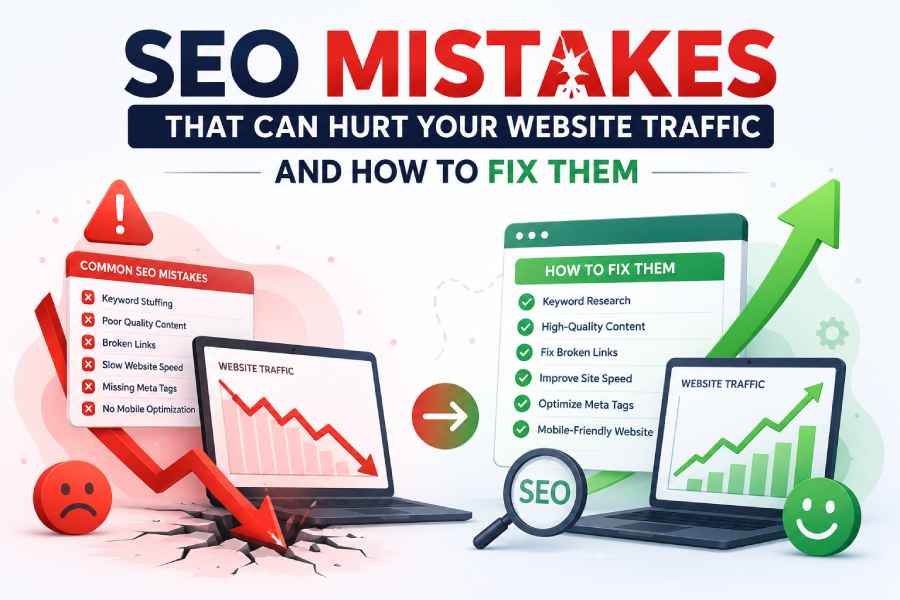
Google’s search algorithms have become much smarter in 2026. Websites that ignore technical SEO, user experience, content quality, and search intent often struggle to compete.
This guide explains the most common SEO mistakes that can hurt your website traffic and provides practical solutions you can implement immediately.
Table of Contents
- Why SEO Mistakes Matter More Than Ever
- SEO Mistake #1: Ignoring Search Intent
- SEO Mistake #2: Publishing Thin Content
- SEO Mistake #3: Keyword Stuffing
- SEO Mistake #4: Poor Internal Linking
- SEO Mistake #5: Ignoring EEAT Signals
- SEO Mistake #6: Ignoring Technical SEO Issues
- SEO Mistake #7: Slow Website Speed
- SEO Mistake #8: Poor Mobile Optimization
- SEO Mistake #9: Duplicate Content Issues
- SEO Mistake #10: Ignoring Content Updates
- SEO Mistake #11: Weak Backlink Strategy
- SEO Mistake #12: Not Using Schema Markup
- SEO Mistake #13: Poor URL Structure
- SEO Mistake #14: Creating Content Only for Search Engines
- SEO Mistake #15: Ignoring Topical Authority
- SEO Mistake #16: Not Monitoring SEO Performance
- SEO Mistake #17: Ignoring AI Search Optimization
- SEO Mistake #18: Weak Brand Building
- The Biggest SEO Mistakes to Avoid in 2026
- Frequently Asked Questions
- Internal Linking Opportunities for LotsDiary.com
- Google Discover Optimization Checklist
Why SEO Mistakes Matter More Than Ever
Google’s AI-powered ranking systems evaluate websites based on quality, relevance, authority, and user satisfaction. Small SEO mistakes can lead to lower rankings, reduced visibility, fewer clicks, and lost revenue.
Many websites fail because they focus on SEO tactics while ignoring user experience and content quality.
Fixing SEO problems often produces faster results than publishing more content.
SEO Mistake 1: Ignoring Search Intent
One of the biggest SEO mistakes is creating content that does not match what users want.
Google ranks pages that satisfy search intent. If users search for a buying guide and your page provides only definitions, rankings may suffer.
Common Intent Types
- Informational searches.
- Navigational searches.
- Commercial investigation searches.
- Transactional searches.
How to Fix It
- Analyze top-ranking pages.
- Identify user expectations.
- Create content that solves the searcher’s problem.
- Use formats matching search intent.
Matching search intent often produces immediate ranking improvements.
SEO Mistake 2: Publishing Thin Content
Thin content provides little value to users. It often lacks depth, examples, expertise, and useful information.
Google increasingly rewards comprehensive content that fully answers user questions.
Examples of Thin Content
- Very short articles.
- Duplicate content.
- AI-generated content without editing.
- Pages with little useful information.
How to Fix It
- Expand existing articles.
- Add examples and case studies.
- Include FAQs.
- Provide actionable advice.
- Update outdated information.
Quality almost always beats quantity in modern SEO.
SEO Mistake 3: Keyword Stuffing
Many website owners still believe repeating keywords excessively will improve rankings.
Modern search engines understand context and natural language. Keyword stuffing often creates poor user experiences and may reduce content quality.
Signs of Keyword Stuffing
- Unnatural keyword repetition.
- Poor readability.
- Forced keyword placement.
- Over-optimized headings.
How to Fix It
- Write naturally.
- Use semantic keywords.
- Focus on topic coverage.
- Prioritize user experience.
Natural language optimization performs better than outdated keyword density strategies.
SEO Mistake 4: Poor Internal Linking
Internal links help search engines understand relationships between pages.
Many websites publish content without connecting related articles.
Problems Caused by Poor Internal Linking
- Orphan pages.
- Weak topical authority.
- Reduced crawlability.
- Lower engagement.
How to Fix It
- Link related articles.
- Build content clusters.
- Use descriptive anchor text.
- Update older content regularly.
A strong internal linking structure supports rankings and user navigation.
SEO Mistake 5: Ignoring EEAT Signals
Google increasingly evaluates content using Experience, Expertise, Authoritativeness, and Trustworthiness (EEAT).
Websites that fail to demonstrate credibility often struggle to compete.
How to Improve EEAT
- Add author bios.
- Show expertise.
- Publish original insights.
- Include contact information.
- Build brand authority.
Strong EEAT signals help Google trust your content.
SEO Mistake 6: Ignoring Technical SEO Issues
Many website owners focus entirely on content creation while overlooking technical SEO. Even excellent content may struggle to rank if search engines cannot properly crawl, index, or understand your website.
Technical problems often remain hidden for months, gradually reducing organic visibility.
Common Technical SEO Problems
- Broken links.
- Redirect errors.
- Missing XML sitemaps.
- Improper robots.txt settings.
- Crawl errors.
- Indexing issues.
How to Fix It
- Perform monthly SEO audits.
- Monitor Google Search Console.
- Fix crawl errors quickly.
- Maintain XML sitemaps.
- Review indexing reports.
A strong technical foundation supports all other SEO efforts.
SEO Mistake 7: Slow Website Speed
Page speed affects user experience, engagement, conversions, and SEO performance.
Visitors often leave websites that take too long to load. Google also prefers websites that deliver fast experiences.
Common Causes of Slow Websites
- Large image files.
- Poor hosting.
- Excessive plugins.
- Unoptimized code.
- Render-blocking resources.
How to Fix It
- Compress images.
- Use WebP image formats.
- Enable caching.
- Minify CSS and JavaScript.
- Use a CDN.
- Upgrade hosting if necessary.
Faster websites typically generate better engagement and stronger rankings.
SEO Mistake 8: Poor Mobile Optimization
Google uses mobile-first indexing, meaning the mobile version of your website is the primary version used for ranking purposes.
If mobile users have a poor experience, your rankings may suffer.
Mobile SEO Problems
- Unreadable text.
- Slow loading times.
- Touch elements too close together.
- Poor navigation.
- Intrusive popups.
How to Fix It
- Use responsive design.
- Optimize mobile page speed.
- Improve navigation.
- Test usability regularly.
- Reduce unnecessary popups.
Mobile optimization is no longer optional in 2026.
SEO Mistake 9: Duplicate Content Issues
Duplicate content can confuse search engines and dilute ranking signals.
When multiple versions of similar content exist, Google may struggle to determine which page should rank.
Common Sources of Duplicate Content
- URL variations.
- Category archives.
- Copied product descriptions.
- Printer-friendly pages.
- Multiple versions of the same article.
How to Fix It
- Use canonical tags.
- Redirect duplicate pages.
- Create unique content.
- Review indexing reports.
Canonicalization helps consolidate authority and improve rankings.
SEO Mistake 10: Ignoring Content Updates
Many website owners publish content and never revisit it.
Over time, information becomes outdated, statistics change, and competitors publish newer resources.
Google often rewards fresh and updated content.
How to Fix It
- Update outdated statistics.
- Add recent examples.
- Improve internal links.
- Expand thin sections.
- Refresh images and screenshots.
Content refreshes are often one of the fastest ways to recover lost traffic.
SEO Mistake 11: Weak Backlink Strategy
Backlinks remain an important authority signal, but many websites pursue low-quality link-building tactics.
Google’s systems are increasingly effective at identifying manipulative link schemes.
Backlink Mistakes
- Buying spammy links.
- Using irrelevant websites.
- Excessive link exchanges.
- Automated link-building tactics.
How to Fix It
- Create link-worthy content.
- Publish original research.
- Build industry relationships.
- Earn editorial links naturally.
Quality backlinks are far more valuable than large quantities of weak links.
SEO Mistake 12: Not Using Schema Markup
Schema markup helps search engines understand content and may improve visibility through rich search features.
Many websites fail to implement structured data, missing opportunities for enhanced search results.
Useful Schema Types
- Article Schema.
- FAQ Schema.
- Breadcrumb Schema.
- Organization Schema.
- Review Schema.
How to Fix It
- Implement structured data.
- Validate schema regularly.
- Use schema relevant to content type.
Schema can improve click-through rates and search visibility.
SEO Mistake 13: Poor URL Structure
Complex URLs make it harder for users and search engines to understand page topics.
Bad URL Examples
- Long parameter-heavy URLs.
- Random character strings.
- Unclear page descriptions.
How to Fix It
- Keep URLs short.
- Use descriptive words.
- Include keywords naturally.
- Maintain consistency.
SEO-friendly URLs improve usability and crawlability.
SEO Mistake 14: Creating Content Only for Search Engines
One of the biggest mistakes website owners make is creating content solely to rank instead of helping users.
Google’s AI-powered ranking systems are becoming increasingly effective at identifying content that exists only to manipulate search rankings.
Pages that provide little value, repeat information from other websites, or are created purely for keyword targeting often struggle to maintain rankings.
How to Fix It
- Focus on solving real problems.
- Provide actionable advice.
- Add original insights.
- Include examples and case studies.
- Prioritize user satisfaction.
Content designed to help users usually performs better than content designed only for algorithms.
SEO Mistake 15: Ignoring Topical Authority
Many websites publish random articles without building expertise around a specific topic.
Google increasingly rewards websites that demonstrate deep knowledge within a subject area.
This concept is known as topical authority.
How to Fix It
- Create topic clusters.
- Publish supporting articles.
- Cover subjects comprehensively.
- Strengthen internal linking.
- Build content hubs.
Topical authority helps search engines trust your expertise.
SEO Mistake 16: Not Monitoring SEO Performance
Many website owners never review their SEO data.
Without performance tracking, it becomes difficult to identify traffic declines, indexing issues, or content opportunities.
Important Metrics to Monitor
- Organic traffic.
- Keyword rankings.
- Click-through rates.
- Index coverage.
- Core Web Vitals.
- Backlink growth.
How to Fix It
- Use Google Search Console.
- Track ranking changes.
- Monitor crawl errors.
- Review content performance monthly.
Regular analysis helps identify problems before they become major traffic losses.
SEO Mistake 17: Ignoring AI Search Optimization
AI-powered search experiences are changing how users discover information online.
Many websites continue optimizing only for traditional search results while ignoring AI-generated summaries and conversational search experiences.
How to Fix It
- Answer questions clearly.
- Use descriptive headings.
- Create comprehensive content.
- Add FAQ sections.
- Implement structured data.
- Demonstrate expertise.
Content that is easy for AI systems to understand often gains greater visibility.
SEO Mistake 18: Weak Brand Building
Brand authority is becoming increasingly important in SEO.
Users tend to trust recognized brands, and Google often views trusted brands as more reliable sources of information.
How to Fix It
- Publish consistently.
- Develop a recognizable voice.
- Create original research.
- Build social proof.
- Earn mentions from trusted websites.
Strong brands often achieve more sustainable SEO success.
The Biggest SEO Mistakes to Avoid in 2026
- Ignoring search intent.
- Publishing thin content.
- Keyword stuffing.
- Poor internal linking.
- Weak EEAT signals.
- Technical SEO issues.
- Slow website speed.
- Poor mobile optimization.
- Duplicate content.
- Outdated content.
- Low-quality backlinks.
- Missing schema markup.
- Poor URL structures.
- Content created only for search engines.
- Lack of topical authority.
- Not monitoring SEO performance.
- Ignoring AI search.
- Weak brand authority.
Avoiding these mistakes can significantly improve rankings, visibility, and long-term organic traffic growth.
Frequently Asked Questions
What is the most common SEO mistake?
Ignoring search intent is one of the most common SEO mistakes because content that does not satisfy user needs rarely ranks well.
Can technical SEO issues reduce traffic?
Yes. Crawl errors, indexing problems, broken links, and slow page speed can negatively impact rankings.
Does keyword stuffing still work?
No. Modern search engines prioritize content quality and relevance rather than excessive keyword repetition.
How often should content be updated?
Important pages should be reviewed regularly and updated whenever information becomes outdated.
Why is EEAT important?
EEAT helps Google evaluate content quality, expertise, authority, and trustworthiness.
Google Discover Optimization Checklist
- Use original high-quality images.
- Create compelling headlines.
- Focus on expertise and trust.
- Publish consistently.
- Improve mobile usability.
- Optimize page speed.
- Update content regularly.
- Build brand authority.
Websites that consistently publish helpful content are more likely to gain visibility through Google Discover.
Final Thoughts
SEO success in 2026 depends as much on avoiding mistakes as it does on implementing best practices.
Many traffic declines occur because websites unknowingly create technical issues, publish weak content, ignore user intent, or fail to adapt to Google’s evolving ranking systems.
The good news is that most SEO mistakes are fixable. By improving content quality, strengthening technical SEO, enhancing user experience, and building authority, website owners can recover lost traffic and achieve stronger rankings.
Focus on creating genuinely helpful content, maintaining a technically sound website, and building trust with your audience. These strategies will continue to deliver results regardless of future algorithm updates.