

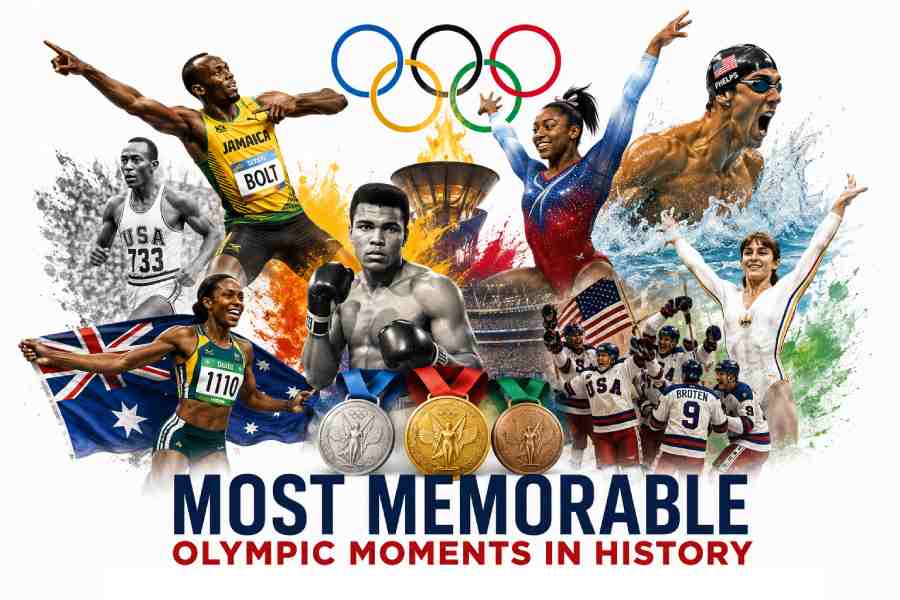
 From breathtaking sprints and impossible gymnastics routines to emotional victories against overwhelming odds, Olympic history is filled with unforgettable achievements. These moments remind us that the Games represent more than medals—they celebrate dedication, perseverance, and the universal spirit of competition.In this comprehensive guide, we revisit the most memorable Olympic moments in history, examining why they remain iconic decades later and how they changed the landscape of international sports.
Why Olympic Moments Become Timeless
The Olympic Games are unique because they bring together athletes from nearly every nation to compete under one set of rules and one global stage. Unlike regular championships, Olympic victories often become defining moments in an athlete’s career and, in many cases, symbols of national pride.
The most memorable Olympic moments usually combine extraordinary athletic ability with compelling personal stories. Athletes overcome injuries, political tensions, personal hardships, and enormous pressure to produce performances that inspire audiences worldwide.
These unforgettable events often extend beyond sport. They influence culture, encourage participation in athletics, and demonstrate the power of determination. Even decades later, many Olympic highlights continue to be replayed and discussed because they represent excellence at its highest level.
1. Jesse Owens Silences the World – Berlin Olympics 1936
One of the greatest Olympic moments in history occurred during the 1936 Summer Olympics in Berlin, Germany. American track and field athlete Jesse Owens competed in front of Adolf Hitler and a global audience during one of history’s most politically charged sporting events.
Despite enormous pressure and racial discrimination at the time, Owens delivered one of the finest athletic performances ever witnessed. He won four gold medals in:
- 100 metres
- 200 metres
- Long Jump
- 4×100 metre Relay
His achievements shattered misconceptions about racial superiority and demonstrated that talent, discipline, and determination know no boundaries.
Why This Moment Matters
- Four Olympic gold medals at one Games.
- Historic performance under global political pressure.
- Inspired generations of athletes worldwide.
- Remains one of the defining moments in Olympic history.
2. Nadia Comăneci Earns the First Perfect 10 (Montreal 1976)
Before the 1976 Olympics, many believed a perfect score in Olympic gymnastics was impossible. Romanian gymnast Nadia Comăneci changed that forever.
During the Montreal Olympic Games, the scoreboard displayed “1.00” because officials had never anticipated a perfect 10.00 score. The electronic system simply could not display it.
Nadia ultimately achieved seven perfect scores during the Games and captured worldwide attention with routines that combined elegance, precision, and technical brilliance.
Historic Achievements
- First gymnast to score a perfect 10 in Olympic history.
- Won three Olympic gold medals.
- Revolutionized women’s artistic gymnastics.
- Inspired future champions around the world.
Today, her performances remain among the most replayed Olympic routines ever recorded.
3. Miracle on Ice – Lake Placid Winter Olympics 1980
One of the greatest underdog stories in sports occurred during the 1980 Winter Olympics in Lake Placid, New York.
The United States men’s ice hockey team, made up primarily of amateur and college players, faced the heavily favoured Soviet Union—a team widely regarded as nearly unbeatable.
Few experts believed the American team had any realistic chance of winning. Yet they delivered one of the biggest upsets in Olympic history by defeating the Soviet Union 4–3.
Broadcaster Al Michaels’ famous call—
“Do you believe in miracles? Yes!”
became one of the most iconic moments in sports broadcasting history.
Legacy of the Miracle on Ice
- One of the greatest Olympic upsets ever.
- Inspired millions during a period of Cold War tension.
- Demonstrated teamwork over individual talent.
- Became one of the most celebrated stories in sporting history.
4. Carl Lewis Dominates Multiple Olympic Games
American sprinter and long jumper Carl Lewis established himself among the greatest Olympians of all time during the 1980s and 1990s.
Lewis won an incredible nine Olympic gold medals across four Olympic Games, displaying remarkable consistency over more than a decade.
His combination of explosive speed and exceptional jumping ability allowed him to dominate multiple events, including the 100 metres, 200 metres, long jump, and relay competitions.
Career Highlights
- Nine Olympic gold medals.
- One Olympic silver medal.
- Four consecutive Olympic long jump titles.
- Among the greatest track and field athletes ever.
Carl Lewis proved that sustained excellence is just as impressive as a single unforgettable performance.
5. Muhammad Ali Lights the Olympic Flame (Atlanta 1996)
Some Olympic moments are remembered not because of athletic competition but because they symbolize resilience and hope. One such moment came during the opening ceremony of the 1996 Atlanta Olympic Games when boxing legend Muhammad Ali was chosen to light the Olympic cauldron.
Years after being diagnosed with Parkinson’s disease, Ali stood before millions of viewers worldwide. Despite visible tremors, he carried the Olympic torch with remarkable courage and ignited the cauldron, creating one of the most emotional scenes in Olympic history.
Ali had previously won the light heavyweight boxing gold medal at the 1960 Rome Olympics, launching one of the greatest careers in sports history. His appearance in Atlanta reminded the world that Olympic champions continue inspiring long after their competitive careers end.
Why It Remains Historic
- Celebrated courage over adversity.
- One of the most emotional Olympic opening ceremonies.
- Honoured one of the greatest athletes in history.
- Inspired millions facing personal challenges.
6. Michael Johnson’s Golden Shoes and Double Gold (Atlanta 1996)
American sprinter Michael Johnson entered the 1996 Olympic Games as one of the favourites, but nobody expected the level of dominance he would display.
Wearing his famous golden racing shoes, Johnson won both the 200-metre and 400-metre events. His victory in the 200 metres came in a world-record time of 19.32 seconds, a record that stood for more than a decade.
His powerful running style and unmatched speed transformed sprinting and inspired countless athletes to pursue excellence.
Major Achievements
- Won Olympic gold in both the 200m and 400m.
- Set a world record in the 200 metres.
- Popularised one of the most iconic looks in Olympic history.
- Inspired future generations of sprinters.
7. Cathy Freeman Unites a Nation (Sydney 2000)
Hosting the Olympic Games is a significant honour, and Australia’s Sydney 2000 Olympics delivered one of the most inspirational victories ever witnessed.
Australian sprinter Cathy Freeman carried enormous expectations as she competed in the women’s 400 metres. Representing both athletic excellence and Indigenous Australians, she became a symbol of national unity.
Freeman won the gold medal in front of a home crowd, creating one of the loudest celebrations in Olympic history. Her emotional victory lap carrying both the Australian and Aboriginal flags became an enduring image of inclusion and pride.
Historical Importance
- Won gold in front of a home audience.
- Promoted unity and cultural recognition.
- Inspired women and Indigenous athletes worldwide.
- One of Australia’s greatest sporting achievements.
8. Michael Phelps Becomes the Greatest Olympian
No athlete has collected more Olympic medals than American swimmer Michael Phelps. Across five Olympic Games, Phelps achieved a level of dominance rarely seen in any sport.
His greatest Olympic performance came during the 2008 Beijing Games, where he won an incredible eight gold medals, surpassing the previous record for most gold medals at a single Olympics.
By the end of his Olympic career, Phelps had earned an astonishing 28 Olympic medals, including 23 gold medals, making him the most decorated Olympian in history.
Career Highlights
- 28 Olympic medals.
- 23 Olympic gold medals.
- Eight gold medals at one Olympic Games.
- Multiple world records across freestyle, butterfly and medley events.
His relentless work ethic, consistency and longevity continue to set the standard for elite athletes around the world.
9. Usain Bolt Becomes the Fastest Man in History
The Olympic Games have produced many legendary sprinters, but none captured the imagination quite like Usain Bolt of Jamaica.
Bolt dominated the Beijing 2008, London 2012 and Rio 2016 Olympics with extraordinary speed and remarkable confidence. His relaxed celebrations and charismatic personality helped make athletics one of the most watched Olympic events.
He won Olympic gold medals in the 100 metres, 200 metres and 4×100 metre relay, establishing himself as the greatest sprinter of the modern era.
Olympic Achievements
- World-record holder in the 100 metres.
- World-record holder in the 200 metres.
- Multiple Olympic sprint titles.
- Global ambassador for athletics.
Bolt’s performances changed expectations of what human speed could achieve and inspired millions of young athletes worldwide.
10. Simone Biles Redefines Gymnastics Excellence
American gymnast Simone Biles is widely regarded as one of the greatest gymnasts of all time. Her routines combine unmatched difficulty, precision and consistency.
Biles has won numerous Olympic medals while introducing skills so challenging that many are now officially named after her in the Code of Points.
Beyond her medals, Biles became a global advocate for athlete mental health after prioritising her wellbeing during Olympic competition. Her honesty encouraged broader discussions about the pressures faced by elite athletes.
Legacy
- Multiple Olympic gold medals.
- Several gymnastics skills officially named after her.
- Inspired conversations about mental health in sport.
- Considered one of the greatest gymnasts in history.
How Olympic Moments Shape Future Generations
Every unforgettable Olympic achievement inspires future athletes to dream bigger. Young competitors often begin their sporting journeys after watching legendary Olympic performances that demonstrate determination, resilience and sportsmanship.
These iconic moments also encourage greater investment in sports development, coaching, youth participation and international competition. Many countries have expanded athletic programmes following Olympic success, creating opportunities for the next generation of champions.
The Olympics continue to prove that extraordinary accomplishments are possible regardless of nationality, background or personal circumstances. Each edition of the Games adds new stories to an already remarkable sporting legacy.
Key Lessons from the Greatest Olympic Moments
The Olympic Games are more than a collection of sporting events—they are a celebration of perseverance, discipline, unity, and human achievement. Every unforgettable Olympic moment teaches valuable life lessons that extend far beyond stadiums and arenas.
1. Hard Work Always Pays Off
Every Olympic champion spends years training for a performance that may last only seconds or minutes. Their dedication demonstrates that consistent effort is the foundation of success.
2. Sports Unite the World
Athletes from more than 200 nations compete under one Olympic flag, proving that sport has the power to overcome political, cultural, and geographical differences.
3. Never Give Up
Many Olympic champions have overcome injuries, setbacks, financial struggles, and personal hardships before achieving greatness. Their stories inspire millions to keep pursuing their goals despite obstacles.
4. Respect Your Competitors
Some of the greatest Olympic memories involve acts of sportsmanship, where athletes helped one another, celebrated together, or showed compassion during competition. These moments remind us that respect is just as important as victory.
Interesting Facts About the Olympic Games
- The modern Olympic Games began in 1896 in Athens, Greece.
- The Olympic motto is “Citius, Altius, Fortius – Communiter”, meaning Faster, Higher, Stronger – Together.
- The Olympic rings represent the union of the five inhabited continents.
- More than 10,000 athletes typically compete in each Summer Olympic Games.
- The Summer and Winter Olympics are held every four years.
- Gold medals are primarily made of silver with a thin layer of gold.
- The Olympic torch relay symbolizes peace and friendship among nations.
- Billions of viewers watch the Olympic Games worldwide, making them one of the largest sporting events on Earth.
Frequently Asked Questions (FAQs)
1. What is the most memorable Olympic moment in history?
Many sports historians consider Jesse Owens winning four gold medals at the 1936 Berlin Olympics one of the greatest Olympic moments because of its historical significance and athletic excellence.
2. Who has won the most Olympic medals?
Michael Phelps holds the record with 28 Olympic medals, including 23 gold medals, making him the most decorated Olympian in history.
3. Who is the fastest Olympic sprinter ever?
Usain Bolt of Jamaica is widely regarded as the fastest sprinter in Olympic history, holding world records in both the 100 metres and 200 metres.
4. Who scored the first perfect 10 in Olympic gymnastics?
Romanian gymnast Nadia Comăneci achieved the first perfect 10 in Olympic gymnastics during the 1976 Montreal Olympics.
5. What was the Miracle on Ice?
The Miracle on Ice refers to the United States men’s ice hockey team’s shocking victory over the Soviet Union during the 1980 Winter Olympics in Lake Placid.
6. Why are Olympic moments so important?
Olympic moments inspire people worldwide by showcasing excellence, perseverance, sportsmanship, and the power of international unity through sport.
7. When were the first modern Olympic Games held?
The first modern Olympic Games were held in Athens, Greece, in 1896.
8. Which Olympic athlete inspired the most people?
Athletes such as Jesse Owens, Muhammad Ali, Michael Phelps, Simone Biles, Nadia Comăneci, and Usain Bolt are among the most inspirational Olympians because of their achievements and influence beyond sports.
Conclusion
The Olympic Games have produced countless unforgettable moments that continue to inspire athletes and fans across generations. From record-breaking performances and dramatic finishes to remarkable acts of courage and sportsmanship, these events remind us why the Olympics remain the pinnacle of international competition.
The stories of Jesse Owens, Nadia Comăneci, Michael Phelps, Usain Bolt, Muhammad Ali, Cathy Freeman, Simone Biles, Carl Lewis, and many other legendary Olympians demonstrate that success is built on determination, discipline, resilience, and an unwavering commitment to excellence.
As each new Olympic Games unfolds, new records will be broken and new legends will emerge. Yet the greatest Olympic moments in history will always serve as a powerful reminder that sport has the unique ability to unite people, inspire hope, and celebrate the very best of humanity.