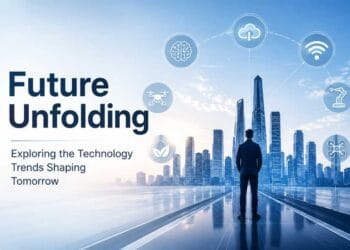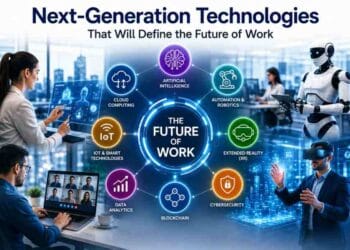

Technology continues to reshape every aspect of modern business. Companies that embrace innovation gain competitive advantages through greater efficiency, improved customer experiences, stronger cybersecurity, and better decision-making.
From artificial intelligence and intelligent automation to cloud computing and advanced data analytics, emerging technologies are creating entirely new ways for businesses to operate and compete in global markets.
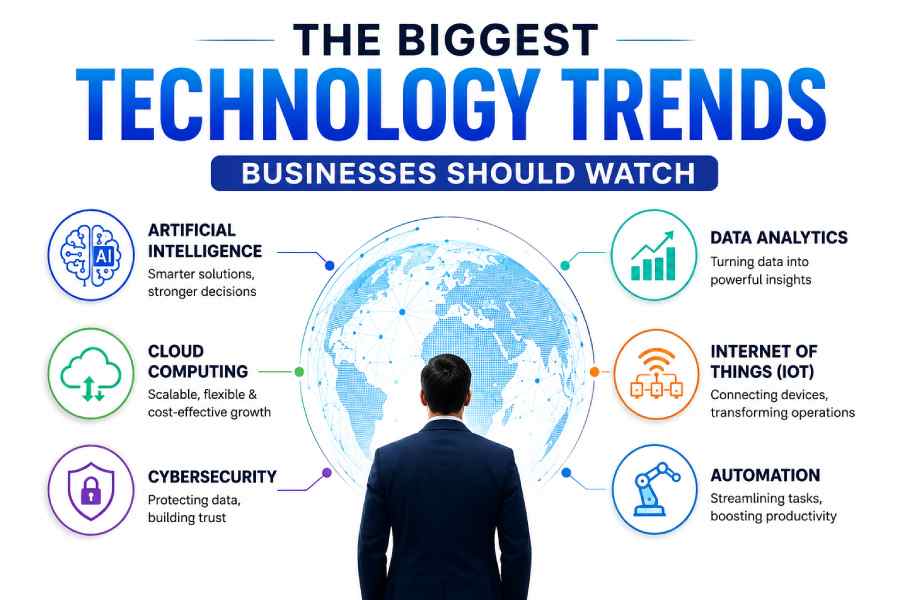 Organizations that prepare for these technology trends today will be better positioned to respond to changing customer expectations, market conditions, and future opportunities.
Key Insight: Digital transformation is no longer optional. Businesses that invest in emerging technologies today are more likely to remain competitive throughout 2026 and beyond.
Table of Contents
- Why Businesses Must Prepare for Technology Changes
- Artificial Intelligence Becoming a Business Standard
- Intelligent Automation and Robotic Process Automation
- Cloud Computing and Multi-Cloud Strategies
- Data Analytics and Business Intelligence
- Cybersecurity and Zero Trust Architecture
- Internet of Things (IoT) and Smart Business Operations
- Blockchain Beyond Cryptocurrency
- Edge Computing and 5G Connectivity
- Generative AI Transforming Business Productivity
- Sustainable Technology and Green IT
- Digital Twins and Smart Simulation
- Quantum Computing for Enterprise
- Future Workforce Technology Trends
- Business Predictions Beyond 2026
- Frequently Asked Questions
1. Why Businesses Must Prepare for Technology Changes
Technology evolves faster than ever before. Organizations that delay digital transformation often struggle with outdated systems, rising operational costs, and changing customer expectations.
Modern businesses must continuously evaluate new technologies that improve productivity, security, collaboration, and innovation.
Benefits of Staying Ahead
- Greater operational efficiency
- Better customer experiences
- Improved business agility
- Reduced operating costs
- Competitive market advantage
- Faster innovation cycles
| Technology Adoption | Business Impact |
|---|---|
| Early Adoption | Competitive advantage and innovation |
| Delayed Adoption | Higher operational risks and slower growth |
Preparing for technology change is now a strategic business priority rather than simply an IT initiative.
2. Artificial Intelligence Becoming a Business Standard
Artificial intelligence has moved beyond experimentation and is becoming a core business capability. Companies use AI to automate repetitive work, analyze customer behavior, optimize operations, and improve strategic decision-making.
Business Applications of AI
- Customer service chatbots
- Sales forecasting
- Marketing personalization
- Fraud detection
- Document processing
- Predictive maintenance
| Industry | AI Example |
|---|---|
| Retail | Personalized product recommendations |
| Healthcare | Medical image analysis |
| Finance | Fraud prevention |
| Manufacturing | Predictive equipment maintenance |
Businesses adopting AI effectively can improve productivity while providing faster and more personalized customer experiences.
3. Intelligent Automation and Robotic Process Automation (RPA)
Automation continues to reduce manual workloads across departments. Robotic Process Automation (RPA) handles repetitive digital tasks such as invoice processing, payroll, reporting, customer onboarding, and compliance documentation.
Advantages of Automation
- Reduced human error
- Lower operational costs
- 24/7 business processes
- Faster transaction processing
- Improved employee productivity
- Better regulatory compliance
| Automation Type | Business Benefit |
|---|---|
| RPA | Automates repetitive administrative work |
| AI Automation | Supports intelligent business decisions |
| Workflow Automation | Improves collaboration across teams |
Rather than replacing employees, intelligent automation enables teams to focus on higher-value strategic activities.
4. Cloud Computing and Multi-Cloud Strategies
Cloud computing remains one of the most important technologies for digital transformation. Businesses increasingly use multi-cloud strategies to improve flexibility, reduce vendor dependency, and enhance business continuity.
Benefits of Cloud Adoption
- Scalable infrastructure
- Lower hardware investment
- Remote workforce support
- Faster software deployment
- Improved collaboration
- Reliable disaster recovery
| Cloud Service | Business Value |
|---|---|
| Public Cloud | Flexible and cost-effective infrastructure |
| Private Cloud | Greater control and security |
| Multi-Cloud | Higher resilience and flexibility |
Cloud technologies continue enabling businesses to innovate faster while supporting hybrid and remote work environments.
5. Data Analytics and Business Intelligence
Organizations generate enormous amounts of business data every day. Business intelligence and advanced analytics transform this information into valuable insights that support strategic decisions.
Key Benefits
- Real-time reporting
- Customer behavior analysis
- Sales forecasting
- Operational optimization
- Performance monitoring
- Risk management
| Analytics Solution | Business Outcome |
|---|---|
| Business Intelligence Dashboards | Real-time performance visibility |
| Predictive Analytics | Improved planning and forecasting |
| Customer Analytics | Better personalization and engagement |
| Operational Analytics | Higher efficiency and cost savings |
Businesses that use data effectively make faster, more informed decisions and respond more quickly to changing market conditions.
6. Cybersecurity and Zero Trust Architecture
As businesses become increasingly digital, cybersecurity has evolved from an IT responsibility into a core business priority. Modern organizations face ransomware, phishing attacks, insider threats, supply chain attacks, and data breaches that can disrupt operations and damage customer trust.
One of the fastest-growing security approaches is the Zero Trust model, which assumes that no user or device should automatically be trusted. Every access request must be verified before sensitive resources are accessed.
Key Cybersecurity Trends
- Zero Trust security architecture
- AI-powered threat detection
- Multi-factor authentication (MFA)
- Endpoint detection and response (EDR)
- Cloud security platforms
- Identity and access management (IAM)
| Security Technology | Business Benefit |
|---|---|
| Zero Trust | Reduces unauthorized access risks |
| AI Security | Detects threats faster using intelligent analysis |
| Multi-Factor Authentication | Improves account protection |
| Cloud Security | Protects remote employees and cloud applications |
Businesses that strengthen cybersecurity today will be better prepared to manage future digital risks while maintaining customer confidence.
7. Internet of Things (IoT) and Smart Business Operations
The Internet of Things (IoT) connects machines, sensors, vehicles, buildings, and equipment through the internet, allowing businesses to collect real-time operational data.
IoT improves productivity by automating monitoring, reducing downtime, and helping organizations make data-driven decisions.
Business Uses of IoT
- Smart manufacturing
- Warehouse monitoring
- Fleet management
- Energy management
- Asset tracking
- Predictive maintenance
| Industry | IoT Application |
|---|---|
| Manufacturing | Machine performance monitoring |
| Retail | Inventory management |
| Healthcare | Connected medical equipment |
| Logistics | Vehicle and shipment tracking |
As IoT devices become more affordable, businesses of every size can improve operational visibility and efficiency.
8. Blockchain Beyond Cryptocurrency
Blockchain technology is expanding beyond digital currencies into enterprise applications. Businesses are adopting blockchain to improve transparency, traceability, and trust in digital transactions.
Industries such as finance, logistics, healthcare, and supply chain management increasingly use blockchain for secure record management.
Enterprise Blockchain Applications
- Smart contracts
- Supply chain tracking
- Digital identity verification
- Financial transactions
- Document authentication
- Regulatory compliance
| Blockchain Use | Business Value |
|---|---|
| Supply Chain | Greater transparency |
| Finance | Secure transactions |
| Healthcare | Protected medical records |
| Identity Management | Improved verification processes |
Blockchain adoption continues growing because organizations increasingly value secure and verifiable digital records.
9. Edge Computing and 5G Connectivity
Businesses require faster processing as connected devices generate massive amounts of information. Edge computing processes data closer to where it is created, reducing delays while improving performance.
Combined with 5G connectivity, edge computing enables faster communication between devices, applications, and employees.
Advantages of Edge Computing
- Lower latency
- Real-time processing
- Reduced bandwidth costs
- Improved operational efficiency
- Enhanced IoT performance
- Greater reliability
| Technology | Business Benefit |
|---|---|
| Edge Computing | Faster local data processing |
| 5G Networks | High-speed communication |
| IoT Integration | Connected business operations |
Manufacturing, healthcare, logistics, retail, and smart city projects are expected to benefit significantly from edge computing technologies.
10. Generative AI Transforming Business Productivity
Generative AI has become one of the fastest-growing technology trends for businesses. Unlike traditional AI systems that primarily analyze data, generative AI can create text, images, presentations, reports, software code, marketing content, and business documentation.
Organizations are using generative AI to improve productivity while reducing repetitive work across multiple departments.
Business Applications of Generative AI
- Content creation
- Customer support automation
- Marketing campaign development
- Software code generation
- Business report creation
- Knowledge management
| Department | Generative AI Benefit |
|---|---|
| Marketing | Creates personalized campaigns |
| Human Resources | Supports recruitment documentation |
| Customer Service | Improves chatbot responses |
| Software Development | Accelerates coding and testing |
| Sales | Generates proposals and presentations |
How Businesses Can Prepare for AI Adoption
- Train employees on responsible AI usage
- Develop AI governance policies
- Protect confidential business data
- Integrate AI into existing workflows gradually
- Measure productivity improvements regularly
- Maintain human oversight for critical decisions
Technology Trends Comparison
| Technology Trend | Primary Business Benefit | Industries Using It |
|---|---|---|
| Artificial Intelligence | Automation and decision-making | All industries |
| Cloud Computing | Scalability and collaboration | Enterprise, Education, Healthcare |
| Cybersecurity | Data protection | Finance, Government, Enterprise |
| IoT | Real-time monitoring | Manufacturing, Logistics, Retail |
| Blockchain | Transparency and trust | Finance, Supply Chain, Healthcare |
| Generative AI | Productivity and creativity | Marketing, IT, HR, Sales |
The most successful organizations will combine several of these technologies instead of adopting them individually. Integrated digital ecosystems deliver greater efficiency, stronger security, and improved customer experiences.
11. Sustainable Technology and Green IT
Sustainability has become a strategic priority for businesses worldwide. Green IT focuses on reducing environmental impact while improving operational efficiency through energy-efficient hardware, cloud infrastructure, renewable energy, and responsible technology management.
Organizations are adopting sustainable technology to lower operational costs, reduce carbon emissions, meet environmental regulations, and strengthen their corporate reputation.
Green Technology Strategies
- Energy-efficient data centers
- Cloud optimization
- Renewable energy adoption
- Digital document management
- Electronic waste recycling
- AI-powered energy optimization
| Green Technology | Business Benefit |
|---|---|
| Cloud Infrastructure | Lower energy consumption |
| Smart Energy Systems | Reduced operating costs |
| Paperless Workflows | Improved sustainability |
| Renewable Energy | Lower environmental impact |
12. Digital Twins and Smart Simulation
Digital twin technology creates virtual models of physical products, machines, factories, and business processes. These virtual models allow organizations to simulate operations, predict failures, and optimize performance before implementing real-world changes.
Manufacturing, healthcare, construction, logistics, and smart city projects increasingly rely on digital twins to improve planning and reduce costs.
Applications of Digital Twins
- Manufacturing optimization
- Supply chain simulation
- Building management
- Healthcare planning
- Equipment maintenance
- Product development
| Industry | Digital Twin Benefit |
|---|---|
| Manufacturing | Predictive maintenance |
| Construction | Project planning and monitoring |
| Healthcare | Medical equipment optimization |
| Logistics | Supply chain simulation |
13. Quantum Computing for Enterprise
Although still in its early stages, quantum computing has the potential to transform industries by solving complex calculations much faster than traditional computers.
Businesses are exploring quantum computing for optimization, scientific research, financial modeling, cryptography, and pharmaceutical development.
Potential Business Applications
- Financial risk analysis
- Drug discovery
- Supply chain optimization
- Advanced cybersecurity
- Climate modeling
- Scientific simulations
| Business Area | Potential Advantage |
|---|---|
| Finance | Advanced portfolio optimization |
| Healthcare | Accelerated medical research |
| Manufacturing | Complex production optimization |
| Research | Faster scientific computation |
14. Future Workforce Technology Trends
Technology is transforming the skills businesses need from their workforce. Employees will increasingly collaborate with AI systems, automation platforms, and intelligent software to improve productivity and innovation.
Essential Skills for the Future Workforce
- Artificial intelligence literacy
- Data analytics skills
- Cloud computing knowledge
- Cybersecurity awareness
- Critical thinking
- Digital communication
- Adaptability and continuous learning
| Skill | Business Importance |
|---|---|
| AI Knowledge | Improves technology adoption |
| Data Analysis | Supports informed decision-making |
| Cybersecurity | Protects digital assets |
| Problem Solving | Drives innovation |
Organizations investing in employee training and digital skills development will adapt more successfully to future technology changes.
15. Business Predictions Beyond 2026
Technology innovation will continue accelerating beyond 2026. Businesses that combine AI, cloud computing, cybersecurity, automation, IoT, blockchain, and advanced analytics into integrated strategies will achieve stronger competitive advantages.
Predicted Technology Trends
- AI integrated into every business function
- Autonomous business operations
- Expansion of digital twin technology
- Smarter cybersecurity powered by AI
- Greater adoption of sustainable technology
- Growth of intelligent customer experiences
- More connected global digital ecosystems
Advantages of Emerging Business Technologies
| Advantage | Business Impact |
|---|---|
| Higher Productivity | Automates repetitive tasks |
| Better Customer Experience | Delivers personalized services |
| Lower Costs | Improves operational efficiency |
| Faster Innovation | Accelerates product development |
| Better Decisions | Uses data-driven insights |
Challenges Businesses Must Prepare For
| Challenge | Recommended Solution |
|---|---|
| Cybersecurity Threats | Implement Zero Trust security and continuous monitoring |
| Skills Shortage | Invest in employee training and certification |
| Technology Costs | Adopt phased digital transformation strategies |
| Data Privacy | Strengthen governance and compliance policies |
| Legacy Systems | Modernize infrastructure gradually |
Frequently Asked Questions
1. What are the biggest technology trends for businesses in 2026?
Artificial intelligence, automation, cloud computing, cybersecurity, IoT, blockchain, edge computing, digital twins, and generative AI are among the leading trends.
2. Why is AI important for businesses?
AI improves productivity, automates repetitive tasks, enhances customer experiences, and supports better business decisions.
3. What is intelligent automation?
Intelligent automation combines AI with robotic process automation to streamline business operations and reduce manual work.
4. Why are multi-cloud strategies becoming popular?
Multi-cloud strategies improve flexibility, resilience, and reduce dependence on a single cloud provider.
5. How does IoT improve business operations?
IoT enables real-time monitoring, predictive maintenance, asset tracking, and operational efficiency.
6. How is generative AI helping organizations?
Generative AI assists with content creation, software development, customer support, reporting, and workflow automation.
7. Why is cybersecurity critical?
Strong cybersecurity protects business systems, customer information, intellectual property, and digital operations.
8. What industries benefit most from digital twins?
Manufacturing, healthcare, construction, logistics, and energy organizations gain significant planning and operational benefits.
9. What workforce skills are becoming more valuable?
AI literacy, cloud computing, cybersecurity, data analytics, communication, and continuous learning are increasingly important.
10. How can businesses prepare for future technology trends?
Businesses should invest in digital transformation, employee training, cybersecurity, cloud infrastructure, and innovation-driven strategies.
Conclusion
The technology landscape will continue evolving rapidly throughout 2026 and beyond. Artificial intelligence, intelligent automation, cloud computing, cybersecurity, IoT, blockchain, digital twins, and sustainable technology are redefining how businesses operate and compete.
Organizations that embrace innovation while developing skilled workforces and secure digital infrastructures will be better positioned to improve productivity, strengthen customer relationships, and respond to future market changes.
Final Thought: Technology is no longer just a support function—it is the foundation of business growth, resilience, and long-term competitive advantage. Companies that continuously innovate and adapt will be best prepared for the opportunities and challenges of the digital future.