
The future of technology is being shaped by artificial intelligence, automation, advanced computing, connected devices, sustainable solutions, and digital transformation across every industry.
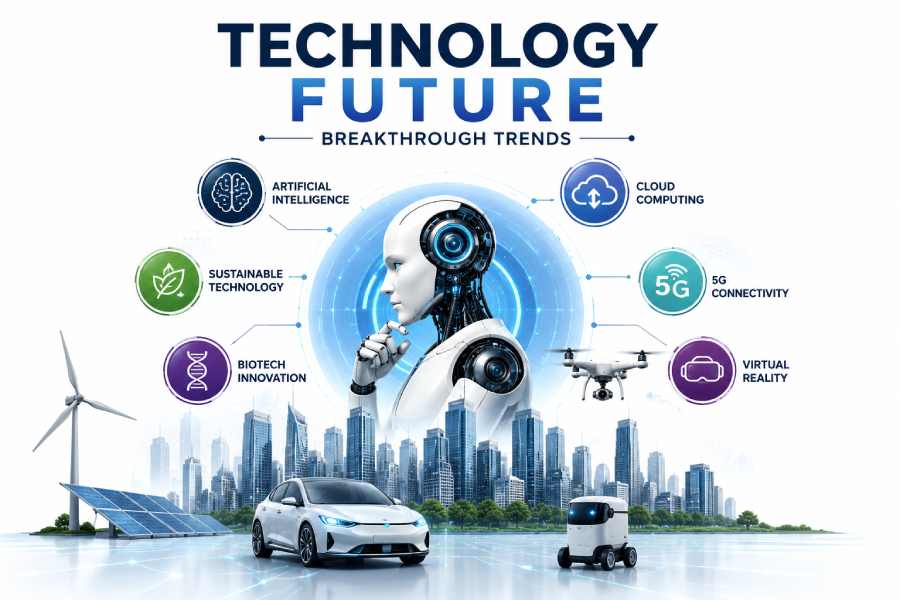
From intelligent virtual assistants and autonomous vehicles to personalized healthcare and smart cities, emerging technologies are creating a world where digital systems work more closely with humans.
Businesses, governments, and individuals who understand these technological changes will be better prepared to adapt and benefit from future opportunities.
Key Insight: The next generation of technology will focus on making systems smarter, faster, more connected, and more sustainable.
Table of Contents
- Artificial Intelligence and Machine Learning Revolution
- Generative AI and Intelligent Digital Assistants
- Robotics and Human-Machine Collaboration
- Quantum Computing Breakthroughs
- Internet of Things (IoT) and Connected Ecosystems
- Smart Cities and Intelligent Infrastructure
- Advanced Healthcare Technology
- Autonomous Vehicles and Future Transportation
- Green Technology and Sustainable Innovation
- Cybersecurity and Privacy Technology
- Next-Generation Connectivity (5G/6G)
- Space Technology and Digital Expansion
- Frequently Asked Questions
1. Artificial Intelligence and Machine Learning Revolution
Artificial Intelligence (AI) is one of the most important technologies shaping the future. AI enables computers and machines to analyze information, recognize patterns, understand language, and make intelligent decisions.
Machine learning allows systems to improve automatically by learning from data. These technologies are already transforming industries including healthcare, finance, education, marketing, transportation, and manufacturing.
How AI Is Changing the World
- Automating repetitive business tasks
- Improving medical diagnosis
- Creating personalized digital experiences
- Enhancing cybersecurity protection
- Supporting scientific research
- Improving decision-making through data analysis
| AI Application | Future Impact |
|---|---|
| Healthcare AI | Faster diagnosis and personalized treatments |
| Business AI | Improved productivity and automation |
| Education AI | Personalized learning experiences |
| Creative AI | Advanced content and design creation |
In the future, AI will become a common digital partner that helps people complete tasks, discover information, and solve complex problems.
2. Generative AI and Intelligent Digital Assistants
Generative AI has become one of the fastest-growing areas of technology. Unlike traditional software, generative AI can create new content including text, images, videos, audio, designs, and computer code.
Businesses are using generative AI to improve productivity, accelerate creativity, and automate content-related tasks.
Examples of Generative AI Applications
- AI writing assistants
- Image generation tools
- Software development support
- Automated business reports
- Personal digital assistants
- Customer service automation
Future AI assistants will become more personalized by understanding individual preferences, workflows, and communication styles.
| Technology | Main Purpose |
|---|---|
| Traditional AI | Analyzing data and making predictions |
| Generative AI | Creating new digital content |
| AI Assistants | Helping users complete tasks |
3. Robotics and Human-Machine Collaboration
Robotics is entering a new phase where machines are becoming smarter, safer, and more adaptable. Modern robots are no longer limited to industrial factories; they are expanding into homes, hospitals, agriculture, logistics, and customer services.
The future of robotics will focus on collaboration between humans and machines. Robots will handle dangerous, repetitive, or physically demanding tasks while humans focus on creativity and decision-making.
Future Robotics Applications
- Healthcare assistance robots
- Warehouse automation
- Smart manufacturing systems
- Household robots
- Agricultural automation
- Delivery robots
Human-machine collaboration will increase productivity while improving safety and efficiency across many industries.
4. Quantum Computing Breakthroughs
Quantum computing represents a major breakthrough in computer technology. Unlike traditional computers, quantum systems use quantum mechanics principles to process certain complex calculations in new ways.
Although still developing, quantum computing has the potential to transform areas such as medicine, cybersecurity, climate research, logistics, and scientific discovery.
Potential Quantum Computing Benefits
- Faster scientific simulations
- Advanced drug discovery
- Improved financial modeling
- Complex problem optimization
- New cybersecurity approaches
| Traditional Computing | Quantum Computing |
|---|---|
| Uses classical bits | Uses quantum bits |
| Handles standard computing tasks | Targets highly complex calculations |
| Limited parallel processing | Advanced computational possibilities |
Quantum computing is expected to complement existing technologies and unlock solutions for challenges that require enormous computational power.
5. Internet of Things (IoT) and Connected Ecosystems
The Internet of Things (IoT) is transforming the way people interact with technology by connecting everyday devices through the internet. These connected systems collect data, communicate with each other, and provide intelligent services that improve efficiency and convenience.
From smart homes and wearable devices to industrial sensors and connected vehicles, IoT is creating a world where technology can automatically respond to human needs.
How IoT Is Shaping the Future
- Smart home automation
- Connected healthcare devices
- Intelligent transportation systems
- Smart agriculture solutions
- Industrial monitoring systems
- Energy management technology
| IoT Sector | Future Benefits |
|---|---|
| Smart Homes | Improved comfort, security, and energy savings |
| Healthcare | Remote monitoring and better patient care |
| Agriculture | Efficient farming and resource management |
| Industry | Automation and predictive maintenance |
As IoT technology develops, more devices will become intelligent and connected, creating highly automated environments for homes, businesses, and cities.
6. Smart Cities and Intelligent Infrastructure
Cities around the world are adopting smart technologies to improve transportation, energy management, public safety, and quality of life. Smart cities combine artificial intelligence, IoT, cloud computing, and advanced analytics to manage urban systems more effectively.
Future cities will use real-time data to reduce traffic congestion, improve resource usage, and provide faster public services.
Smart City Technologies
- AI-powered traffic management
- Smart street lighting
- Connected public transportation
- Digital government services
- Smart waste management
- Environmental monitoring systems
| Smart City Feature | Impact |
|---|---|
| Smart Transportation | Reduced traffic and improved mobility |
| Smart Energy Systems | Lower energy consumption |
| Digital Services | Faster access to government resources |
| Connected Infrastructure | Better urban management |
Smart cities represent the future of urban living, where technology helps create safer, cleaner, and more efficient communities.
7. Advanced Healthcare Technology
Healthcare is experiencing a digital transformation through artificial intelligence, robotics, wearable devices, biotechnology, and advanced data analysis.
Future healthcare systems will focus on prevention, personalization, and early detection rather than only treating diseases after they appear.
Healthcare Technology Breakthroughs
- AI-assisted diagnosis
- Robotic surgery systems
- Remote patient monitoring
- Digital health platforms
- Personalized medicine
- Advanced medical imaging
How Technology Improves Healthcare
| Technology | Healthcare Benefit |
|---|---|
| Artificial Intelligence | Faster analysis of medical information |
| Wearable Devices | Continuous health monitoring |
| Robotics | Greater precision in medical procedures |
| Telemedicine | Remote access to healthcare services |
The combination of human medical expertise and advanced technology will create more efficient healthcare systems worldwide.
8. Autonomous Vehicles and Future Transportation
Transportation is moving toward a smarter and more automated future. Autonomous vehicles use artificial intelligence, sensors, cameras, and advanced navigation systems to understand their environment and make driving decisions.
Self-driving technology has the potential to improve road safety, reduce traffic problems, and transform how people and goods move around the world.
Future Transportation Innovations
- Self-driving cars
- Autonomous delivery vehicles
- AI traffic systems
- Electric transportation
- Smart public transport
- Connected vehicle networks
| Transportation Technology | Future Impact |
|---|---|
| Autonomous Vehicles | Safer and more efficient travel |
| Electric Vehicles | Reduced environmental impact |
| Smart Traffic Systems | Lower congestion and improved mobility |
| Connected Vehicles | Better communication between transportation systems |
Future transportation will combine automation, clean energy, and connectivity to create safer and more sustainable mobility solutions.
9. Green Technology and Sustainable Innovation
Climate change and environmental challenges are increasing the importance of sustainable technology. Green technology focuses on creating solutions that reduce waste, conserve resources, and protect the environment.
Renewable energy, advanced batteries, electric transportation, and smart energy systems are among the technologies shaping a more sustainable future.
Major Green Technology Innovations
- Solar energy advancements
- Wind energy technology
- Electric vehicles
- Battery storage solutions
- Smart energy networks
- Carbon reduction technologies
| Green Technology | Environmental Advantage |
|---|---|
| Renewable Energy | Reduces dependence on fossil fuels |
| Electric Vehicles | Lowers transportation emissions |
| Smart Energy Systems | Improves energy efficiency |
| Advanced Batteries | Supports clean energy storage |
Technology Trends Impact Summary
| Technology Trend | Main Purpose | Future Impact |
|---|---|---|
| IoT | Connected devices | Smarter homes and businesses |
| Smart Cities | Intelligent infrastructure | Better urban living |
| Healthcare Technology | Digital medical solutions | Improved health outcomes |
| Autonomous Vehicles | Automated transportation | Safer mobility |
| Green Technology | Sustainable innovation | Environmental protection |
10. Cybersecurity and Privacy Technology
As technology becomes more connected, cybersecurity has become one of the most important areas of future innovation. Businesses, governments, and individuals are generating massive amounts of digital data, making protection against cyber threats a top priority.
Future cybersecurity systems will use artificial intelligence, automation, advanced encryption, and real-time monitoring to detect and prevent attacks before they cause damage.
Future Cybersecurity Innovations
- AI-powered threat detection
- Advanced data encryption
- Biometric security systems
- Passwordless authentication
- Automated security monitoring
- Zero-trust security models
| Cybersecurity Technology | Future Benefit |
|---|---|
| Artificial Intelligence Security | Faster detection of cyber threats |
| Biometric Authentication | Improved identity protection |
| Encryption Technology | Secure digital communication |
| Automated Monitoring | Continuous protection of systems |
Privacy protection will become increasingly important as more devices collect personal information. Future technology will focus on creating secure digital environments where users have greater control over their data.
11. Next-Generation Connectivity: 5G and 6G Networks
High-speed connectivity is the foundation of future technology. Advanced networks such as 5G and future 6G systems will enable faster communication, lower delays, and support billions of connected devices.
These networks will power technologies including autonomous vehicles, smart cities, virtual reality, artificial intelligence applications, and industrial automation.
Benefits of Advanced Connectivity
- Faster internet speeds
- Lower communication delays
- Better support for smart devices
- Improved remote collaboration
- Enhanced digital experiences
- Real-time data processing
| Network Technology | Expected Impact |
|---|---|
| 5G Networks | High-speed mobile connectivity and IoT support |
| 6G Networks | Advanced intelligent communication systems |
| Satellite Connectivity | Expanded global internet access |
Future connectivity will create a more connected world where devices, businesses, and people can communicate instantly.
12. Space Technology and Digital Expansion
Space technology is becoming an important part of the future digital economy. Advances in satellites, space communication, and commercial space exploration are creating new opportunities beyond Earth.
Modern satellite systems are improving global communication, navigation, weather forecasting, environmental monitoring, and scientific research.
Future Space Technology Applications
- Satellite internet services
- Earth observation systems
- Advanced navigation technology
- Space-based research
- Commercial space missions
- Global communication networks
| Space Technology | Future Contribution |
|---|---|
| Satellite Networks | Improved worldwide connectivity |
| Earth Monitoring | Better climate and environmental analysis |
| Space Research | Scientific discoveries and innovation |
| Commercial Space | New technology markets and opportunities |
The expansion of space technology will support communication, research, and digital infrastructure for future generations.
Advantages of Future Technology
| Advantage | How Technology Helps |
|---|---|
| Improved Efficiency | Automation helps complete tasks faster and reduces human effort. |
| Better Healthcare | Advanced systems improve diagnosis and treatment. |
| Enhanced Communication | Faster networks connect people globally. |
| Sustainable Development | Green technologies reduce environmental impact. |
| Economic Growth | New industries and career opportunities are created. |
Challenges of Future Technology Adoption
| Challenge | Possible Solution |
|---|---|
| Data Privacy | Strong security policies and user protection systems |
| Cybersecurity Threats | Advanced AI-powered security solutions |
| Technology Costs | Affordable and scalable innovations |
| Digital Skills Gap | Technology education and training programs |
| Ethical Concerns | Responsible technology development |
Future Technology Predictions
The future of technology will be defined by deeper integration between humans, machines, and digital systems. Innovations will become more intelligent, personalized, and accessible.
Expected Technology Changes in the Coming Years
- AI assistants becoming everyday digital partners
- More automated homes and workplaces
- Advanced healthcare solutions
- Smarter transportation systems
- Greater use of renewable energy technology
- More immersive digital experiences
- Increased human-machine collaboration
Technology will continue changing how people work, communicate, learn, and interact with the world.
Frequently Asked Questions About Future Technology
1. What is the future of technology?
The future of technology includes advanced innovations such as artificial intelligence, robotics, quantum computing, smart devices, sustainable solutions, and next-generation connectivity.
2. What are the biggest technology trends for 2026?
Major technology trends include AI, generative AI, IoT, cybersecurity, smart cities, healthcare innovation, autonomous systems, and green technology.
3. How will artificial intelligence impact the future?
AI will improve automation, decision-making, healthcare, education, business operations, and personalized digital experiences.
4. Why is IoT important for future technology?
IoT connects devices and allows them to exchange information, creating smarter homes, industries, and cities.
5. How will technology change healthcare?
Technology will improve healthcare through AI diagnosis, wearable devices, telemedicine, robotics, and personalized treatments.
6. What role will robotics play in the future?
Robotics will support manufacturing, healthcare, transportation, agriculture, and everyday activities through automation.
7. Will future technology create new jobs?
Yes. While some tasks may become automated, new careers will develop in artificial intelligence, cybersecurity, robotics, data science, and technology management.
8. Why is sustainable technology important?
Sustainable technology helps reduce environmental impact through renewable energy, efficient systems, and cleaner solutions.
9. How important is cybersecurity in the future?
Cybersecurity will be essential for protecting personal data, business information, and connected digital systems.
10. How can people prepare for future technology changes?
People can prepare by learning digital skills, understanding new technologies, and adapting to continuous innovation.
Conclusion: Technology Will Define the Future
The future of technology will bring remarkable changes across every part of human life. Artificial intelligence, robotics, connected devices, advanced healthcare, sustainable innovation, cybersecurity, and space technology are creating new possibilities that were once unimaginable.
These breakthrough technologies will not only improve efficiency but also help solve important global challenges. The combination of human creativity and technological innovation will shape a smarter, safer, and more connected future.
Individuals and organizations that understand these technology trends and prepare for change will be better positioned to take advantage of future opportunities.
Final Thought: The future of technology is not just about machines becoming more advanced. It is about creating better experiences, improving lives, and building a more innovative world.