
The workplace is experiencing one of the biggest transformations in history. Advances in artificial intelligence, automation, cloud computing, robotics, and digital collaboration tools are changing how people work, communicate, and build careers.
The future of work will not simply be about replacing traditional jobs with machines. Instead, next-generation technologies will create new opportunities by helping humans become more productive, creative, and efficient.
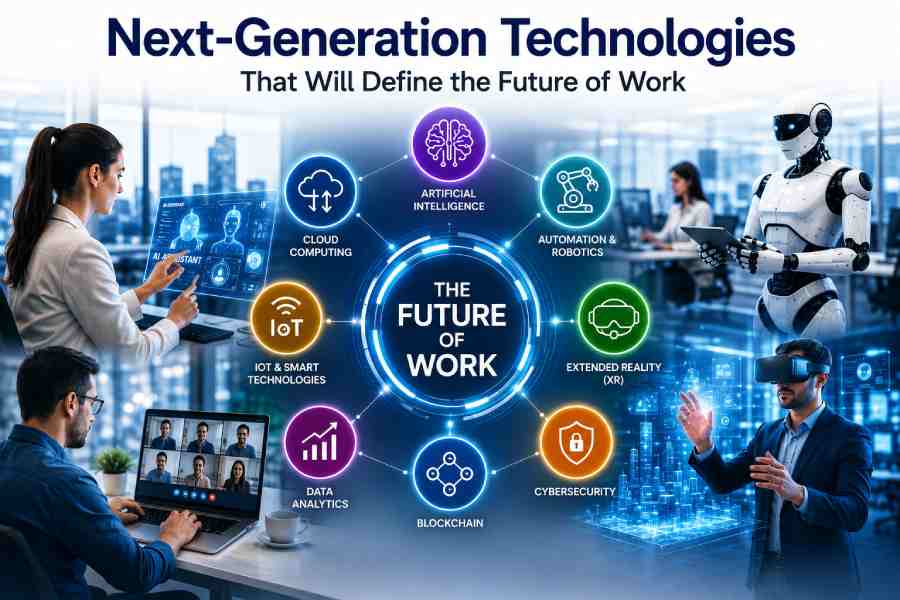 Companies worldwide are adopting intelligent technologies to improve operations, support remote teams, automate repetitive tasks, and create better employee experiences.
From AI-powered assistants to smart offices and virtual collaboration environments, technology is redefining the modern workplace.
Table of Contents
- The Future of Work: How Technology Is Changing Careers
- Artificial Intelligence Transforming Workplace Productivity
- Automation and Smart Workflows
- Generative AI and AI Workplace Assistants
- Cloud Computing and Digital Collaboration Platforms
- Robotics and Human-Machine Collaboration
- Virtual Reality and Augmented Reality Workspaces
- Internet of Things and Smart Offices
- Cybersecurity in Future Workplaces
- Data Analytics and Intelligent Decisions
- 5G and Connected Workplaces
- Blockchain and Secure Digital Work Systems
- Quantum Computing Applications
- Sustainable Technology Workplaces
- Future Workforce Skills
- Frequently Asked Questions
1. The Future of Work: How Technology Is Changing Careers
Technology is transforming careers by changing the skills, tools, and environments required for success. Traditional workplace models are evolving into flexible digital ecosystems where employees can collaborate from anywhere.
Organizations are moving toward hybrid work models, AI-supported decision-making, and automated workflows that allow employees to focus on higher-value tasks.
Major Changes in the Future Workplace
- Remote and hybrid work environments
- AI-assisted productivity tools
- Digital collaboration platforms
- Automation of repetitive tasks
- Data-driven decision-making
- Continuous technology-based learning
| Workplace Change | Technology Driving It |
|---|---|
| Remote Collaboration | Cloud platforms and video communication tools |
| Task Automation | Artificial intelligence and robotics |
| Employee Analytics | Big data and machine learning |
| Digital Training | Virtual reality and online learning platforms |
The future of work will reward employees and businesses that can adapt quickly to technological change.
2. Artificial Intelligence Transforming Workplace Productivity
Artificial Intelligence (AI) is one of the most influential technologies shaping the future workplace. AI systems can analyze information, automate tasks, generate content, and support complex decision-making.
Businesses are using AI to improve efficiency, reduce operational costs, and help employees complete tasks faster.
AI Applications in the Workplace
- AI-powered virtual assistants
- Automated customer support
- Intelligent scheduling systems
- Predictive business analysis
- Content and document creation
- Employee productivity tools
| Industry | AI Workplace Application |
|---|---|
| Healthcare | AI-assisted research and medical analysis |
| Finance | Risk analysis and fraud detection |
| Marketing | Personalized campaigns and customer insights |
| Technology | Software development assistance |
AI will become a workplace partner that helps employees solve problems, analyze information, and improve productivity.
3. Automation and Smart Workflows
Automation is changing how organizations complete everyday tasks. Smart workflows use software, artificial intelligence, and robotics to reduce manual work and improve efficiency.
Instead of spending time on repetitive activities, employees can focus on creative thinking, innovation, and strategic decision-making.
Examples of Workplace Automation
- Automated data entry
- AI-based customer service systems
- Automated reporting
- Smart scheduling
- Workflow management systems
- Robotic process automation
| Automation Type | Workplace Benefit |
|---|---|
| Software Automation | Faster business processes |
| Robotic Automation | Improved operational efficiency |
| AI Automation | Smarter decision support |
Future workplaces will use automation not only to reduce costs but also to create more productive and engaging employee experiences.
4. Generative AI and AI Workplace Assistants
Generative AI is becoming one of the most important workplace technologies. These systems can create text, images, software code, reports, presentations, and business insights.
AI assistants are helping employees manage tasks, research information, create content, and improve communication.
Generative AI Workplace Uses
- Writing and editing assistance
- Meeting summaries
- Research automation
- Software development support
- Business document creation
- Creative design assistance
| AI Technology | Workplace Impact |
|---|---|
| Generative AI | Creates digital content and solutions |
| AI Assistants | Improves employee productivity |
| Machine Learning | Provides intelligent predictions |
As AI technology improves, digital assistants will become more personalized and integrated into daily work processes.
5. Cloud Computing and Digital Collaboration Platforms
Cloud computing has become the foundation of modern digital workplaces. It allows employees to access applications, files, and business systems from anywhere.
Cloud technology supports remote work, global collaboration, and flexible business operations.
Benefits of Cloud-Based Workplaces
- Remote access to business tools
- Real-time team collaboration
- Scalable digital infrastructure
- Improved data management
- Reduced technology costs
- Faster innovation
| Cloud Technology | Workplace Role |
|---|---|
| Cloud Storage | Secure file access and sharing |
| Cloud Applications | Digital productivity tools |
| Cloud Infrastructure | Flexible business technology |
Cloud computing will continue supporting the future of work by creating connected, flexible, and efficient digital environments.
6. Robotics and Human-Machine Collaboration
Robotics is becoming a major technology shaping the future of work. Modern robots are no longer limited to factory environments. They are expanding into healthcare, logistics, agriculture, retail, and service industries.
The future workplace will focus on collaboration between humans and intelligent machines. Instead of completely replacing workers, robots will support employees by handling repetitive, dangerous, or physically demanding tasks.
How Robotics Is Transforming Workplaces
- Automated manufacturing processes
- Warehouse and logistics automation
- Healthcare assistance robots
- Customer service robots
- AI-powered industrial machines
- Robotic quality inspection systems
| Robotics Application | Workplace Impact |
|---|---|
| Industrial Robots | Increase production speed and accuracy |
| Service Robots | Improve customer support experiences |
| Healthcare Robots | Assist medical professionals and patients |
| Warehouse Robots | Optimize inventory and delivery operations |
Human-machine collaboration will become an important part of future workplaces. Employees will work alongside intelligent machines to improve productivity and innovation.
7. Virtual Reality (VR) and Augmented Reality (AR) Workspaces
Virtual Reality (VR) and Augmented Reality (AR) are changing how employees learn, collaborate, and interact with digital environments.
These technologies create immersive experiences that allow workers to perform training, meetings, design projects, and simulations in new ways.
Future Workplace Applications of VR and AR
- Virtual meetings and collaboration spaces
- Employee training simulations
- Remote equipment assistance
- Product design visualization
- Virtual customer experiences
- Digital workplace environments
| Technology | Workplace Benefit |
|---|---|
| Virtual Reality | Creates immersive training and collaboration environments |
| Augmented Reality | Adds digital information to the real world |
| Mixed Reality | Combines physical and digital experiences |
Industries Using VR and AR Technology
- Healthcare: Medical training and surgical simulations
- Education: Interactive learning experiences
- Manufacturing: Equipment training and maintenance
- Retail: Virtual shopping experiences
- Architecture: Digital building visualization
As VR and AR technology improves, future employees will have more immersive ways to learn, communicate, and complete complex tasks.
8. Internet of Things (IoT) and Smart Offices
The Internet of Things (IoT) is transforming traditional workplaces into intelligent environments. IoT connects devices, sensors, and systems to collect data and automate workplace operations.
Smart offices use connected technologies to improve employee comfort, energy efficiency, security, and productivity.
Smart Office Technologies
- Connected lighting systems
- Smart temperature control
- Occupancy monitoring sensors
- Connected workplace devices
- Automated security systems
- Smart meeting rooms
| IoT Workplace Solution | Benefit |
|---|---|
| Smart Sensors | Monitor workplace conditions in real time |
| Connected Devices | Improve workplace automation |
| Smart Energy Systems | Reduce energy consumption |
| Digital Workplace Analytics | Improve space management |
Future offices will become more adaptive by automatically adjusting environments based on employee needs and workplace activity.
9. Cybersecurity and Privacy in the Future Workplace
As businesses become more digital, cybersecurity will become essential for protecting employees, company systems, and sensitive information.
Remote work, cloud platforms, connected devices, and AI systems create new security challenges that require advanced protection methods.
Future Workplace Cybersecurity Technologies
- AI-powered threat detection
- Multi-factor authentication
- Biometric security systems
- Zero-trust security frameworks
- Advanced data encryption
- Automated security monitoring
| Cybersecurity Challenge | Technology Solution |
|---|---|
| Data Breaches | Encryption and secure access systems |
| Identity Theft | Biometric authentication |
| Cyber Attacks | AI-based threat detection |
| Remote Work Risks | Secure cloud security solutions |
Why Workplace Security Matters
- Protects confidential business data
- Maintains customer trust
- Prevents financial losses
- Supports safe remote work
- Ensures business continuity
Future workplaces will require strong cybersecurity strategies to safely operate in increasingly connected digital environments.
10. Data Analytics and Intelligent Decision-Making
Data analytics is becoming one of the most valuable technologies for future businesses. Organizations are collecting massive amounts of information and using advanced analytics to make better decisions.
Artificial intelligence and machine learning help companies analyze patterns, predict trends, and improve workplace strategies.
Workplace Applications of Data Analytics
- Employee performance analysis
- Business forecasting
- Workforce planning
- Customer behavior analysis
- Operational improvement
- Resource optimization
| Analytics Technology | Workplace Advantage |
|---|---|
| Predictive Analytics | Forecasts future business trends |
| Real-Time Analytics | Supports faster decisions |
| AI Data Processing | Finds valuable insights automatically |
| Data Visualization | Makes information easier to understand |
How Data Analytics Improves Workplaces
- Identifies productivity opportunities
- Improves employee experiences
- Supports strategic planning
- Reduces operational problems
- Creates smarter business decisions
Companies that effectively use data analytics will have a major advantage in the future workplace because they can make decisions based on accurate information rather than assumptions.
How Next-Generation Technologies Work Together
| Technology Combination | Future Workplace Impact |
|---|---|
| AI + Data Analytics | Smarter decisions and automation |
| Cloud + Collaboration Tools | Flexible remote work environments |
| IoT + Smart Office Systems | Connected and efficient workplaces |
| Robotics + AI | Advanced human-machine teamwork |
| Cybersecurity + Digital Systems | Safer future workplaces |
The future workplace will be a connected ecosystem where technology supports human creativity, productivity, and innovation.
11. 5G, Edge Computing, and Connected Workplaces
The future of work will depend heavily on faster and more reliable digital connectivity. Advanced networks such as 5G, along with edge computing, will enable businesses to create highly connected workplaces where employees, devices, and systems can communicate instantly.
Traditional workplace systems often depend on centralized data processing. Edge computing changes this approach by processing information closer to where it is generated, reducing delays and improving performance.
Impact of 5G Technology on Future Work
- Faster communication between employees and systems
- Improved remote work experiences
- Better support for virtual collaboration
- Enhanced IoT workplace connectivity
- Real-time business operations
- Advanced automation capabilities
| Technology | Future Workplace Benefit |
|---|---|
| 5G Networks | High-speed and reliable workplace connectivity |
| Edge Computing | Faster processing and real-time decisions |
| Connected Devices | Improved workplace automation |
| Smart Infrastructure | Efficient digital workplace management |
Industries such as manufacturing, healthcare, transportation, and logistics will benefit significantly from connected workplace technologies.
12. Blockchain and Secure Digital Work Systems
Blockchain technology is becoming an important part of future digital workplaces by improving security, transparency, and trust between organizations.
Although blockchain is widely known for cryptocurrency applications, businesses are exploring its use for identity management, secure transactions, digital contracts, and information verification.
Blockchain Applications in Future Workplaces
- Secure employee identity management
- Digital certificates and credentials
- Smart contracts
- Secure financial transactions
- Transparent supply chains
- Protected business records
| Blockchain Use Case | Workplace Advantage |
|---|---|
| Digital Identity | Improves employee authentication |
| Smart Contracts | Automates business agreements |
| Secure Records | Protects important information |
| Verification Systems | Reduces fraud and errors |
Future organizations will require secure digital systems to manage increasingly complex remote teams, online transactions, and digital workflows.
13. Quantum Computing and Future Problem Solving
Quantum computing represents one of the most advanced technology developments that could transform the future of work. Unlike traditional computers, quantum systems use quantum principles to solve highly complex problems at incredible speeds.
Although quantum computing is still developing, it has the potential to impact industries that require advanced calculations, simulations, and optimization.
Potential Workplace Applications of Quantum Computing
- Advanced scientific research
- Complex financial modeling
- Drug and healthcare innovation
- Supply chain optimization
- Advanced cybersecurity solutions
- Climate and environmental analysis
| Industry | Quantum Computing Impact |
|---|---|
| Healthcare | Faster research and medical discoveries |
| Finance | Advanced risk calculations |
| Logistics | Improved route optimization |
| Technology | Next-generation computing capabilities |
Quantum computing may not replace traditional workplace technology, but it could become a powerful tool for solving challenges that are currently impossible to manage.
14. Sustainable Technology and Future Work Environments
The future of work will also focus on sustainability. Organizations are adopting green technologies to reduce environmental impact while improving efficiency.
Sustainable workplaces combine digital innovation with environmentally responsible practices, creating healthier and more efficient working environments.
Green Technologies Transforming Workplaces
- Energy-efficient smart buildings
- Renewable energy solutions
- Digital document systems
- Remote work technologies
- Smart resource management
- Carbon monitoring platforms
| Sustainable Technology | Workplace Benefit |
|---|---|
| Smart Building Systems | Reduces energy consumption |
| Cloud Work Platforms | Reduces physical resource usage |
| Remote Collaboration Tools | Lowers travel requirements |
| AI Energy Management | Improves resource efficiency |
Future workplaces will combine productivity with sustainability by using technology to create environmentally responsible business models.
15. Future Workforce Skills and Technology Predictions
As technology continues changing the workplace, employees will need new skills to succeed. Future careers will require a combination of technical knowledge, creativity, problem-solving abilities, and adaptability.
Important Skills for the Future Workforce
- Artificial intelligence literacy
- Data analysis skills
- Digital communication skills
- Cybersecurity awareness
- Creative problem-solving
- Technology adaptation skills
- Continuous learning ability
| Future Skill | Why It Matters |
|---|---|
| AI Skills | Helps employees work effectively with intelligent systems |
| Data Skills | Supports better decision-making |
| Digital Skills | Improves workplace technology adoption |
| Creative Thinking | Provides human value beyond automation |
Advantages of Next-Generation Workplace Technologies
| Advantage | Impact on Work |
|---|---|
| Higher Productivity | Automation and AI help employees complete tasks faster. |
| Flexible Work Models | Technology enables remote and hybrid workplaces. |
| Better Collaboration | Digital platforms connect global teams. |
| Improved Decision-Making | Data analytics provides valuable insights. |
| Employee Innovation | Technology supports creativity and experimentation. |
Challenges of Future Workplace Technology
| Challenge | Possible Solution |
|---|---|
| Technology Skills Gap | Provide continuous employee training. |
| Job Transformation | Develop new skills and career opportunities. |
| Cybersecurity Risks | Implement advanced security systems. |
| Privacy Concerns | Create responsible data management policies. |
| Technology Costs | Use scalable digital solutions. |
Future Predictions for the Workplace
The next decade will bring significant changes to how people work. Technology will continue creating smarter workplaces where humans and machines collaborate to achieve better results.
Future Workplace Trends
- AI assistants becoming common workplace partners
- Fully connected smart offices
- More remote and hybrid work opportunities
- Greater use of robotics and automation
- Virtual collaboration becoming mainstream
- Personalized employee experiences
- Continuous digital learning environments
Frequently Asked Questions About Future of Work Technology
1. What technologies will define the future of work?
Artificial intelligence, automation, robotics, cloud computing, IoT, cybersecurity, virtual reality, and advanced connectivity will shape future workplaces.
2. How will AI change the workplace?
AI will automate repetitive tasks, improve decision-making, support creativity, and help employees become more productive.
3. Will automation replace human jobs?
Automation will change many job roles, but it will also create new opportunities requiring advanced digital and creative skills.
4. Why is cloud computing important for future work?
Cloud computing enables remote access, collaboration, scalability, and flexible digital operations.
5. How will robotics impact employees?
Robotics will support workers by handling repetitive and dangerous tasks while allowing humans to focus on strategic activities.
6. What are smart workplaces?
Smart workplaces use connected devices, sensors, AI, and automation to create efficient and comfortable working environments.
7. Why is cybersecurity important for future workplaces?
Cybersecurity protects digital systems, employee information, and business data from increasing online threats.
8. What skills will workers need in the future?
Workers will need digital literacy, AI knowledge, problem-solving skills, creativity, and continuous learning abilities.
9. How will VR and AR change work?
VR and AR will improve training, remote collaboration, design, and immersive workplace experiences.
10. What is the future of workplace technology?
The future workplace will combine human creativity with intelligent technologies to create flexible, productive, and innovative environments.
Conclusion: Technology Will Redefine the Future of Work
Next-generation technologies are creating a completely new workplace environment. Artificial intelligence, automation, robotics, cloud computing, IoT, cybersecurity, and advanced connectivity are changing how businesses operate and how employees build careers.
The future of work will not be defined only by machines. It will be shaped by the collaboration between human creativity and intelligent technology.
Organizations and professionals who embrace continuous learning and digital transformation will be better prepared for future opportunities.