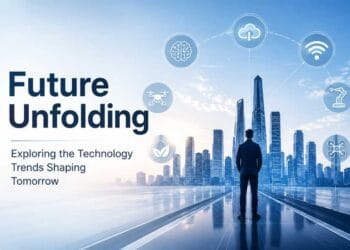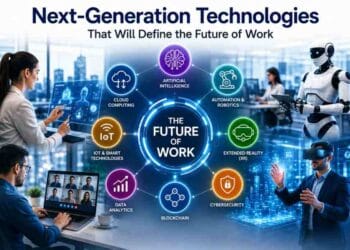

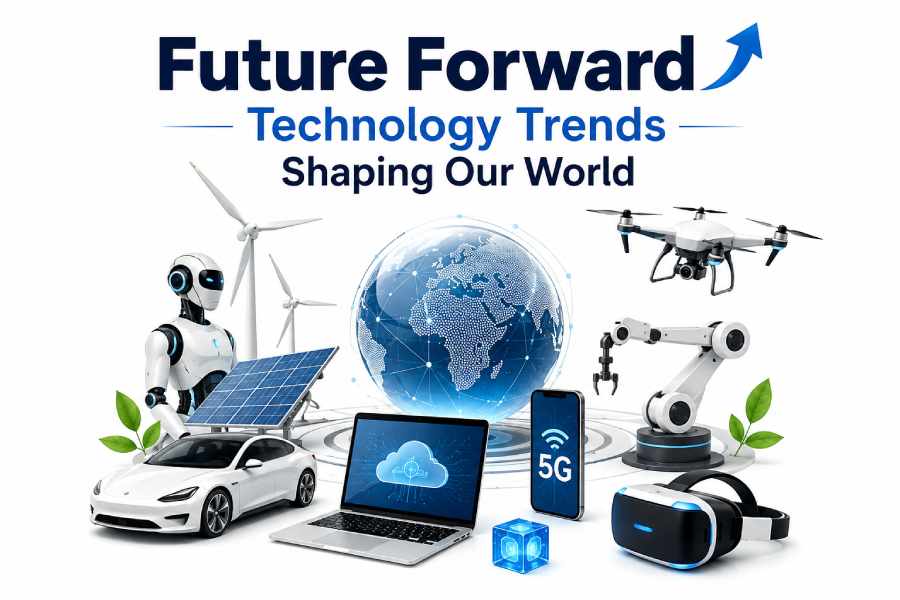
 Whether you’re a student, entrepreneur, technology enthusiast, investor, or business owner, understanding these emerging innovations can help you prepare for tomorrow’s digital economy.
This comprehensive guide explores fifteen revolutionary technology trends shaping our future that are changing industries and shaping the future of our world.
Table of Contents
- Artificial Intelligence Everywhere
- Generative AI Revolution
- Robotics and Automation
- Quantum Computing
- Cybersecurity Powered by AI
- Green Technology Innovations
- Digital Healthcare Transformation
- Internet of Things (IoT)
- Smart Cities
- Autonomous Vehicles
- Blockchain Beyond Cryptocurrency
- Mixed Reality
- 5G and 6G Connectivity
- Space Technology
- Edge Computing
- Frequently Asked Questions
1. Artificial Intelligence Is Becoming Everyone’s Daily Assistant
Artificial Intelligence (AI) has evolved beyond simple chatbots and recommendation engines. In 2026, AI is becoming an essential assistant for businesses, educators, healthcare providers, software developers, marketers, designers, and everyday consumers.
Modern AI systems can summarize documents, generate software code, analyze financial reports, create marketing campaigns, detect diseases, optimize logistics, and even assist in scientific research.
Companies adopting AI are reporting significant improvements in productivity while reducing repetitive manual work. Rather than replacing human workers completely, AI is increasingly serving as a collaborative tool that enhances human decision-making.
Key Applications
- AI customer support
- Content generation
- Predictive analytics
- Medical diagnosis
- Fraud detection
- Smart manufacturing
- Personalized education
Artificial Intelligence is becoming the operating system of the digital economy.
2. Generative AI Is Transforming Creative Industries
Generative AI has become one of the fastest-growing technologies in the world. Businesses now use AI to create articles, presentations, graphics, videos, advertisements, music, product descriptions, and software prototypes within minutes.
Marketing agencies use AI to speed up campaign development, while software companies accelerate coding and debugging. Designers combine AI with traditional creativity to produce unique concepts much faster than before.
Educational institutions are also integrating AI into learning environments, enabling students to receive personalized tutoring and instant explanations.
Industries Benefiting Most
- Digital Marketing
- Software Development
- Education
- Media
- Publishing
- E-commerce
- Healthcare Documentation
3. Robotics and Intelligent Automation Continue Expanding
Modern robots are becoming smarter, safer, and more affordable. Manufacturing remains the largest adopter, but warehouses, hospitals, restaurants, hotels, and agriculture are rapidly integrating robotic systems.
Collaborative robots—often called cobots—work alongside humans rather than replacing them. These machines handle repetitive, dangerous, or physically demanding tasks while employees focus on problem-solving and customer interactions.
Autonomous warehouse robots now move inventory efficiently, reducing fulfillment times and minimizing workplace injuries.
Major Advantages
- Higher productivity
- Lower operating costs
- Improved workplace safety
- Greater accuracy
- 24/7 operations
4. Quantum Computing Is Solving Previously Impossible Problems
Quantum computing is transitioning from research laboratories toward commercial applications. Unlike traditional computers, quantum systems process information using quantum bits, enabling them to solve highly complex calculations significantly faster for certain types of problems.
Industries including pharmaceuticals, financial services, logistics, aerospace, and scientific research are investing heavily in quantum technology.
Potential applications include advanced drug discovery, climate modeling, cryptography, financial forecasting, and supply chain optimization.
| Traditional Computing | Quantum Computing |
|---|---|
| Sequential calculations | Massively parallel problem solving |
| Binary processing | Quantum states |
| Limited optimization | Complex optimization |
5. AI-Powered Cybersecurity Is Becoming Essential
As cyberattacks grow more sophisticated, organizations are increasingly using artificial intelligence to detect threats in real time. AI systems analyze network activity, identify unusual behavior, and respond to potential attacks before they escalate.
Businesses are also investing in zero-trust security models, biometric authentication, and continuous monitoring to protect sensitive data.
With remote work and cloud computing now widespread, cybersecurity has become a strategic priority rather than simply an IT responsibility.
Emerging Security Technologies
- AI threat detection
- Behavior analytics
- Multi-factor authentication
- Passwordless login
- Cloud security automation
6. Green Technology Is Driving Sustainable Innovation
Technology is playing a major role in addressing climate change and improving energy efficiency. Governments and businesses are investing in renewable energy, battery storage, electric transportation, carbon capture, and sustainable manufacturing.
Smart energy management systems help organizations monitor electricity usage in real time, reducing waste and lowering operational costs.
Consumers are also embracing eco-friendly innovations, including smart home devices that automatically optimize heating, cooling, and lighting.
Green Technology Trends
- Solar innovation
- Wind energy
- Electric vehicles
- Battery technology
- Carbon capture
- Smart grids
7. Digital Healthcare Is Revolutionizing Patient Care
Healthcare continues to experience one of the most significant digital transformations. Artificial intelligence, wearable devices, telemedicine, robotic surgery, and predictive analytics are improving patient outcomes while reducing healthcare costs.
Doctors can now remotely monitor patients using connected medical devices that continuously collect health data. AI helps analyze medical images, identify abnormalities earlier, and assist physicians in making more informed treatment decisions.
Wearable fitness trackers and smart health monitors are empowering individuals to take greater control of their own well-being by providing real-time insights into heart rate, sleep quality, physical activity, blood oxygen levels, and other vital health metrics.
Benefits of Digital Healthcare
- Remote consultations
- AI-assisted diagnosis
- Personalized treatment plans
- Remote patient monitoring
- Electronic health records
- Predictive healthcare analytics
8. Internet of Things (IoT) Is Connecting the Physical and Digital World
The Internet of Things (IoT) continues to expand rapidly in 2026 as billions of connected devices exchange data in real time. From smart homes and wearable devices to industrial sensors and connected factories, IoT enables organizations to make faster, data-driven decisions while improving efficiency and reducing operational costs.
Businesses use IoT to monitor equipment performance, predict maintenance needs, optimize supply chains, and improve workplace safety. Consumers benefit from connected appliances, smart security systems, and intelligent home automation that simplify everyday life.
Popular IoT Applications
- Smart home automation
- Industrial monitoring
- Connected healthcare devices
- Smart agriculture
- Fleet management
- Retail inventory tracking
- Energy management systems
| Industry | IoT Benefits |
|---|---|
| Manufacturing | Predictive maintenance and automation |
| Healthcare | Remote patient monitoring |
| Agriculture | Precision farming |
| Retail | Inventory optimization |
9. Smart Cities Are Improving Urban Living
Cities across the globe are investing in digital infrastructure to improve transportation, reduce pollution, enhance public safety, and deliver better public services. Smart cities combine IoT, AI, cloud computing, and big data analytics to manage resources more efficiently.
Traffic management systems can reduce congestion using real-time data, while intelligent street lighting automatically adjusts brightness to conserve energy. Connected public transportation also provides more reliable travel information for commuters.
Smart City Technologies
- AI traffic management
- Smart parking systems
- Digital public services
- Waste management automation
- Environmental monitoring
- Smart energy grids
10. Autonomous Vehicles Continue to Advance
Self-driving technology continues to mature with improvements in computer vision, artificial intelligence, radar, LiDAR, and high-definition mapping. Although fully autonomous transportation is still evolving, advanced driver-assistance systems have become increasingly common.
Autonomous delivery robots, warehouse vehicles, and commercial transportation solutions are already improving logistics efficiency while reducing operational expenses.
Benefits
- Reduced accidents through driver assistance
- Improved logistics efficiency
- Lower transportation costs
- Better fuel optimization
- Enhanced accessibility
11. Blockchain Is Expanding Beyond Cryptocurrency
Blockchain technology is no longer limited to digital currencies. Organizations are adopting decentralized systems for supply chain transparency, digital identity verification, healthcare records, intellectual property protection, and secure financial transactions.
Businesses value blockchain because it provides transparency, improves traceability, and reduces opportunities for fraud across complex business operations.
Business Applications
- Supply chain management
- Digital contracts
- Healthcare records
- Identity verification
- Cross-border payments
- Asset tracking
12. Mixed Reality Is Changing Learning and Collaboration
Augmented Reality (AR), Virtual Reality (VR), and Mixed Reality (MR) continue to reshape education, healthcare, manufacturing, entertainment, and workplace collaboration. Businesses now conduct virtual product demonstrations, employee training, and remote technical support using immersive technologies.
Educational institutions increasingly use interactive simulations to help students understand complex scientific and engineering concepts through realistic virtual experiences.
Common Uses
- Virtual classrooms
- Medical training
- Architecture visualization
- Industrial maintenance
- Gaming and entertainment
- Remote collaboration
13. 5G Expansion and Early 6G Research
High-speed wireless connectivity continues to support digital transformation worldwide. Expanded 5G coverage enables lower latency, faster downloads, and improved support for connected devices, while researchers continue exploring future 6G technologies.
Reliable connectivity benefits cloud computing, online education, remote healthcare, industrial automation, and smart city infrastructure.
| Technology | Primary Advantage |
|---|---|
| 5G | High-speed, low-latency connectivity |
| Future 6G | Higher capacity and advanced intelligent networking |
14. Space Technology Is Creating New Opportunities
Investment in commercial space technology continues to increase. Satellite communications, Earth observation, navigation systems, and scientific exploration are supporting industries including agriculture, disaster management, telecommunications, and environmental monitoring.
Private companies and government agencies continue developing reusable launch systems, satellite constellations, and deep-space research initiatives that may unlock new commercial opportunities over the coming decade.
Growing Applications
- Satellite internet
- Climate monitoring
- Precision agriculture
- Disaster response
- Scientific research
- Global communications
15. Edge Computing Is Bringing Data Processing Closer to Users
Edge computing reduces delays by processing data closer to where it is generated rather than relying entirely on centralized cloud servers. This approach improves performance for applications that require near real-time responses.
Industries including healthcare, manufacturing, transportation, retail, and telecommunications increasingly use edge computing to improve responsiveness, reduce bandwidth usage, and strengthen reliability.
Advantages
- Lower latency
- Faster processing
- Reduced bandwidth costs
- Improved reliability
- Enhanced data privacy
Technology Trends Comparison
| Technology | Main Impact | Industries |
|---|---|---|
| Artificial Intelligence | Automation & decision-making | All industries |
| IoT | Connected devices | Healthcare, Manufacturing |
| Quantum Computing | Complex problem solving | Research, Finance |
| Blockchain | Trust and transparency | Finance, Logistics |
| Edge Computing | Real-time processing | Telecom, Retail |
| Smart Cities | Urban efficiency | Government |
Expert Insight
Organizations that successfully adopt emerging technology trends shaping our future typically combine innovation with employee training, strong cybersecurity practices, and responsible data governance. Rather than implementing every new technology at once, businesses often achieve better results by prioritizing solutions that address measurable operational challenges and deliver long-term value.
Frequently Asked Questions About Technology Trends
1. What are the biggest technology trends shaping the future in 2026?
The biggest technology trends in 2026 include artificial intelligence, generative AI, robotics, quantum computing, cybersecurity innovation, green technology, digital healthcare, IoT, smart cities, autonomous vehicles, blockchain, mixed reality, advanced connectivity, space technology, and edge computing.
2. How is artificial intelligence changing everyday life?
Artificial intelligence is improving daily experiences through smart assistants, personalized recommendations, automated customer support, healthcare analysis, productivity tools, and intelligent decision-making systems used by individuals and businesses.
3. Will AI replace human jobs in the future?
AI is expected to automate many repetitive tasks, but it will also create new opportunities requiring creativity, technical skills, problem-solving abilities, and human collaboration. Many industries are focusing on AI-assisted work rather than complete replacement.
4. Why is cybersecurity becoming more important?
As businesses store more information online and rely on cloud platforms, cyber threats are increasing. Advanced cybersecurity technologies help organizations protect customer data, prevent fraud, and detect attacks faster.
5. How will IoT impact businesses?
IoT helps businesses collect real-time data from connected devices. Companies use this information to improve productivity, monitor equipment, reduce costs, optimize operations, and create better customer experiences.
6. What role does quantum computing play in future technology?
Quantum computing may help solve complex problems in areas such as medicine, climate research, logistics, finance, and scientific discovery. While still developing, it has significant long-term potential.
7. How are smart cities improving urban life?
Smart cities use connected technologies, artificial intelligence, and data analytics to improve transportation, energy management, public safety, waste management, and government services.
8. What is the importance of green technology?
Green technology supports sustainable development by improving energy efficiency, expanding renewable energy adoption, reducing waste, and helping organizations lower their environmental impact.
9. How are autonomous vehicles changing transportation?
Autonomous vehicles use artificial intelligence, sensors, and advanced navigation systems to improve transportation safety, efficiency, and accessibility. They are also transforming logistics and delivery services.
10. Why is edge computing important?
Edge computing processes data closer to where it is created, reducing delays and improving performance for applications that require fast responses, including healthcare systems, smart factories, and connected vehicles.
Key Takeaways: Technology Trends Shaping Our Future
- Artificial intelligence is becoming a core technology across almost every industry.
- Automation and robotics are improving productivity and workplace efficiency.
- Cybersecurity is essential as digital transformation continues.
- Sustainable technologies are helping create a cleaner and more efficient future.
- Connected devices and smart infrastructure are changing how people live and work.
- Emerging technologies such as quantum computing and advanced connectivity may create major breakthroughs in the coming years.
Conclusion: Preparing for a Technology-Driven Future
Technology innovation is accelerating at an unprecedented pace. The developments shaping 2026 are not only improving existing systems but also creating completely new ways for people, businesses, and communities to interact with the digital world.
Artificial intelligence, robotics, smart infrastructure, healthcare innovation, sustainable solutions, and advanced computing are becoming important parts of modern society. Organizations that understand these changes and adapt strategically will have a stronger advantage in the future economy.
The future of technology will not be defined by a single invention. Instead, it will be shaped by the combination of multiple innovations working together to solve real-world problems, improve efficiency, and create new possibilities.
By staying informed about emerging technology trends, individuals and businesses can make smarter decisions and prepare for the opportunities of tomorrow.