
Digital transformation has become one of the most important strategies for businesses looking to compete in a rapidly changing world. Organizations across industries are adopting advanced technologies to improve operations, enhance customer experiences, and create new business opportunities.
The combination of artificial intelligence, cloud computing, automation, data analytics, Internet of Things, and advanced connectivity is changing how companies operate and deliver value.
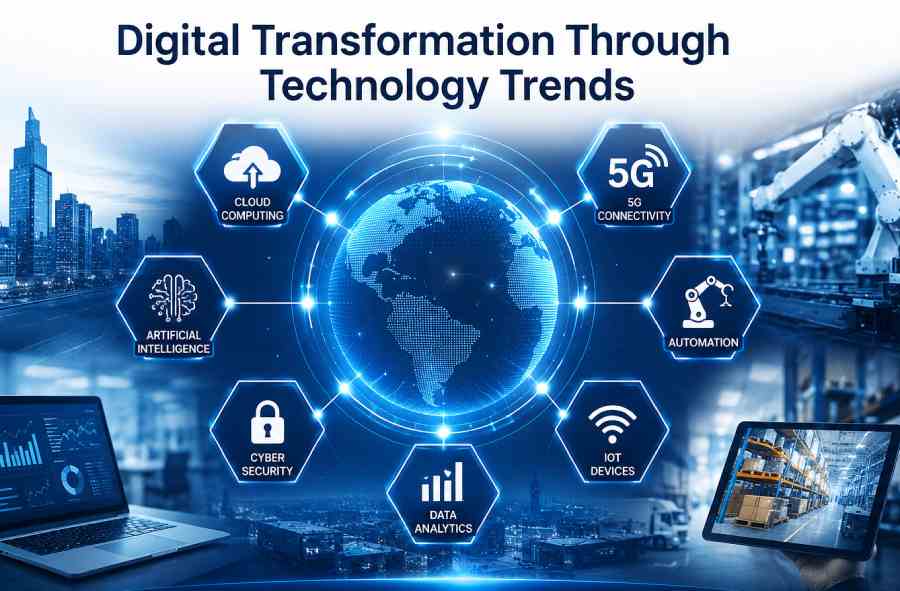 Digital transformation is not only about adopting new software or upgrading systems. It represents a complete change in how businesses use technology, data, and innovation to solve problems and meet customer expectations.
From healthcare and finance to manufacturing, retail, education, and transportation, technology trends are creating smarter, faster, and more efficient industries.
Table of Contents
- What Is Digital Transformation?
- Why Digital Transformation Matters for Businesses
- Artificial Intelligence Driving Business Innovation
- Cloud Computing and Scalable Digital Infrastructure
- Big Data Analytics and Data-Driven Decision Making
- Internet of Things (IoT) Transforming Industries
- Automation and Robotics in Industry 4.0
- Cybersecurity as a Foundation of Digital Transformation
- Blockchain Technology and Secure Digital Systems
- Digital Transformation Across Healthcare, Finance, Retail, and Manufacturing
- 5G Connectivity and Future Digital Ecosystems
- Edge Computing and Real-Time Data Processing
- Generative AI and the Future of Business Operations
- Sustainable Technology and Green Digital Transformation
- Future Digital Transformation Trends
- Frequently Asked Questions
1. What Is Digital Transformation?
Digital transformation is the process of using modern technologies to improve business operations, customer experiences, and organizational strategies.
It involves integrating digital tools into every area of a business, from internal processes and employee collaboration to customer services and product development.
Key Elements of Digital Transformation
- Modern digital infrastructure
- Cloud-based services
- Artificial intelligence solutions
- Data-driven decision making
- Business automation
- Connected digital systems
| Digital Technology | Business Impact |
|---|---|
| Artificial Intelligence | Automates tasks and improves decision-making |
| Cloud Computing | Provides flexible and scalable infrastructure |
| Data Analytics | Creates valuable business insights |
| Automation | Improves efficiency and reduces costs |
Digital transformation allows companies to become more adaptable and respond quickly to changing market conditions.
2. Why Digital Transformation Matters for Businesses
Customer expectations, market competition, and technological advancements are forcing businesses to rethink traditional methods. Companies that fail to adopt digital solutions may struggle to compete in modern markets.
Benefits of Digital Transformation
- Improved operational efficiency
- Better customer experiences
- Faster decision-making
- Reduced operational costs
- Improved collaboration
- New revenue opportunities
| Business Area | Digital Transformation Impact |
|---|---|
| Customer Service | Personalized support through digital platforms |
| Operations | Automation and process optimization |
| Marketing | Data-driven campaigns and personalization |
| Management | Real-time insights and analytics |
Organizations are no longer using technology only as a support tool. Digital solutions have become a central part of business growth strategies.
3. Artificial Intelligence Driving Business Innovation
Artificial Intelligence (AI) is one of the biggest technology trends driving digital transformation. AI enables machines to analyze data, recognize patterns, automate processes, and support intelligent decision-making.
Businesses across industries are using AI to improve productivity, reduce costs, and create better customer experiences.
AI Applications in Digital Transformation
- AI-powered customer service chatbots
- Predictive analytics
- Automated workflows
- Personalized recommendations
- Fraud detection systems
- Intelligent business forecasting
| Industry | AI Transformation Example |
|---|---|
| Healthcare | Medical diagnosis and patient monitoring |
| Finance | Fraud detection and risk analysis |
| Retail | Personalized shopping experiences |
| Manufacturing | Smart automation and predictive maintenance |
As AI technology continues to improve, it will become a core component of digital transformation strategies across almost every industry.
4. Cloud Computing and Scalable Digital Infrastructure
Cloud computing has become the foundation of modern digital transformation. It allows businesses to access computing resources, applications, and storage through internet-based platforms.
Instead of investing heavily in physical infrastructure, organizations can use flexible cloud solutions that scale according to their needs.
Benefits of Cloud Computing
- Lower infrastructure costs
- Faster business innovation
- Remote accessibility
- Improved collaboration
- Better data management
- Scalable technology resources
| Cloud Service | Purpose |
|---|---|
| Infrastructure as a Service (IaaS) | Provides virtual computing resources |
| Platform as a Service (PaaS) | Supports application development |
| Software as a Service (SaaS) | Provides online software solutions |
Cloud technology enables businesses to become more flexible and quickly adopt new digital innovations.
5. Big Data Analytics and Data-Driven Decision Making
Data has become one of the most valuable resources for modern organizations. Big data analytics helps businesses collect, process, and analyze large volumes of information to discover important insights.
Companies use data analytics to understand customers, predict trends, optimize operations, and improve strategic decisions.
Applications of Big Data Analytics
- Customer behavior analysis
- Market trend prediction
- Business performance monitoring
- Supply chain optimization
- Risk management
- Personalized services
| Data Technology | Business Advantage |
|---|---|
| Predictive Analytics | Forecasts future trends |
| Real-Time Analytics | Supports faster decisions |
| Data Visualization | Makes complex information easier to understand |
Organizations that effectively use data analytics can make smarter decisions and gain a competitive advantage in digital markets.
6. Internet of Things (IoT) Transforming Industries
The Internet of Things (IoT) is one of the most powerful technologies driving digital transformation across industries. IoT connects physical devices, machines, sensors, and systems through the internet, allowing them to collect and exchange data in real time.
Businesses are using IoT solutions to monitor operations, improve efficiency, reduce costs, and create smarter products and services.
How IoT Supports Digital Transformation
- Real-time monitoring of business operations
- Smart equipment management
- Predictive maintenance
- Connected customer experiences
- Improved resource management
- Automated decision-making
| Industry | IoT Application | Business Benefit |
|---|---|---|
| Manufacturing | Smart factory sensors | Improved production efficiency |
| Healthcare | Connected medical devices | Remote patient monitoring |
| Agriculture | Smart farming sensors | Better crop management |
| Retail | Connected inventory systems | Improved customer experience |
IoT will continue expanding as more businesses adopt connected systems to create intelligent and automated environments.
7. Automation and Robotics in Industry 4.0
Automation and robotics are transforming manufacturing and industrial operations. Known as Industry 4.0, this new era combines artificial intelligence, robotics, IoT, and data analytics to create smart factories.
Modern businesses are using automated systems to improve production speed, reduce errors, and increase workplace safety.
Role of Robotics in Digital Transformation
- Automated manufacturing processes
- Robotic quality inspection
- Warehouse automation
- AI-powered industrial robots
- Automated supply chain operations
- Predictive equipment maintenance
| Technology | Industrial Impact |
|---|---|
| Industrial Robots | Faster and more accurate production |
| AI Automation | Smarter operational decisions |
| Digital Twins | Virtual testing and optimization |
| Smart Sensors | Real-time machine monitoring |
Industry 4.0 allows companies to build flexible production systems that can quickly adapt to market demands.
8. Cybersecurity as a Foundation of Digital Transformation
As organizations become more digital, cybersecurity has become essential for protecting business systems, customer information, and critical infrastructure.
Digital transformation increases connectivity, but it also creates new security risks. Businesses must implement advanced cybersecurity strategies to protect against cyber threats.
Cybersecurity Technologies Supporting Digital Transformation
- Artificial intelligence threat detection
- Advanced encryption systems
- Multi-factor authentication
- Zero-trust security frameworks
- Cloud security solutions
- Automated monitoring systems
| Security Challenge | Digital Solution |
|---|---|
| Data breaches | Advanced encryption and access control |
| Cyber attacks | AI-powered threat detection |
| Identity theft | Biometric authentication |
| Cloud risks | Cloud security management |
Strong cybersecurity is not only a protective measure but also a requirement for successful digital transformation.
9. Blockchain Technology and Secure Digital Systems
Blockchain technology is expanding beyond cryptocurrencies and becoming an important tool for secure digital transactions, data management, and business transparency.
Blockchain creates decentralized digital records that are difficult to modify, making it useful for industries that require trust, security, and accountability.
Blockchain Applications in Digital Transformation
- Secure financial transactions
- Digital identity management
- Supply chain tracking
- Smart contracts
- Healthcare data security
- Fraud prevention
| Industry | Blockchain Benefit |
|---|---|
| Finance | Secure and transparent transactions |
| Healthcare | Protected patient records |
| Supply Chain | Improved product tracking |
| Government | Secure digital services |
Blockchain technology can help organizations build more secure and transparent digital ecosystems.
10. Digital Transformation Across Healthcare, Finance, Retail, and Manufacturing
Digital transformation is impacting almost every industry. Organizations are adopting advanced technologies to improve customer experiences, increase efficiency, and create innovative services.
Digital Transformation in Healthcare
Healthcare organizations are using artificial intelligence, telemedicine, electronic health records, and connected medical devices to improve patient care.
- AI-powered diagnosis
- Remote healthcare services
- Digital patient records
- Wearable health monitoring
- Personalized treatment plans
Digital Transformation in Finance
Banks and financial institutions are adopting digital technologies to provide faster, safer, and more personalized services.
- Mobile banking platforms
- AI fraud detection
- Digital payment systems
- Automated financial services
- Personalized customer solutions
Digital Transformation in Retail
Retail businesses are using technology to improve shopping experiences and better understand customer behavior.
- AI product recommendations
- Online shopping platforms
- Automated inventory systems
- Customer data analytics
- Virtual shopping experiences
Digital Transformation in Manufacturing
Manufacturing companies are creating smart factories using automation, robotics, IoT, and advanced analytics.
- Smart production systems
- Automated quality control
- Predictive maintenance
- Digital supply chains
- Real-time production monitoring
| Industry | Main Digital Technologies | Transformation Result |
|---|---|---|
| Healthcare | AI, IoT, Telemedicine | Improved patient care |
| Finance | AI, Blockchain, Cloud | Faster financial services |
| Retail | Analytics, AI, Automation | Better customer experiences |
| Manufacturing | Robotics, IoT, Industry 4.0 | Smarter production |
How Technology Trends Work Together in Digital Transformation
| Technology Combination | Future Business Impact |
|---|---|
| AI + Big Data | Smarter predictions and decisions |
| IoT + Cloud Computing | Connected and scalable operations |
| Robotics + AI | Advanced automation |
| Blockchain + Digital Platforms | Secure business transactions |
Companies that successfully combine these technologies can create stronger digital strategies and achieve long-term growth.
11. 5G Connectivity and Future Digital Ecosystems
Advanced connectivity is becoming a critical driver of digital transformation. Technologies such as 5G and future 6G networks are enabling faster communication, lower delays, and reliable connections between billions of devices.
High-speed networks are creating new opportunities for businesses by supporting artificial intelligence applications, smart cities, autonomous systems, cloud services, and real-time digital experiences.
How 5G Supports Digital Transformation
- Faster data transfer speeds
- Low-latency communication
- Support for connected devices
- Improved remote collaboration
- Advanced industrial automation
- Better customer experiences
| Technology | Digital Transformation Impact |
|---|---|
| 5G Networks | Enables faster and more reliable connectivity |
| 6G Networks | Supports future intelligent communication systems |
| Satellite Connectivity | Expands global internet accessibility |
Future digital ecosystems will depend on powerful connectivity that allows businesses, devices, and people to communicate instantly.
12. Edge Computing and Real-Time Data Processing
Edge computing is changing how organizations process information by moving computing power closer to where data is created. Instead of sending all information to centralized cloud servers, edge computing analyzes important data locally.
This technology improves speed, reduces delays, and supports applications that require instant responses, such as autonomous vehicles, healthcare monitoring, and smart manufacturing.
Benefits of Edge Computing
- Faster data processing
- Reduced network delays
- Improved system reliability
- Lower bandwidth requirements
- Enhanced data privacy
- Real-time decision-making
| Industry | Edge Computing Application |
|---|---|
| Healthcare | Real-time patient monitoring |
| Manufacturing | Instant machine analysis |
| Transportation | Autonomous vehicle processing |
| Retail | Smart customer experiences |
As businesses require faster digital services, edge computing will become an important part of future technology infrastructure.
13. Generative AI and the Future of Business Operations
Generative Artificial Intelligence is one of the fastest-growing technologies influencing digital transformation. Unlike traditional AI systems that analyze data, generative AI can create new content, ideas, designs, software code, and business solutions.
Companies are adopting generative AI to improve productivity, automate creative tasks, and enhance customer interactions.
Generative AI Business Applications
- Automated content creation
- AI-powered customer support
- Software development assistance
- Business report generation
- Personalized marketing campaigns
- Product design innovation
| Business Function | Generative AI Impact |
|---|---|
| Marketing | Creates personalized content and campaigns |
| Customer Service | Provides intelligent automated support |
| Development | Assists with coding and testing |
| Management | Improves research and decision-making |
Generative AI will become a major digital transformation tool by helping organizations work faster, innovate more effectively, and create better customer experiences.
14. Sustainable Technology and Green Digital Transformation
Digital transformation is not only about improving business performance. Modern organizations are also focusing on sustainability by using technology to reduce environmental impact and improve resource efficiency.
Green digital transformation combines advanced technologies with sustainable practices to create environmentally responsible business models.
Green Technology Solutions
- Renewable energy systems
- Smart energy management
- Energy-efficient data centers
- Electric transportation
- Carbon monitoring technology
- Sustainable manufacturing systems
| Technology | Sustainability Benefit |
|---|---|
| AI Optimization | Reduces energy waste through smarter decisions |
| IoT Sensors | Improves resource monitoring |
| Cloud Computing | Supports efficient digital infrastructure |
| Smart Energy Systems | Reduces unnecessary energy consumption |
Future businesses will increasingly combine digital innovation with environmental responsibility.
15. Future Digital Transformation Trends
Digital transformation will continue evolving as new technologies become more advanced and accessible. Businesses that embrace innovation will have greater opportunities to improve efficiency, create new services, and compete globally.
Major Future Trends
- Artificial intelligence becoming a standard business tool
- Greater adoption of automation
- Expansion of smart connected ecosystems
- Advanced cybersecurity solutions
- More personalized digital experiences
- Growth of sustainable technology
- Increased human-machine collaboration
| Future Technology Trend | Expected Business Impact |
|---|---|
| Artificial Intelligence | Smarter automation and decision-making |
| Cloud Innovation | Flexible digital infrastructure |
| IoT Expansion | Connected operations |
| Automation | Higher productivity |
| Cybersecurity | Safer digital environments |
Advantages of Digital Transformation
| Advantage | Business Benefit |
|---|---|
| Improved Efficiency | Automated processes reduce time and operational costs. |
| Better Customer Experience | Personalized digital services improve satisfaction. |
| Data-Driven Decisions | Analytics help businesses make smarter choices. |
| Innovation Opportunities | Technology creates new products and services. |
| Competitive Advantage | Digital businesses adapt faster to market changes. |
Challenges of Digital Transformation
| Challenge | Solution |
|---|---|
| High Implementation Costs | Create phased technology adoption strategies. |
| Cybersecurity Risks | Use advanced protection systems. |
| Employee Skill Gaps | Provide digital training programs. |
| Data Management Issues | Develop strong data governance policies. |
| Resistance to Change | Create innovation-focused company cultures. |
Frequently Asked Questions About Digital Transformation
1. What is digital transformation?
Digital transformation is the process of using modern technologies to improve business operations, customer experiences, and organizational strategies.
2. Which technologies are driving digital transformation?
Artificial intelligence, cloud computing, IoT, automation, big data analytics, blockchain, cybersecurity, and advanced connectivity are major digital transformation technologies.
3. Why is digital transformation important for businesses?
It helps businesses improve efficiency, reduce costs, create better customer experiences, and remain competitive in changing markets.
4. How does AI support digital transformation?
AI helps businesses automate tasks, analyze data, predict trends, and improve decision-making.
5. How does cloud computing help companies?
Cloud computing provides flexible infrastructure, scalable resources, and easier access to digital tools.
6. What role does IoT play in digital transformation?
IoT connects devices and systems, allowing businesses to collect real-time data and improve operations.
7. How does automation affect industries?
Automation improves productivity by reducing repetitive work and increasing operational efficiency.
8. Why is cybersecurity important in digital transformation?
Cybersecurity protects digital systems, customer information, and business data from online threats.
9. What is the future of digital transformation?
Future digital transformation will focus on AI, automation, smart ecosystems, sustainability, and advanced connectivity.
10. How can businesses prepare for digital transformation?
Businesses can prepare by adopting new technologies, training employees, improving data management, and developing digital strategies.
Conclusion: Digital Transformation Will Shape the Future of Industries
Technology trends are creating a new era of digital transformation across industries. Artificial intelligence, cloud computing, IoT, automation, cybersecurity, blockchain, and advanced connectivity are changing how organizations operate and deliver value.
Businesses that successfully adopt these technologies can improve efficiency, create better customer experiences, and build stronger competitive advantages.
The future belongs to organizations that combine innovation, technology, and human creativity to solve challenges and create new opportunities.