
Windows 12 remains one of the most heavily searched and discussed topics across the personal computing landscape. PC enthusiasts, enterprise IT managers, and casual users alike want to understand how Microsoft’s next-generation operating system could reshape daily productivity, gaming, system security, and hardware compatibility. From deeply integrated artificial intelligence models to hardware-backed security modules, the rumors surrounding the next major evolution of Windows are vast.
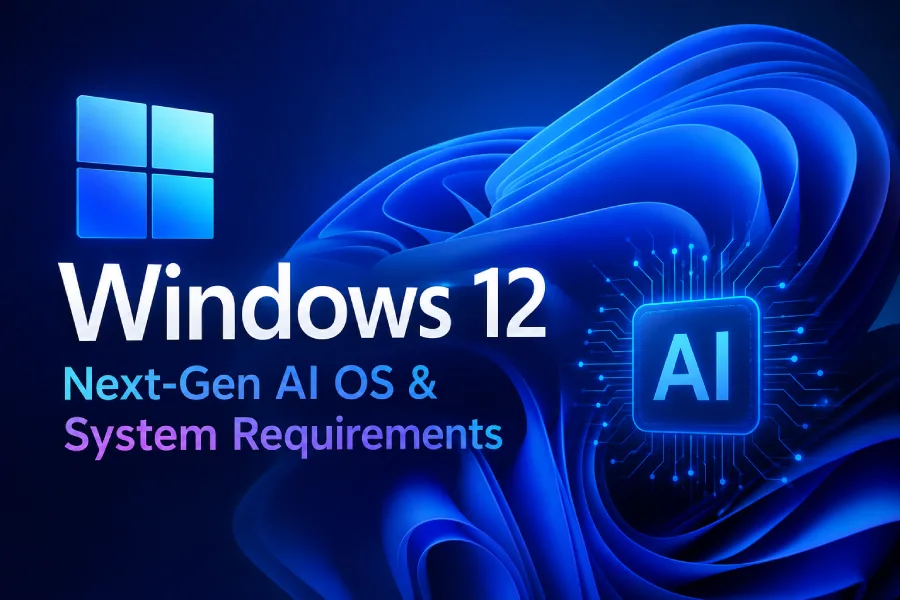 However, navigating the future of personal computing requires a clear boundary between verified technical engineering trends and internet speculation. As of August 2026, Microsoft has not published a finalized, consumer-facing Windows 12 specification sheet, nor have they committed to an explicit release timeline under that specific brand name. This comprehensive technical guide separates verified hardware and software developments from ongoing industry expectations, giving you a clear picture of what the future holds for Windows.
Windows 12 at a Glance
The term “Windows 12” is widely used by the tech community, hardware manufacturers, and software developers to represent the next major architectural evolution of Microsoft’s flagship desktop operating system. While internal codenames and engineering builds leak periodically through insider channels, Microsoft’s public brand marketing continues to focus heavily on rolling feature updates for Windows 11, cloud-connected hybrid environments, and the rollout of Copilot+ PC experiences.
Microsoft’s modern operating system strategy is built on continuous engineering delivery. Rather than holding back all technical breakthroughs for a massive, disruptive OS release every three years, Microsoft frequently delivers system-level features, shell updates, and core security enhancements directly through annual Windows 11 feature updates. Consequently, the transition to the next generation of Windows may feel more like an evolving ecosystem than a sudden, jarring shift.
Windows 12 Quick Facts & Technical Baselines
- Official Product Name: “Windows 12” is an industry placeholder; Microsoft has not officially confirmed the final consumer branding.
- Official Release Timeline: Unannounced by Microsoft; development continues across Insider engineering channels.
- Primary Architectural Shift: Deep operating system integration of local and cloud-based artificial intelligence workloads.
- Silicon Requirements: Increased reliance on modern x86-64 and ARM64 processors with integrated Neural Processing Units (NPUs).
- Security Baseline: Continuation of mandatory hardware-backed security, including TPM 2.0, UEFI, and Secure Boot.
- Current Production Platform: Windows 11 (24H2 / 25H2 builds).
Windows 12 Release Date: When Will It Launch?
As of 2026, Microsoft has not announced a specific, official Windows 12 release date. Consumers, journalists, and system builders should approach any third-party claims of a firm release date with caution. Microsoft’s engineering cadence is dictated by hardware readiness, partner ecosystem alignment, and thorough testing across enterprise environments.
In previous operating system cycles, Microsoft relied on rigid three-year release windows. However, the rapid acceleration of AI hardware—specifically the deployment of Qualcomm Snapdragon X series, Intel Core Ultra, and AMD Ryzen AI processors—has altered how operating systems are updated. Microsoft frequently introduces major platform capabilities directly into active Windows 11 builds, allowing new AI-PC hardware features to reach users immediately without waiting for a new operating system version number.
This modular approach means that many of the core features rumored for Windows 12—such as semantic local search, real-time contextual assistance, and advanced background power management—are already being deployed incrementally. If Microsoft chooses to officially launch “Windows 12,” it will likely coincide with a major shift in silicon architecture and enterprise adoption milestones.
Engineering Reality Check: No official public ISO or commercial installation key exists for Windows 12. Be wary of unauthorized websites promising early access or leaked installers, as these files frequently contain malicious code or compromised system files.
Windows 12 Features: What Could the Next-Generation OS Include?
By analyzing Microsoft’s public patent filings, Insider Preview builds, and ongoing silicon partnerships with chipmakers, we can map out the core features expected to define the next generation of Windows. These enhancements center around artificial intelligence, modern shell design, threat mitigation, and heterogeneous silicon scheduling.
1. Deeply Integrated System-Wide AI
Rather than treating artificial intelligence as a standalone web application or a floating sidebar widget, the next generation of Windows is being designed with AI embedded straight into the kernel, File Explorer, and system compositor. The OS will be capable of understanding multi-app context, allowing users to execute complex, multi-step actions across different software packages using natural language commands.
2. Next-Generation Semantic File Search
Traditional file indexing relies on rigid file names, metadata tags, and specific folder structures. Windows 12 is expected to transition toward semantic vector search powered by local NPUs. Users can search their local storage using natural descriptions—such as “Find the PDF contract I was reading last Tuesday about home renovation”—and the OS will scan file content, images, and document context locally without uploading sensitive data to the cloud.
3. Advanced On-Device Machine Learning Models
To preserve user privacy and reduce network latency, the next major evolution of Windows prioritizes local on-device processing. By utilizing dedicated NPU hardware, features such as live multi-language translation, real-time video background blurring, studio voice filtering, and local text generation run natively on your laptop or desktop without needing an active internet connection.
4. Intelligent System Settings & Automated Troubleshooting
Navigating nested Control Panel menus and Settings pages can be frustrating for non-technical users. The next-generation Windows interface is set to feature an intelligent settings engine. Users can describe their issue naturally—such as “My secondary monitor is blurry and my battery is draining too fast”—and the OS will analyze running background processes, adjust display scaling, tweak refresh rates, and apply optimal power profiles automatically.
5. Context-Aware Copilot Integration
Evolution of the Copilot engine aims to make the assistant context-aware across your active workflow. If you are drafting an email in Outlook while referencing a complex Excel spreadsheet, Copilot will automatically understand the relationship between the two applications, offering to summarize column data or draft contextual responses without needing manual copy-pasting.
6. Modular State-Separated Architecture
A major architectural goal for future Windows versions is state separation. By separating the core operating system files, user data, and third-party applications into distinct, isolated partitions, Windows becomes significantly more resilient against system corruption and malware. State separation allows for near-instant background system updates that require zero downtime or long reboot screens.
7. Advanced Heterogeneous Core Scheduling
Modern CPUs rely on complex hybrid architectures combining Performance cores (P-cores), Efficient cores (E-cores), Low-Power Efficient cores (LPE-cores), integrated GPUs, and NPUs. Next-gen Windows kernel scheduling will use predictive machine learning to route background tasks to the most energy-efficient silicon clusters dynamically, extending laptop battery life significantly.
8. Hardware-Enforced Security Baselines
Building upon the security baseline established by Windows 11, the next major OS release will expand hardware-backed protection. Features like Pluton security processors, Virtualization-Based Security (VBS), Memory Integrity (HVCI), and kernel-level DMA protection will operate by default, creating a resilient defense against zero-day exploits and ransomware attacks.
9. Modernized Desktop Shell & Dynamic Taskbar
Concept designs and Insider builds suggest a modernized, highly customizable desktop shell. Potential changes include a floating, modular taskbar, detached system tray controls at the top of the screen, dynamic desktop widgets that update based on daily routines, and fluid animated transitions optimized for both traditional mouse/keyboard setups and touchscreens.
10. Low-Latency Gaming & DirectStorage Evolution
For PC gamers, the next generation of Windows aims to refine DirectStorage technology, allowing graphics cards to stream game assets directly from high-speed NVMe SSDs without overloading the CPU. Paired with OS-level Auto HDR enhancements, variable refresh rate (VRR) optimizations, and low-latency driver scheduling, Windows will maintain its position as the premier platform for high-performance PC gaming.
Windows 12 as a Next-Generation AI OS
The transition toward an “AI Operating System” marks one of the most fundamental shifts in computing history. For decades, operating systems acted strictly as passive resource managers—allocating memory, handling file storage, and managing hardware drivers so user applications could run. An AI-first operating system takes an active, proactive role in assisting the user.
In a next-generation AI OS, artificial intelligence operates as an underlying system service rather than an isolated application. The operating system learns your daily workflow habits, anticipates resource needs, indexes local files semantically, and provides instant contextual assistance across all desktop software.
Semantic Context
The operating system understands the relationship between your open apps, documents, emails, and active projects, eliminating manual search steps.
Hybrid Execution
Intelligent workload distribution routes light AI tasks to the local NPU for privacy and speed, while heavy generative tasks utilize cloud clusters.
Proactive Automation
The OS identifies repetitive tasks—such as organizing weekly download folders or formatting reports—and offers one-click automated macros.
Adaptive Accessibility
Real-time system-wide live captions, AI screen descriptions for visually impaired users, and voice control make computing seamless for everyone.
Why NPUs Matter for the Future of Windows
To understand why hardware requirements are evolving, it is essential to understand the Neural Processing Unit (NPU). For decades, the Central Processing Unit (CPU) handled sequential calculations, while the Graphics Processing Unit (GPU) specialized in complex parallel math needed for 3D rendering and video decoding. However, running continuous AI models on a CPU or GPU drains laptop batteries rapidly and generates significant heat.
An NPU is a specialized processor built specifically to handle complex matrix math and neural network calculations using minimal power. By offloading continuous AI tasks—such as background eye-contact correction, audio noise suppression, local language modeling, and real-time image generation—to an NPU, your laptop can maintain fast overall performance while sipping battery power.
| Silicon Component | Primary Architectural Role | Power Efficiency for AI |
|---|---|---|
| CPU (Central Processing Unit) | General-purpose system logic, OS execution, app instructions. | Low (High power drain for continuous AI math) |
| GPU (Graphics Processing Unit) | Parallel 3D rendering, video encoding, heavy AI model training. | Moderate (High raw power, high energy consumption) |
| NPU (Neural Processing Unit) | Dedicated local AI inference, vision processing, audio filtering. | Extremely High (Designed for low-power continuous AI) |
As Microsoft expands on-device AI capabilities, having a silicon architecture that includes a capable NPU (typically rated at 40+ TOPS—Trillions of Operations Per Second) is becoming a major benchmark for modern PC hardware.
System Requirements: What Could Your PC Need?
While official Windows 12 requirements have not been released by Microsoft, we can establish a realistic baseline by looking at current Windows 11 (24H2) requirements alongside Copilot+ PC standards. A future major Windows release will certainly maintain strict security requirements while raising recommended memory and processing standards.
| Component | Estimated Minimum Requirement | Recommended Baseline for Optimal AI OS Experience |
|---|---|---|
| Processor | 1 GHz or faster 64-bit dual-core CPU (x86-64 or ARM64) | Modern Multi-core CPU (Intel Core Ultra, AMD Ryzen AI, Snapdragon X) |
| Memory (RAM) | 8 GB RAM minimum | 16 GB to 32 GB LPDDR5X / DDR5 RAM |
| Storage | 64 GB available storage space | 512 GB or larger NVMe PCIe 4.0 SSD |
| System Firmware | UEFI, Secure Boot capable | UEFI, Secure Boot Enabled, Pluton Security Processor |
| TPM Module | TPM Version 2.0 (Discrete or Firmware fTPM/dTPM) | TPM Version 2.0 Enabled by Default |
| Graphics Card | DirectX 12 compatible / WDDM 2.0 driver | DirectX 12 Ultimate / WDDM 3.0+ compatible GPU |
| NPU (Neural Unit) | Not universally mandatory for basic desktop boot | NPU with 40+ TOPS performance for local AI capabilities |
| Display | 720p HD display (9-inch diagonal) | 1080p FHD or 4K display with Variable Refresh Rate (VRR) |
Deep-Dive on Key Hardware Baselines
Memory (RAM): While 8 GB may serve as an absolute bare-minimum boot threshold, running an operating system with integrated local language models alongside web browsers and productivity suites heavily taxes system memory. For a smooth, stutter-free experience, 16 GB of RAM has effectively become the practical standard for modern personal computing.
NVMe SSD Storage: Traditional mechanical hard disk drives (HDDs) are completely unsuitable for modern operating systems. High-speed NVMe Solid State Drives (SSDs) are essential for rapid system boot times, instant app launching, and streaming neural network weights into memory quickly.
TPM 2.0 & Secure Boot: Hardware-backed security is non-negotiable for Microsoft. Trusted Platform Module (TPM 2.0) chips store sensitive cryptographic keys, securing features like BitLocker drive encryption, Windows Hello biometric logins, and Credential Guard.
Windows 12 vs Windows 11: Key Differences
Understanding how a future major Windows release compares to Windows 11 helps put ongoing technical developments into perspective. The table below outlines the core architectural and user-experience differences between the platforms.
| Architectural Area | Windows 11 (Current Platform) | Future Windows Generation (Projected) |
|---|---|---|
| AI Integration | App-based Copilot sidebar, cloud-dependent AI processing. | Kernel-level AI integration, deep local NPU processing. |
| Search Architecture | Keyword-based local search, web-integrated indexing. | Semantic vector local search, contextual document parsing. |
| OS Architecture | Traditional monolithic state installation with modern virtualized layers. | Fully state-separated modular architecture for seamless background updates. |
| Silicon Support | Optimized for traditional x86-64 CPUs and GPUs. | Deep, unified scheduling across CPU, GPU, and dedicated NPU hardware. |
| Interface Shell | Centered taskbar, modernized Settings app, traditional system tray. | Floating taskbar, modular top status bar, context-adaptive widgets. |
| Security Baseline | Mandatory TPM 2.0, Secure Boot, optional VBS/HVCI. | Default Pluton hardware security, state separation, hardware sandboxing. |
PC Compatibility & Future-Proofing Strategy
If you are planning to purchase a new laptop or desktop computer, you don’t need to delay your purchase waiting for an unannounced operating system. By following a smart hardware purchasing strategy, you can ensure that any PC you buy today will remain fast, secure, and fully compatible with future Windows upgrades for years to come.
Hardware Checklist for Long-Term Windows Compatibility
- Processor Selection: Choose a recent-generation processor equipped with integrated AI acceleration (such as Intel Core Ultra Series 2, AMD Ryzen AI 300 Series, or Qualcomm Snapdragon X Elite/Plus).
- Memory Allocation: Opt for a minimum of 16 GB of DDR5 or LPDDR5X RAM. If you perform heavy multitasking, media editing, or software development, target 32 GB.
- Storage Technology: Ensure the system boots from a fast PCIe 4.0 or PCIe 5.0 NVMe SSD with at least 512 GB or 1 TB of storage capacity. Avoid mechanical drives or slow eMMC storage completely.
- Security Hardware: Verify that the motherboard firmware supports TPM 2.0 and Secure Boot natively. On modern laptops, look for integrated Microsoft Pluton security processors.
- Firmware Support: Purchase hardware from major, reputable manufacturers that maintain a strong track record of releasing long-term BIOS and driver updates.
Official Upgrades vs. Unofficial ISO Warnings
As online search interest around “Windows 12 download” continues to climb, bad actors routinely take advantage of user curiosity. Dozens of unauthorized websites, video tutorials, and forum posts claim to offer early access to “leaked Windows 12 ISO files” or “windows 12 activators.”
It is vital to understand that no official consumer ISO image for Windows 12 exists. Installing modified, third-party ISO files from unverified online sources poses severe cybersecurity risks:
- Embedded Ransomware & Trojans: Modified ISO files frequently contain hidden rootkits, keyloggers, and backdoors designed to steal financial passwords and personal data.
- Crypto-Mining Malware: Unauthorized builds often include silent background mining scripts that hijack your CPU and GPU resources, causing severe overheating and hardware degradation.
- Lack of Security Patches: Unofficial operating system builds cannot receive official security updates from Microsoft servers, leaving your PC vulnerable to zero-day exploits.
Security Warning: Always obtain your operating system software directly through official Microsoft channels, such as Windows Update, the official Microsoft Download Center, or authorized Windows Insider Preview rings.
Frequently Asked Questions
1. When will Windows 12 be released?
Microsoft has not announced an official release date for Windows 12. Specific dates circulating online are speculative. Microsoft continues to update and support Windows 11 as its primary desktop platform while testing next-generation features through Insider builds.
2. Is Windows 12 officially available to download right now?
No. There is no official consumer release or public ISO download for Windows 12. Users should avoid downloading alleged “Windows 12 installers” from third-party websites, as these files are unverified and frequently carry malicious software.
3. What are the expected Windows 12 system requirements?
While official specifications have not been published, expect a baseline requiring a modern 64-bit multi-core processor, 8 GB to 16 GB of RAM, 64 GB+ NVMe SSD storage, TPM 2.0, UEFI Secure Boot, and DirectX 12 compatible graphics. Advanced AI features will leverage dedicated NPUs.
4. Will Windows 12 require 16 GB of RAM?
Microsoft has not confirmed a mandatory 16 GB minimum requirement for general OS booting. However, 16 GB of RAM is strongly recommended for running modern operating systems with local AI background features and multi-app workflows comfortably.
5. Will my current Windows 11 PC be able to upgrade to Windows 12?
If your PC was built within the last few years and meets modern Windows 11 standards—including an approved 64-bit processor, TPM 2.0, Secure Boot, and an SSD—it will likely run core functions of the next Windows version. However, localized AI features may require an NPU.
6. Will an NPU (Neural Processing Unit) be mandatory for Windows 12?
It is unlikely that an NPU will be mandatory for basic desktop booting, web browsing, or traditional software execution. However, an NPU with 40+ TOPS performance will be required to run advanced local AI capabilities, such as semantic local search and real-time studio effects.
7. Will Windows 12 be a free upgrade for Windows 11 users?
Microsoft has not officially announced pricing or upgrade terms for a future major Windows release. Historically, Microsoft has provided free upgrades to existing licensed users on supported hardware during major OS transitions, but official terms will only be confirmed upon release.
8. Should I buy an “AI PC” today or wait for Windows 12?
If you need a new computer today, purchasing a modern PC equipped with a current-generation processor (Intel Core Ultra, AMD Ryzen AI, or Snapdragon X), 16 GB+ of RAM, and an NVMe SSD is a smart investment. These systems are well-equipped to handle current features and future OS upgrades.
Final Verdict: Should You Wait for Windows 12?
The technical evolution of Windows is unmistakable: personal computing is moving toward a future defined by artificial intelligence, hardware-enforced security, state-separated architecture, and multi-processor silicon scheduling. Whether Microsoft chooses to brand its next major evolutionary milestone as “Windows 12” or continue updating the Windows 11 platform, the direction of PC hardware and software is clear.
If you currently own a healthy, capable PC running Windows 11 on supported hardware, there is no need to panic or make hasty purchasing decisions based on internet speculation. Keep your current system updated, ensure Secure Boot and TPM 2.0 are enabled, maintain regular file backups, and enjoy your computer.
When you do decide to upgrade your computer, prioritizing a modern processor with integrated NPU support, 16 GB or 32 GB of RAM, high-speed NVMe storage, and robust firmware security will ensure your system remains fast, capable, and ready for whatever the future of Windows brings.
Windows 12 Technical Guide: Revision History
Last Reviewed & Verified: August, 2026
This technical reference guide is regularly updated as Microsoft publishes new official information, Insider builds, hardware guidelines, and developer documentation regarding the future of the Windows operating system.