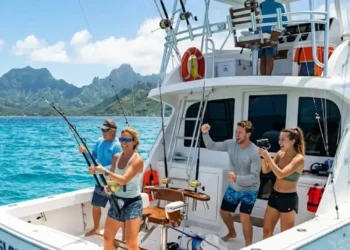

Big game sportfishing is a demanding maritime discipline. It requires specialized ocean-going vessels, heavy 50- to 130-pound class tackle, custom outriggers, live-bait tubes, modern chirp sonar, and professional crews who understand current edges, sea surface temperature (SST) breaks, and seasonal bait movements. From the calm waters of Central America to the continental shelves of Australia, the Atlantic drop-offs of Portugal, and the remote atolls of the Indian Ocean, booking a reputable charter connects you with seasoned local captains.
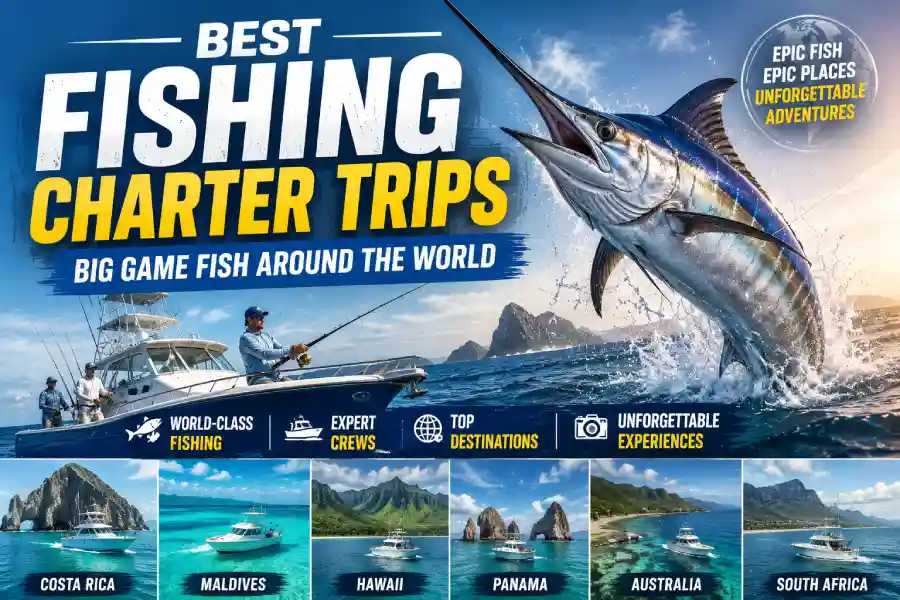 Choosing the right big game charter requires matching your personal bucket-list species with the correct calendar window, vessel class, and regional techniques. Whether you are an experienced angler pursuing a “Grand Slam” or planning your first offshore voyage, this guide breaks down 25 of the world’s best big game fishing charter trips, covering key fishing grounds, target species, optimal seasons, boat specs, and booking strategies.
What Defines Big Game Sportfishing?
Big game fishing refers to offshore angling focused on large, apex pelagic and open-ocean predatory fish species. These fish possess immense power, high swimming speeds, and stamina, requiring specialized heavy-tackle systems, custom trolling spreads, live-bait bridling, and deep-drop techniques.
The premier species pursued on global big game charters include:
- Blue Marlin (Atlantic & Pacific): The premier billfish trophy, known for greyhounding jumps, violent surface strikes, and growing past 1,000 pounds.
- Black Marlin: The heaviest of all billfish, recognized for rigid pectoral fins, exceptional power, and concentrated in the Indo-Pacific.
- Striped Marlin: An acrobatic billfish that lights up with brilliant electric-blue stripes when hunting bait balls.
- Giant Bluefin Tuna: Massive, torpedo-shaped cold-water predators that exceed 800 to 1,000 pounds, requiring multi-hour stand-up or fighting-chair battles.
- Yellowfin & Bigeye Tuna: Fast-swimming warm-water pelagics renowned for deep, circular sounding runs and excellent culinary value.
- Pacific & Atlantic Sailfish: The fastest fish in the ocean, celebrated for expansive dorsal sails and multi-leap aerial displays.
- Broadbill Swordfish: Deep-water predators targeted via daytime deep-dropping (1,500+ feet) or drifting rigged squid at night.
- Wahoo & Dorado (Mahi-Mahi): High-speed surface predators that hit trolled lures at speeds up to 50 mph.
- Giant Trevally (GT): Aggressive coral reef apex predators that smash surface poppers along shallow atoll breaks.
Because big game fish roam open pelagic currents, charter boats travel anywhere from 2 to 50+ miles offshore. A seasoned crew uses omnidirectional sonar, radar bird-scanners, and sea surface temperature charts to locate temperature breaks and current rips where baitfish and predators gather.
How to Select the Right Offshore Charter Operation
A successful big game trip begins with picking the right boat and crew. Keep these key factors in mind before paying a deposit:
1. Target Species & Realistic Seasonal Run Timing
Pelagic fish migrate along oceanic current highways. Arriving in Costa Rica during the peak of the green season or visiting Cape Cod after the bluefin schools have migrated south results in empty waters. Research historical catch logs, moon phases, and temperature data to match your travel dates with peak seasonal activity.
2. Vessel Size, Range & Seaworthiness
Offshore conditions can change quickly. A 31-foot center console is fast and maneuverable for day trips in calm waters, but a 45- to 60-foot twin-diesel custom sportfisher (such as a Viking, Hatteras, or custom cold-molded Carolina boat) offers gyro-stabilization, an enclosed air-conditioned salon, a mezzanine observation deck, and a dedicated fighting chair needed for 500+ pound fish.
3. Captain Credentials & Crew Experience
The captain finds the fish, but the first mate rigs the baits, sets the outriggers, and wires the fish alongside the boat. Look for owner-operated charter boats where the captain has decades of experience on those specific local waters and a proven track record in catch-and-release billfish tournaments.
Top Big Game Charters #1 to #8 (Pacific & Central America)
1. Central Pacific Coast (Quepos & Los Sueños), Costa Rica
Primary Vessel Types: 31-foot Custom Center Consoles to 60-foot Custom Sportfishers (Bertram, Viking, Maverick)
Target Big Game Species: Pacific Sailfish, Blue Marlin, Black Marlin, Yellowfin Tuna, Dorado
Costa Rica’s central Pacific coast—anchored by Marina Pez Vela in Quepos and Los Sueños Marina in Herradura—is universally recognized as one of the world’s most consistent billfish destinations. The offshore waters are protected from heavy ocean swells, providing calm seas that allow charter boats to run 20 to 40 miles to productive drop-offs like the “Pocket” and underwater seamounts.
Crews specialize in dredge trolling and pitch-baiting with circle-hooked ballyhoo, routinely raising 10 to 30+ sailfish per day during peak months, alongside blue marlin and yellowfin tuna feeding around spinner dolphin pods.
- Peak Season: December through April for high-volume sailfish and marlin; May through November for heavy yellowfin tuna and inshore roosterfish.
- Charter Rates: Full-day private offshore charters range from $1,400 to $3,200+ depending on boat class and engine range.
- Technique: Tease-and-switch trolling using multi-arm squid dredges and 30–50 lb stand-up tackle.
2. Cabo San Lucas & East Cape, Baja California, Mexico
Primary Vessel Types: 28-foot Custom Pangas to 55-foot Custom Convertible Sportfishers
Target Big Game Species: Striped Marlin, Blue Marlin, Black Marlin, “Cow” Yellowfin Tuna, Wahoo, Dorado
Positioned at the tip of the Baja Peninsula where the Pacific Ocean collides with the Sea of Cortez, Cabo San Lucas is a legendary sportfishing capital. Steep underwater sea trenches (such as the Golden Gate Bank and Gordo Banks) force nutrient-rich upwellings close to the coastline, creating rich feeding grounds for marlin.
Cabo is famous for year-round striped marlin action, with boats sight-casting live green jacks to fish tailing on the surface. In autumn, tournament fleets arrive for the famous Bisbee’s Black & Blue tournament, hunting for giant blue and black marlin exceeding 500 pounds, alongside yellowfin tuna over 200 pounds.
- Peak Season: Year-round for striped marlin; September through November for giant blue/black marlin and cow yellowfin tuna; winter for wahoo.
- Charter Rates: Half-day pangas start at $300–$450; full-day private offshore sportfishers run $850 to $2,800+.
- Technique: Slow-trolling live bait, high-speed wahoo lure trolling, and surface kite-fishing with flying fish.
3. Kona, Big Island, Hawaii, USA
Primary Vessel Types: 37-foot to 53-foot Custom Hawaiian Sportfishers (Merritt, Bertram, Force)
Target Big Game Species: Pacific Blue Marlin, Ahi (Yellowfin Tuna), Ono (Wahoo), Mahimahi, Shortbill Spearfish
Kona’s unique volcanic geography makes it unlike almost any other big game port. The massive volcanoes of Mauna Kea and Mauna Loa block the prevailing trade winds, creating calm, lake-like ocean conditions along the western coast. More importantly, the ocean floor drops into 6,000-foot deep trenches less than two miles from Honokohau Harbor.
Kona is world-renowned for “Grander” Pacific blue marlin (over 1,000 lbs), with several world records set in these waters. Charters pull large resin-headed skirted trolling lures at 8 to 10 knots along depth contours and ocean buoys (FADs).
- Peak Season: April through September for giant blue marlin; May to August for large Ahi yellowfin tuna; winter for shortbill spearfish.
- Charter Rates: Full-day private offshore charters average $1,100 to $1,800+.
- Technique: High-speed heavy lure trolling (130-lb class tackle) and live-baiting skipjack tuna (aku) over deep pinnacles.
4. Gulf of Chiriquí & Hannibal Bank, Panama
Primary Vessel Types: 31-foot to 40-foot Twin-Diesel Express Sportfishers & Center Consoles
Target Big Game Species: Black Marlin, Blue Marlin, Yellowfin Tuna, Pacific Sailfish, Cubera Snapper, Roosterfish
The remote waters of Panama’s Gulf of Chiriquí—anchored by the famous Hannibal Bank and Isla Montuosa—host an active offshore ecosystem. Deep ocean currents slam into an underwater plateau that rises from thousands of feet to within 200 feet of the surface, creating a feeding frenzy of baitfish, yellowfin tuna, and giant black marlin.
Panama charter lodges operate private center consoles and express sportfishers, combining live-bait bridle trolling with bonito for marlin alongside topwater popper casting for 100+ pound yellowfin tuna boiling on the surface.
- Peak Season: December through April for dry weather, marlin, and sailfish; May through July for peak yellowfin tuna “tuna frenzy” action.
- Charter Rates: All-inclusive multi-day fishing lodge packages range from $3,500 to $6,500+ per angler per week.
- Technique: Slow-trolling live bonito on circle hooks and throwing heavy wooden poppers on heavy spinning tackle.
5. Iztapa & Puerto San José, Guatemala
Primary Vessel Types: 31-foot Bertram Flybridges to 45-foot Custom Game Boats
Target Big Game Species: Pacific Sailfish, Blue Marlin, Dorado, Yellowfin Tuna
Guatemala’s Pacific coast holds the undisputed title of the “Sailfish Capital of the World.” An offshore current pocket creates a massive, nutrient-dense eddy 15 to 30 miles off the coast of Iztapa, concentrating thousands of Pacific sailfish throughout the winter and spring.
Guatemala’s charter fleet has pioneered billfish fly fishing and light-tackle conventional fishing. Charter vessels routinely record 15 to 40+ sailfish bites per day, with skilled crews using circle-hooked ballyhoo and fly-fishing teasers.
- Peak Season: October through June (peak billfish density runs November to May with calm seas).
- Charter Rates: Full-day private charters range from $1,500 to $2,600+ per day, often booked through all-inclusive fishing lodges.
- Technique: Tease-and-switch dead-bait trolling and dedicated 14-weight saltwater fly casting.
6. Golfito & Osa Peninsula, Southern Costa Rica
Primary Vessel Types: 33-foot to 48-foot Sportfishing Yachts & Fast Center Consoles
Target Big Game Species: Blue Marlin, Black Marlin, Sailfish, Yellowfin Tuna, Roosterfish
Located near the Panamanian border, the Osa Peninsula and Golfito provide access to remote Pacific fishing grounds. Protected by the calm Golfo Dulce, charter boats run offshore to target deep seamounts and the continental shelf, where marlin, sailfish, and yellowfin tuna feed heavily.
Inshore charters target Matapalo Rock at the mouth of the gulf, using live bait to catch roosterfish, big cubera snapper, and amberjack against the backdrop of Corcovado National Park.
- Peak Season: November through April for billfish; May through October for inshore species and yellowfin tuna.
- Charter Rates: Private day charters range from $1,200 to $2,400+; remote lodge packages average $4,000–$7,000/week.
- Technique: Live-bait bridling, lure trolling, and inshore rock casting.
7. Piñas Bay, Panama (Tropic Star Lodge)
Primary Vessel Types: Classic 31-foot Custom Bertram Sportfishers
Target Big Game Species: Black Marlin, Blue Marlin, Pacific Sailfish, Bigeye Tuna, Dorado, Roosterfish
Accessible only by chartered boat or bush plane, Piñas Bay in the Darién Gap is home to the historic Tropic Star Lodge. Located just 20 minutes from the famous Zane Grey Reef, the ocean floor rises abruptly from the deep Pacific abyss to within 150 feet of the surface.
More than 300 IGFA world records have been set in these waters. The legendary fleet of wooden 31-foot Bertrams specializes in slow-trolling live rainbow runners and bonito for black marlin, blue marlin, and sailfish.
- Peak Season: December through March for black and blue marlin; April through August for sailfish, tuna, and roosterfish.
- Charter Rates: All-inclusive private lodge packages range from $6,000 to $10,000+ per angler per week.
- Technique: Slow-trolling live bait on circle hooks over shallow seamounts.
8. Puerto Vallarta & Punta Mita (Corbetena & El Banco), Mexico
Primary Vessel Types: 32-foot to 45-foot Express Cruisers & Center Consoles
Target Big Game Species: Giant Yellowfin Tuna (“Cows”), Black Marlin, Blue Marlin, Sailfish, Dorado
While Banderas Bay offers family-friendly fishing, serious big game charter boats run 35 to 50 miles offshore to the famous deep-water rocks of El Banco and La Corbetena. These isolated volcanic rock pillars in the Pacific Ocean attract baitfish and giant “cow” yellowfin tuna exceeding 200 to 350 pounds.
Charters run multi-day or extended 12- to 14-hour trips, drifting live goggle-eyes and skipjack tuna with balloon rigs and kite systems to target trophy tuna and black marlin.
- Peak Season: July through December (September to November offers peak giant yellowfin tuna and black marlin).
- Charter Rates: Extended offshore day charters run $1,400 to $2,800+; 2.5-day liveaboard offshore trips range from $4,000 to $7,500+.
- Technique: Live-bait drifting with balloon rigs, kite fishing, and downrigger trolling.
Top Big Game Charters #9 to #17 (Atlantic & North America)
9. Venice & Mississippi River Delta, Louisiana, USA
Primary Vessel Types: 36-foot to 42-foot High-Speed Quad-Engine Offshore Catamarans (Freeman, Invincible)
Target Big Game Species: Yellowfin Tuna, Blue Marlin, Swordfish, Wahoo, Mahi-Mahi
Nicknamed the “End of the World,” Venice, Louisiana, sits at the mouth of the Mississippi River. The nutrient-rich river outflow meets the deep blue waters of the Gulf of Mexico, creating a productive marine food chain. Fast offshore catamarans run 30 to 60 miles out to deep-water oil platforms, drillships, and the Mississippi Canyon drop-off.
Venice is famous for high-speed chunking around deep oil rigs for yellowfin tuna (often 100–200 lbs), high-speed wahoo trolling along temperature rips, and daytime deep-dropping (1,500 feet) for broadbill swordfish.
- Peak Season: October through March for large winter yellowfin tuna; May through September for blue marlin and swordfish.
- Charter Rates: Full-day offshore catamaran charters average $2,200 to $3,200+ per boat (plus actual fuel burned).
- Technique: Chunking cut pogies/herring around deep oil rigs, live-baiting hardtails, and daytime swordfish deep-dropping.
10. Outer Banks (Oregon Inlet & Hatteras), North Carolina, USA
Primary Vessel Types: 45-foot to 65-foot Custom Carolina-Built Sportfishers
Target Big Game Species: Giant Bluefin Tuna, Yellowfin Tuna, White Marlin, Blue Marlin, Wahoo, Mahi-Mahi
The Outer Banks (OBX) of North Carolina sit close to the convergence of the warm southern Gulf Stream and the cold northern Labrador Current. Departing through Oregon Inlet or Hatteras Inlet, custom Carolina sportfishing yachts navigate the continental shelf edge to target pelagic predators.
In winter (January to March), giant Atlantic bluefin tuna (often 500–900+ lbs) feed heavily within sight of the beach. In summer, the fleet switches to trolling ballyhoo on light tackle for white marlin, blue marlin, yellowfin tuna, and wahoo.
- Peak Season: January through March for giant bluefin tuna; May through September for yellowfin tuna, blue marlin, and white marlin.
- Charter Rates: Full-day offshore private charters range from $1,800 to $3,000+ per day.
- Technique: Spreader bar and naked ballyhoo trolling, green-stick tuna trolling, and heavy-tackle live baiting.
11. Funchal & Calheta, Madeira, Portugal
Primary Vessel Types: 37-foot to 43-foot Bertram & Cabo Express Sportfishers
Target Big Game Species: Atlantic Blue Marlin, Bigeye Tuna, Bluefin Tuna, Albacore, Wahoo
The volcanic Portuguese island of Madeira in the eastern Atlantic is an elite destination for monster Atlantic blue marlin. Rising steeply from the ocean floor, deep 3,000-foot waters sit within 500 meters of the coastline, eliminating long transit times.
Madeira is famous for the average size of its marlin, with fish averaging over 600 pounds and “Granders” (1,000+ lbs) hooked every summer. The international charter fleet pulls large artificial lures along coastal drop-offs and current lines.
- Peak Season: May through September (June and July are prime for monster blue marlin; spring brings bigeye tuna).
- Charter Rates: Full-day private offshore charters average 1,200€ to 1,800€ ($1,300–$2,000 USD).
- Technique: Heavy-tackle (130-lb class) artificial lure trolling with customized teaser patterns.
12. Cape Cod (Chatham & Stellwagen Bank), Massachusetts, USA
Primary Vessel Types: 31-foot to 42-foot Downeast Lobster-Style Cruisers & Center Consoles
Target Big Game Species: Giant Atlantic Bluefin Tuna, Mako Shark, Thresher Shark
The nutrient-rich waters of Stellwagen Bank, Cape Cod Bay, and the “Regal Sword” grounds off Chatham, Massachusetts, host giant Atlantic bluefin tuna during the summer and fall. These fish feed on mackerel, sand eels, and menhaden to build fat reserves before winter.
Charter captains use customized Downeast vessels, drift live mackerel with balloon rigs, anchor on structure with chum slicks, or cast topwater hollow-body lures to tuna crashing bait balls on the surface.
- Peak Season: June through November (September and October are prime for giant commercial-grade bluefins over 500 lbs).
- Charter Rates: Full-day private bluefin tuna charters range from $1,600 to $2,500+ per boat.
- Technique: Live-bait drifting on balloon rigs, chumming, and heavy spin-casting with stickbaits.
13. Northumberland Strait & Canso, Nova Scotia, Canada
Primary Vessel Types: 45-foot Custom Canadian Fiberglass Downeast Vessels
Target Big Game Species: Giant Atlantic Bluefin Tuna (Catch-and-Release)
The waters off Nova Scotia—specifically Ballantyne’s Cove, the Canso Causeway, and the Gulf of St. Lawrence—host the largest bluefin tuna on the planet. Attracted by massive schools of herring and mackerel, giant bluefins migrate into these shallow, cold northern waters.
Regulated strictly under catch-and-release scientific tagging permits, charters hook fish averaging 700 to 1,000+ pounds in water often less than 100 feet deep. Fights take place on heavy 130-lb class bent-butt rods mounted in swivel rod holders, with battles testing an angler’s endurance.
- Peak Season: August through October (peak feeding aggregation occurs September to mid-October).
- Charter Rates: Full-day private charter rates average $1,800 to $2,500 CAD per boat per day.
- Technique: Kite fishing and drift-lining with live whole mackerel and herring.
14. Prince Edward Island (North Lake), Canada
Primary Vessel Types: 45-foot Custom Canadian Commercial Trawlers
Target Big Game Species: Giant Bluefin Tuna (Catch-and-Release)
North Lake, Prince Edward Island, proudly calls itself the “Tuna Capital of the World.” Operating under strict federal marine regulations, local commercial tuna captains take private sport anglers onto the shallow waters of the Northumberland Strait.
Captains establish chum slicks behind the boat, drawing bluefins right up to the swim platform where anglers can see 800- to 1,200-pound fish feeding on herring chunks before dropping a hooked bait.
- Peak Season: Mid-July through late October.
- Charter Rates: Full-day charter packages average $1,700 to $2,400 CAD per day.
- Technique: Sight-feeding and chumming with live mackerel, hooked on heavy 130-lb braided tackle.
15. Stuart & Jupiter Inlet, Florida, USA
Primary Vessel Types: 34-foot to 50-foot Custom Sportfishers & Center Consoles
Target Big Game Species: Atlantic Sailfish, Blackfin Tuna, Wahoo, Mahi-Mahi
Stuart, Florida, is historically recognized as the “Sailfish Capital of the World.” In the winter, cold fronts push schools of bait south, and Atlantic sailfish travel along the narrow continental shelf edge right off Stuart and Jupiter Inlet.
The local fleet specializes in live-bait kite fishing. Helium-filled kites suspend live goggle-eyes and threadfin herring on the surface, creating splashing commotion that triggers aggressive sailfish attacks.
- Peak Season: December through March (winter cold fronts create tailing sailfish conditions).
- Charter Rates: Half-day charters run $700–$900; full-day private offshore charters average $1,400–$2,200+.
- Technique: Live-bait kite fishing with 20–30 lb light tackle and non-offset circle hooks.
16. San Salvador & Chub Cay, Bahamas
Primary Vessel Types: 40-foot to 65-foot Luxury Convertible Sportfishing Yachts
Target Big Game Species: Blue Marlin, White Marlin, Wahoo, Yellowfin Tuna, Mahi-Mahi
The Bahamas archipelago sits on deep ocean trenches like the “Tongue of the Ocean.” Remote out-islands like San Salvador, Cat Island, and Chub Cay in the Berry Islands provide immediate access to deep-water drop-offs where blue marlin and wahoo hunt along vertical coral walls.
In winter, San Salvador is famous for high-speed trolling for wahoo (often 50–90+ lbs), while spring brings blue marlin and yellowfin tuna.
- Peak Season: November to March for high-speed wahoo; April to July for blue marlin and tuna.
- Charter Rates: Full-day private offshore charters run $2,000 to $3,500+ per day.
- Technique: High-speed wire-line trolling (14–18 knots) with heavy bullet lures for wahoo.
17. Bermuda (Challenger & Plantagenet Banks)
Primary Vessel Types: 40-foot to 55-foot Custom Express & Flybridge Sportfishers
Target Big Game Species: Atlantic Blue Marlin, Yellowfin Tuna, Wahoo
Bermuda is an isolated volcanic peak in the Atlantic Ocean surrounded by two offshore underwater structures: the Challenger Bank and Argus (Plantagenet) Bank. These offshore seamounts force deep currents upward, creating an ideal habitat for baitfish, yellowfin tuna, and giant blue marlin.
Bermuda hosts the annual Triple Crown Billfish Championship in July, with boats regularly boating or releasing blue marlins over 800 to 1,000 pounds.
- Peak Season: June through August for giant blue marlin; May and September for yellowfin tuna and wahoo.
- Charter Rates: Full-day private offshore charters range from $1,800 to $3,000+ USD per day.
- Technique: Trolling live small skipjack tuna and large skirted lures over offshore banks.
Top Big Game Charters #18 to #25 (Oceania, Africa & Indian Ocean)
18. Bay of Islands & Three Kings Islands, New Zealand
Primary Vessel Types: 40-foot to 55-foot Custom New Zealand Game Boats
Target Big Game Species: Striped Marlin, Yellowtail Kingfish, Blue Marlin, Broadbill Swordfish
The northern coast of New Zealand—including the Bay of Islands, Tutukaka, and the remote Three Kings Islands—is famous for trophy big game fishing. The rich waters of the East Auckland Current bring schools of giant striped marlin, with fish averaging 200 to 300+ pounds (significantly larger than striped marlin found anywhere else in the world).
New Zealand charters also target giant yellowtail kingfish (often 40–80 lbs) over shallow rocky pinnacles and execute nighttime drifts for broadbill swordfish.
- Peak Season: January through May (February and March are prime for striped marlin).
- Charter Rates: Day charters run NZ$1,800–NZ$2,800 ($1,100–$1,750 USD); multi-day Three Kings liveaboard expeditions average NZ$12,000–NZ$20,000.
- Technique: Live-bait trolling with kahawai, skipjack trolling, and daytime deep-drop swordfishing.
19. Exmouth & Ningaloo Reef, Western Australia
Primary Vessel Types: 35-foot to 45-foot Custom Game Boats & High-Speed Center Consoles
Target Big Game Species: Blue Marlin, Black Marlin, Sailfish, Giant Trevally, Spanish Mackerel, Ruby Snapper
Exmouth, situated on the remote Northwest Cape of Western Australia, provides immediate access to the Ningaloo Reef continental shelf. The underwater canyon drop-off sits just a short run from the harbor, allowing charter boats to raise billfish within 20 minutes of leaving the boat ramp.
The fishery is famous for the “Billfish Grand Slam”—catching a blue marlin, black marlin, and sailfish in a single day. Inshore reef areas provide sight-popping for giant trevally and deep jigging for ruby snapper.
- Peak Season: October through April for blue and black marlin; year-round for sailfish, GTs, and Spanish mackerel.
- Charter Rates: Full-day private offshore charters run AU$2,200 to AU$3,400 ($1,450–$2,250 USD) per day.
- Technique: Surface lure trolling, switch-baiting, and heavy topwater popping.
20. Watamu & Malindi, Kenya
Primary Vessel Types: 33-foot to 42-foot Classic Sportfishing Cruisers
Target Big Game Species: Sailfish, Black Marlin, Blue Marlin, Striped Marlin, Broadbill Swordfish, Yellowfin Tuna
Kenya’s Indian Ocean coastline, particularly around the Watamu Marine National Park and the “Rips” offshore drop-off, is Africa’s premier big game fishing destination. The North Kenya Bank forces deep Indian Ocean currents to the surface, creating a rich corridor for billfish.
Kenya is one of the few places on Earth where anglers can target a “Fantasy Slam” (five distinct billfish species in a single trip): sailfish, black marlin, blue marlin, striped marlin, and broadbill swordfish.
- Peak Season: October through March (November to February offers peak sailfish numbers; January to March brings marlin).
- Charter Rates: Full-day private offshore charters average $900 to $1,600 USD per boat.
- Technique: Live-bait drifting with frigate mackerel and dredge trolling.
21. Black River & Le Morne, Mauritius
Primary Vessel Types: 40-foot to 50-foot Custom Sportfishing Boats
Target Big Game Species: Blue Marlin, Black Marlin, Yellowfin Tuna, Wahoo, Dorado
Located in the southwest of Mauritius, Black River is a celebrated big game port in the Indian Ocean. An underwater drop-off plunges to 2,000 meters just off the island’s coral reef, allowing charter vessels to begin trolling for blue and black marlin minutes after clearing the pass.
Mauritius holds multiple world records for blue marlin, with fish exceeding 1,000 pounds landed in these waters during the summer months.
- Peak Season: November through April (peak summer blue marlin season).
- Charter Rates: Full-day private offshore charters average 700€ to 1,200€ ($750–$1,300 USD).
- Technique: Heavy-tackle artificial lure trolling (130-lb class) along the reef ledge.
22. Muscat & Hasik (Hallaniyat Islands), Oman
Primary Vessel Types: 31-foot to 38-foot Center Consoles & Liveaboard Catamarans
Target Big Game Species: Giant Trevally (GT), Yellowfin Tuna, Sailfish, Dorado, Queenfish
The rugged Arabian Sea coastline of Oman—including the capital Muscat and the remote southern Hallaniyat Islands—offers a wild big game popping and jigging fishery. The upwelling currents along southern Oman support some of the heaviest giant trevally (GT) in the world, with fish routinely exceeding 100 to 130 pounds.
Anglers cast heavy surface poppers and stickbaits against rocky headlands for GTs and head offshore to cast lures to large yellowfin tuna feeding under bird flocks.
- Peak Season: September through November and February through May (avoiding the rough summer Khareef monsoon).
- Charter Rates: Full-day private sportfishing day charters average $900 to $1,500 USD per boat.
- Technique: Heavy-tackle surface popping (PE 8–10 lines) and vertical jigging.
23. Tahiti & Bora Bora, French Polynesia
Primary Vessel Types: 31-foot to 40-foot Express Sportfishers & Catamarans
Target Big Game Species: Pacific Blue Marlin, Yellowfin Tuna, Mahi-Mahi, Wahoo
French Polynesia provides big game fishing across the deep, clear waters of the South Pacific. Because the volcanic islands rise directly from the ocean floor with minimal continental shelf, charter boats troll for blue marlin and yellowfin tuna within sight of the emerald island peaks.
Captains target ocean current lines, offshore FADs, and barrier reef passes, using local skirted lures and fresh flying fish baits.
- Peak Season: November through April for blue marlin; year-round for yellowfin tuna and mahi-mahi.
- Charter Rates: Full-day private offshore charters range from $1,200 to $2,200+ USD.
- Technique: Surface lure trolling and live-baiting along barrier reef passes.
24. Mindelo, São Vicente, Cape Verde
Primary Vessel Types: 33-foot to 42-foot Bertram & Cabo Sportfishers
Target Big Game Species: Atlantic Blue Marlin, Sailfish, Yellowfin Tuna, Wahoo
Located 350 miles off the coast of West Africa, the windswept islands of Cape Verde are world-famous for high-density Atlantic blue marlin fishing. The ocean channels between the islands of São Vicente, Santo Antão, and San Nicolau create deep upwellings where blue marlin feed aggressively.
Cape Verde charter boats regularly record multiple blue marlin releases per day during the spring run, with fish averaging 400 to 700 pounds.
- Peak Season: Late March through July (peak blue marlin season).
- Charter Rates: Full-day private offshore charters average 1,300€ to 1,800€ ($1,400–$2,000 USD) per day.
- Technique: Pitch-baiting and heavy artificial lure trolling.
25. Isla Mujeres & Cozumel, Mexico
Primary Vessel Types: 31-foot to 45-foot Custom Express Sportfishers
Target Big Game Species: Atlantic Sailfish, White Marlin, Blue Marlin, Mahi-Mahi, Wahoo
Closing out our top 25, the waters off Isla Mujeres and Cancun in the Mexican Caribbean host winter aggregations of Atlantic sailfish. Cold currents push massive schools of sardines into the region, forming tight “bait balls” that attract dozens of hunting sailfish.
Charter captains locate frigate birds diving on surface bait balls, positioning anglers to cast live sardines, light tackle, or saltwater flies to sailfish flashing their sails right beside the boat.
- Peak Season: January through April (peak winter sailfish bait-ball feeding).
- Charter Rates: Full-day private charters average $950 to $1,600+ USD.
- Technique: Live-bait casting to surface bait balls and light-tackle trolling.
Master Species Breakdown & Peak Calendar Windows
Use the matrix below to match your dream big game trophy species with the premier global charter destinations and their peak fishing calendar windows:
| Target Big Game Species | Top 3 World Charter Destinations | Peak Seasonal Calendar Window | Primary Charter Tactic |
|---|---|---|---|
| Blue Marlin | Kona (Hawaii), Madeira (Portugal), Costa Rica | May – September (Hawaii/Madeira); Dec – Apr (Costa Rica) | Heavy Lure Trolling / Live-Bait Bridling |
| Black Marlin | Cairns (Australia), Hannibal Bank (Panama), Mauritius | Sept – Dec (Cairns); Jan – Apr (Panama/Mauritius) | 130-lb Tackle Whole Bait / Live Bonito |
| Striped Marlin | Cabo San Lucas (Mexico), Bay of Islands (NZ), Galápagos | Year-Round (Cabo); Jan – Apr (NZ); Dec – Jun (Galápagos) | Live-Bait Sight-Casting / Teaser Pitching |
| Pacific Sailfish | Iztapa (Guatemala), Quepos (Costa Rica), Gulf of Chiriquí (Panama) | Nov – May (Guatemala); Dec – Apr (Costa Rica/Panama) | Dredge Teaser Trolling / Circle-Hook Ballyhoo |
| Giant Bluefin Tuna | North Lake (PEI, Canada), Nova Scotia, Cape Cod (USA) | August – October (Canada); June – November (Cape Cod) | Live Mackerel Balloon Drifting / Chumming |
| Yellowfin Tuna | Venice (Louisiana, USA), Puerto Vallarta (Mexico), Panama | Oct – March (Venice); Sept – Nov (PV); May – July (Panama) | Oil Rig Chunking / Topwater Popper Casting |
| Broadbill Swordfish | Venice (Louisiana, USA), Florida Keys, New Zealand | Year-Round (Deep-Drop); Winter (Night Drifting) | Daytime Deep-Dropping (1,500 ft with Lead) |
| Giant Trevally (GT) | Cosmoledo (Seychelles), Hallaniyat (Oman), Great Barrier Reef | Oct – April (Seychelles); Feb – May (Oman); Year-Round (Aust.) | Heavy Surface Popping & Stickbaiting |
| Wahoo | San Salvador (Bahamas), Outer Banks (USA), Cabo San Lucas | Nov – March (Bahamas); May – Sept (OBX); Autumn (Cabo) | High-Speed Wire Trolling (14–18 knots) |
Charter Costs, Fuel Policies & Dock Inclusions
Offshore big game fishing is an equipment-intensive pursuit. Operating heavy twin-diesel sportfishing yachts requires significant fuel burn, dockage fees, premium terminal tackle, specialized bait sourcing, and certified crew compensation. Understanding how charters structure their pricing protects you from hidden fees:
1. Fuel Policies & Surcharges
In many destinations (like Costa Rica, Guatemala, and Mexico), charters quote a flat all-inclusive rate covering fuel for standard runs (e.g., up to 35 miles). However, in regions like the northern Gulf of Mexico (Venice, LA) or the US East Coast, charter boats often charge a base boat fee plus the actual cost of marine diesel burned during the trip. Running 50 miles offshore at 30 knots can consume 150 to 250 gallons of diesel, adding $600 to $1,000+ to the final bill. Always confirm the fuel policy in writing before confirming.
2. Live Bait Fees
While frozen rigged ballyhoo and squid are standard inclusions, specialized live bait (like live goggle-eyes in South Florida, live green jacks in Cabo, or live blue runners in Panama) is often purchased cash-in-hand from independent commercial bait skiffs at the harbor mouth ($40–$80 cash per dozen).
3. Crew Tipping Protocol
The first mate works long hours before and after your trip: thawing baits, tying custom wind-on leaders, rigging dredges, handling heavy gear on the deck, and cleaning the boat. The standard industry tipping benchmark for charter crews is 15% to 20% of the total charter price, presented in cash directly to the crew upon returning to the dock.
Offshore Tackle & Tactical Techniques Explained
Big game sportfishing relies on specialized marine angling techniques:
1. Tease-and-Switch Trolling
The boat trolls hookless artificial lures and multi-tier dredge teasers (mimicking a school of baitfish) behind the stern. When a billfish rises behind a teaser, the mate reels the teaser away from the fish while the angler pitches a rigged bait on a circle hook directly in front of the fish, triggering an immediate strike.
2. Live-Bait Kite Fishing
A specialized helium balloon or square spar kite is flown 100 feet above the boat. Fishing lines are attached to the kite line using release clips. This keeps live baits (like goggle-eyes or flying fish) thrashing on the water’s surface with zero fishing line visible in the water, making it deadly for wary sailfish and tuna.
3. Daytime Deep-Dropping for Swordfish
Broadbill swordfish spend daylight hours in the deep ocean abyss (1,200 to 1,800 feet). Anglers attach a 5- to 10-pound concrete or lead weight to a heavy braided line with a rigged squid and deep-water strobe lights, dropping the bait down into the dark bottom layer where swordfish feed.
Essential Offshore Charter Packing Checklist
Proper preparation ensures comfort during a full 8-to-10 hour day offshore:
- Footwear: Non-marking, light-colored deck boots or grip sandals (black-soled running shoes leave scuffs on fiberglass decks).
- Eyewear: High-performance polarized sunglasses (amber, copper, or green-mirror lenses are essential for seeing marlin tracking teasers behind the boat).
- Sun Protection: UPF 50+ long-sleeve sun hoodies, quick-dry shorts, wide-brim hats, and reef-safe lotion sunscreen (avoid aerosol spray sunscreens, which make boat decks dangerously slick and stain vinyl cushions).
- Seasickness Defense: Even seasoned travelers can get motion sickness in offshore swells. Take preventive medication (meclizine, dimenhydrinate, or scopolamine patches) the night before and one hour prior to departure.
- Dry Bag: A 15–20L roll-top waterproof bag to protect cameras, phones, passports, and extra layers from ocean spray.
Billfish Conservation, Circle Hooks & Catch-and-Release
The long-term survival of the world’s premier big game fisheries depends on conservation ethics:
- Mandatory Non-Offset Circle Hooks: When bait-fishing for billfish, non-offset circle hooks slide cleanly to the corner of the fish’s jaw as it turns, preventing deep gut-hooking and ensuring healthy releases.
- Keep Billfish in the Water: Large marlin and sailfish should remain submerged alongside the vessel during unhooking and photography. Dragging a 400-pound marlin over the gunwale onto a hot deck damages its protective slime coat and crushes internal organs, drastically reducing its post-release survival.
- Proper Reviving Protocol: Before release, the boat moves forward at idle speed while the crew holds the billfish upright by its bill, forcing oxygen-rich water over its gills until it swims away under its own power.
Frequently Asked Questions
What is the single best big game fishing charter destination in the world?
The ideal destination depends on your target species. For high-volume Pacific sailfish and blue marlin, Costa Rica and Guatemala lead the world; for 1,000-pound “Grander” black marlin, Cairns, Australia is unmatched; for giant bluefin tuna, Nova Scotia and Cape Cod are premier choices.
What makes big game fishing charters different from standard fishing trips?
Big game fishing targets large, powerful apex pelagic predators (marlin, tuna, swordfish, sailfish) in deep offshore waters. Charters require large, seaworthy sportfishing vessels equipped with outriggers, fighting chairs, heavy-tackle reels (50–130 lb class), sonar electronics, and specialized bait spreads.
How much does a private big game fishing charter cost?
A full-day offshore private sportfishing charter typically ranges from $1,200 to $3,500+ per day depending on boat size, fuel consumption, distance to the continental shelf, and regional operational costs.
Is catch-and-release mandatory for billfish on big game charters?
Yes, in most premier global fisheries (including Costa Rica, Guatemala, Panama, and Australia), strict catch-and-release regulations and non-offset circle hooks are mandatory for all billfish (sailfish, marlin) to ensure marine conservation.
How far offshore do big game charter boats travel?
Distance varies by local underwater topography. In places like Kona, Hawaii, deep trenches sit within 2 miles of the coast. In destinations like Venice, Louisiana or the Outer Banks, boats frequently run 20 to 50 miles offshore to reach oil platforms or the Gulf Stream edge.
Final Thoughts: Booking Your Offshore Expedition
A big game fishing charter is one of the most memorable outdoor adventures in the world. It combines early-morning departures into deep blue water, the guidance of professional skippers, the anticipation of watching teasers in the wake, and the physical thrill of fighting a powerful ocean apex predator on heavy tackle.
From the prolific sailfish grounds of Guatemala and Costa Rica to the giant marlin waters of Cairns and Kona, and the colossal bluefin runs of Nova Scotia, these 25 destinations offer world-class offshore sportfishing. Define your dream target species, book with a reputable captain during peak migration dates, support sustainable catch-and-release practices, and prepare for an unforgettable expedition on the water!
Editorial Note & Offshore Safety Advisory
Charter pricing, marine fuel surcharges, seasonal peak migrations, and local billfish licensing laws fluctuate over time. Anglers should contact licensed charter operators directly to verify current boat specifications, safety equipment, and open-ocean booking terms before traveling.