
Walking through a modern toy aisle can feel overwhelming. Bright plastic boxes flash with neon lights, digital screens chirp with synthesized sound effects, and product packaging promises to turn toddlers into mini-geniuses overnight. Yet child development research consistently shows that the most effective learning tools are rarely the loudest or most expensive gadgets.
The true value of an educational toy lies in what it invites the child to do. High-quality play materials encourage children to build, balance, sort, stack, sketch, experiment, role-play, and problem-solve independently. When a child manipulates wooden blocks, connects magnetic tiles, sets up simple science experiments, or solves a physical puzzle, they engage in active learning that develops spatial reasoning, fine-motor control, language, and emotional resilience.
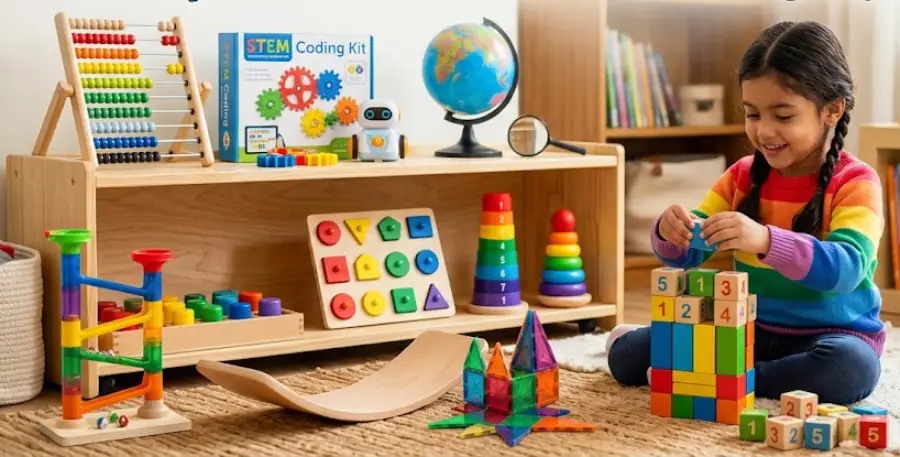
This comprehensive guide provides an exhaustive list of the 100 best educational toys for kids. Grouped into 10 developmental categories, each featured toy includes actionable insights into its learning benefits, core age guidelines, safety considerations, and practical play ideas.
Quick Answer: What Defines the Best Educational Toys?
The best educational toys are hands-on, open-ended, and matched to a child’s developmental stage. Rather than dictating a single outcome, they offer multiple ways to play. Leading examples include hardwood building blocks, magnetic construction tiles, Montessori shape sorters, sensory bins, coding robots, science lab kits, and dramatic pretend-play sets.
Clinical guidance from the American Academy of Pediatrics (AAP) emphasizes that traditional, non-electronic toys foster richer parent-child communication, imaginative problem-solving, and motor skills compared to digital screen-based toys.
The Developmental Value of Play-Based Learning
Play is the primary way children make sense of the physical and social world. When an infant drops a wooden ball through a slot, they learn about gravity and object permanence. When a preschooler balances a tall tower of wooden blocks, they experiment with physical equilibrium, load distribution, and structural geometry.
A truly educational toy possesses specific characteristics:
- Active Manipulation: Requires the child to turn, push, pull, fit, or connect pieces manually rather than pressing a single button to watch an automated light show.
- Open-Ended Potential: Can be used in multiple ways across different stages of childhood. A set of wooden blocks serves as a teetering tower for a one-year-old, a zoo enclosure for a four-year-old, and an elaborate architectural castle for an eight-year-old.
- Skill Isolation: Presents a clear, achievable physical or cognitive challenge without distracting visual or audio noise.
- Caregiver Interaction: Creates natural opportunities for parents and children to talk, ask open-ended questions, tell stories, and solve challenges together.
How to Choose the Right Educational Toy for Your Child
Selecting the right toy requires looking past marketing claims to evaluate how a child will interact with the object:
1. Respect Developmental Windows, Not Just Age Numbers
While manufacturer age guidelines are essential for choking safety, every child develops at their own pace. Observe your child’s current interests: are they focused on fine-motor pincer grasping, large physical climbing, sorting objects by color, or imaginative role-playing? Choose materials that meet them right at their current learning edge.
2. The 90/10 Play Rule
A good rule of thumb is the 90/10 principle: the toy should do 10% of the work, and the child should do 90%. When a battery-operated toy makes all the sounds, drives itself, and flashes lights, the child becomes a passive observer. When the toy is simple, the child must provide the voice, movement, plot, and creativity.
3. Material Safety & Durability
Opt for durable, natural materials like sustainably sourced hardwood, food-grade silicone, organic cotton, and recyclable non-toxic plastics. Ensure items are free from BPA, phthalates, lead, and volatile organic compound (VOC) finishes.
1. Montessori Materials & Sensory Wooden Toys (#1 to #10)
Montessori-aligned materials emphasize natural textures, self-correction, practical life skills, and focused spatial manipulation without overstimulating electronic distractions.
1. Wooden Shape Sorting Cube
A classic wooden cube featuring cutouts for geometric prisms (circles, triangles, squares, pentagons). Teaches visual-spatial discrimination, shape categorization, and fine-motor wrist rotation as toddlers manipulate each block to fit its matching slot.
2. Graduated Wooden Stacking Rings
Natural wood rings of varying diameters that fit over a central vertical peg. Introduces spatial sequencing, size grading, and hand-eye coordination as children learn that larger rings must sit at the base to create a stable pyramid.
3. Rainbow Wooden Sorting Bowls with Tongs
Solid beechwood nesting bowls paired with colorful wooden acorns or balls and wooden pincer tongs. Builds color recognition, early grouping logic, and strengthens the fine-motor finger grip required for holding pencils.
4. Object Permanence Box with Tray
A classic Montessori infant material featuring a wooden box with a top hole and a gentle rollout tray. Dropping a wooden ball through the slot helps babies understand that objects continue to exist even when out of sight.
5. Wooden Cylinder Peg Board
A solid wooden base with vertical holes and matching pegs of varying heights and diameters. Fosters precise three-finger pincer grasp control, depth perception, and size comparison.
6. Montessori Sandpaper Number Cards
Textured sandpaper numerals mounted on smooth wooden boards. Children trace the rough numeral with their index and middle fingers while vocalizing the sound, building tactile muscle memory for early math symbols.
7. Wooden Letter Tracing Board with Stylus
Hardwood grooved alphabet boards accompanied by a smooth wooden tracing stylus. Develops early pencil-holding ergonomics, stroke order, and pre-writing motor control without paper waste.
8. Child-Sized Practical Life Cleaning Set
Real, functional wooden broom, dustpan, mop, and duster scaled to toddler height. Encourages gross-motor coordination, responsibility, household participation, and physical independence.
9. Color Matching Peg Dolls in Cups
Hand-painted, non-toxic wooden peg figures paired with individual colored wooden cups. Fosters open-ended imaginative play, sorting skills, and color association.
10. Wooden Knobbed Anatomy & Nature Puzzles
Layered wooden puzzles with individual wooden knobs on each piece (e.g., life cycles of a tree, frog, or butterfly). Encourages biological curiosity, spatial fitting, and fine-finger dexterity.
2. STEM & Early Engineering Kits (#11 to #20)
STEM play introduces physical science, logic, sequencing, and engineering principles through interactive trial-and-error experimentation.
11. Modular Wooden Marble Run System
Interlocking wooden tracks, spirals, drop chutes, and momentum accelerators. Teaches kinetic energy, gravitational acceleration, momentum, and physical problem-solving as kids adjust track angles to keep marbles rolling.
12. Beginner Science Lab Chemistry Kit
Child-safe beakers, test tubes, pipettes, magnifying goggles, and non-hazardous household chemical experiment cards (volcanoes, density layers). Introduces the scientific method, hypothesis testing, and liquid measurement.
13. Snap-Together Electronic Circuit Blocks
Color-coded, magnetically connecting circuit components that power lights, buzzers, and fans. Teaches electrical polarity, series/parallel circuits, switches, and conductivity safely without soldering.
14. Screen-Free Coding Robot for Early Learners
A physical robot programmed using directional coding cards, physical dials, or push-buttons on its shell (e.g., Forward, Turn Right, Loop). Introduces computational thinking, algorithmic sequencing, and debugging logic without screen time.
15. Interlocking Gear & Pulley Construction Set
Base plates with connecting gear wheels, cranks, and drive belts. Demonstrates mechanical advantage, rotational ratios, drive trains, and cause-and-effect mechanics.
16. Dual-Pan Balance Scale with Counting Weights
A calibrated physical balance scale paired with numbered mass weights and counting bears. Makes mathematical equality, weight comparison, and early addition visually and physically intuitive.
17. Compound Optical Microscope Set for Kids
A sturdy student microscope with 100x–400x magnification, LED illumination, prepared biology slides, and blank glass covers. Opens up the microscopic world, encouraging deep biological observation.
18. Solar-Powered Robot Building Kit
Transformable 3-in-1 or 14-in-1 mechanical models powered by small photovoltaic solar panels and mini electric motors. Teaches renewable solar energy, gear ratios, and mechanical assembly.
19. Hydraulic Robot Arm Construction Kit
A build-it-yourself articulated robotic gripper powered entirely by water pressure, tubing, and manual syringe pistons. Demonstrates fluid dynamics, Pascal’s principle, and mechanical engineering.
20. Weather Station Science Lab
A functional backyard weather kit with a rain gauge, wind anemometer, compass, and indoor thermometer. Teaches meteorology, data logging, barometric pressure, and atmospheric science.
3. Building, Spatial & Construction Sets (#21 to #30)
Construction toys build structural awareness, three-dimensional geometry, fine-motor patience, and architectural imagination.
21. Solid Hardwood Unit Building Blocks
Precision-milled, unpainted solid beech or maple blocks following standard architectural fractions (double units, half units, pillars, arches). Teaches physical balance, fractional proportions, and structural engineering.
22. Translucent Magnetic Building Tiles
Geometric plastic tiles with reinforced internal magnets along all edges. Allows children to construct flat 2D geometric tessellations and 3D architectural towers, exploring magnetic polarity and geometry.
23. Classic Interlocking Construction Bricks
Universal stud-and-tube building bricks. Fosters spatial planning, structural integrity, step-by-step instruction following, and open-ended creative sculpting.
24. High-Density Jumbo Foam Building Blocks
Lightweight, silent EVA foam blocks for young toddlers. Enables the construction of life-sized fort walls and towers without risk of injury or floor damage during toppling.
25. Modular Fort Construction Kit
Heavy-duty interlocking plastic rods and multi-angle connector spheres paired with fabric clips. Children design and assemble large geodesic domes, castles, and indoor reading dens.
26. Real Mini Wooden Plank Building Sets (Kapla Style)
Identically proportioned pine wood planks used without glue, snaps, or clips. Demands concentration, precise finger placement, and spatial balance to create complex gravity-defying structures.
27. Take-Apart Toy Construction Vehicles with Drill
Chunky plastic excavators and dump trucks that can be disassembled using a child-safe battery-powered toy screwdriver. Develops mechanical intuition, hand grip strength, and problem-solving.
28. Architectural Bridge Engineering Challenge Set
Beams, suspension cables, and truss connectors that allow kids to build beam, arch, and suspension bridges, testing how much physical weight each bridge design can hold before bending.
29. 3D Geometric Crystal Polyhedron Builders
Flexible rubber connectors and colored plastic rods for constructing 3D polyhedrons, cubes, and octahedrons. Teaches vertices, edges, face geometry, and structural rigidity.
30. Wooden Ball & Dowel Construction System
Pre-drilled wooden spheres and connecting dowels that create custom rolling vehicles, Ferris wheels, and kinetic machines, fostering spatial coordination and engineering design.
4. Puzzles, Logic & Cognitive Problem-Solving (#31 to #40)
Puzzles and single-player logic games develop visual discrimination, spatial memory, deduction, and task persistence.
31. Chunky Wooden Animal Peg Puzzle
Extra-thick wooden puzzle boards with large grasping knobs designed for small toddler hands. Builds visual matching and hand-eye placement.
32. Self-Correcting Alphabet Matching Puzzles
Two-piece interlocking puzzle cards connecting uppercase/lowercase letters with corresponding phonetic pictures (e.g., ‘A’ connects only with ‘Apple’).
33. Classic Wooden Tangram Puzzle Set
Seven geometric flat polygons (tans) paired with challenge cards. Players rearrange shapes to match silhouettes, developing spatial rotation and geometric decomposition skills.
34. Floor Map of the World Giant Jigsaw Puzzle
Large 50- to 100-piece cardboard floor puzzles illustrating continents, oceans, native wildlife, and landmarks. Combines collaborative assembly with global geography.
35. Sliding Block Traffic Logic Game (Rush Hour Style)
A physical grid puzzle where players shift blocking vehicles to clear a path for the red car to exit. Introduces sequential logic, planning, and deductive reasoning.
36. Pattern & Shadow Matching Cognitive Game
Wooden tiles matching objects to their respective black silhouettes and color-inverted patterns, strengthening visual memory and cognitive classification.
37. 3D Spatial Brain-Teaser Cube
Multi-piece interlocking wooden puzzle cubes that must be dismantled and reassembled through precise rotational steps, challenging three-dimensional spatial thinking.
38. Cooperative Strategy Board Games for Kids
Board games where all players collaborate against the game board (e.g., gathering fruit before the crow arrives). Teaches turn-taking, rule compliance, communication, and shared success.
39. Sudoku Junior Color & Shape Puzzle Board
A 4×4 or 6×6 tactile wooden grid using colored pegs instead of numbers, introducing early logical deduction and elimination strategies.
40. Layered Human Anatomy Wooden Puzzle
Multi-layered puzzle showing progressive biological systems: skeleton, muscular system, internal organs, and skin. Teaches human biology and anatomical vocabulary.
5. Art, Crafting & Creative Expression (#41 to #50)
Art materials allow children to process emotions, experiment with color theory, and develop expressive fine-motor confidence.
41. Triangular Ergonomic Beeswax Crayons
All-natural beeswax crayons with a triangular cross-section that prevents rolling and naturally encourages a proper tripod pencil grip in young children.
42. Non-Toxic Opaque Gouache & Watercolor Paint Set
Richly pigmented, water-soluble paints paired with natural bristle brushes. Teaches color mixing, water control, transparency, and brush pressure modulation.
43. Natural Plant-Based Modeling Dough with Wooden Cutters
Wheat-based, non-toxic dough scented with natural plant oils, paired with wooden rolling pins and pattern stamps. Develops tactile finger strength and sculpting skills.
44. Dual-Sided Magnetic & Chalkboard Art Easel
Height-adjustable standing wooden easel with a magnetic whiteboard on one side, chalkboard on the other, and an integrated top paper roll dispenser.
45. Origami Paper Folding Challenge Kit
Color-coded origami sheets printed with folding guidelines and step-by-step animal folding cards. Fosters geometric precision, patience, and bilateral hand coordination.
46. Kid-Safe Loop Weaving Loom
A sturdy wooden or plastic loom frame with cotton loops for weaving custom pot holders, coasters, and fabric squares. Introduces textile patterns, warp/weft mechanics, and focus.
47. Pottery Wheel Studio for Kids
A motorized, foot-pedal operated desktop clay pottery wheel with shaping tools and air-dry clay. Develops hand-centering control, spatial geometry, and patience.
48. Reusable Water-Reveal Painting Mats
Large fabric floor mats that reveal vibrant colors when painted with water-filled pens, drying clear for reuse without chemical stains or mess.
49. Wooden Pattern Stamping & Ink Pad Kit
Solid rubber-faced wooden stamps illustrating animals, plants, and geometric borders. Fosters decorative pattern sequencing and hand pressure control.
50. Open-Ended Collage & Mixed-Media Creation Box
Curated compartments of buttons, felt strips, yarn, wooden beads, paper shapes, and child-safe glue, encouraging creative collage design without rigid formulas.
6. Fine-Motor & Tactile Sensory Tools (#51 to #60)
Sensory play calms the nervous system, supports tactile processing, and builds the small muscle control needed for handwriting and daily self-care.
51. Themed Sensory Bin Activity Table
Divided wooden table basins filled with colored sensory rice, dried chickpeas, wooden scoops, tongs, and mini silicone bowls for tactile sorting and pouring.
52. Non-Sticky Kinetic Play Sand with Molds
Hydrophobic, moldable kinetic sand that flows like liquid yet holds sharp geometric shapes. Provides deep tactile pressure feedback and calming sensory focus.
53. Fine-Motor Scissor Skills Activity Book & Spring-Loaded Scissors
Progressive paper-cutting workbooks with cutting lines, paired with spring-assisted safety scissors that automatically pop open after each snip.
54. Wooden Threading & Lacing Apple/Cheese Toy
A solid wooden block carved like fruit with smooth holes, attached to a wooden needle and cord. Children guide the caterpillar needle through tunnels, building spatial threading skills.
55. Montessori Fastener & Dressing Activity Board
A multi-panel board featuring zippers, shoelaces, brass buckles, snap buttons, toggle ties, and hook-and-loop straps to master independent daily dressing skills.
56. Primary Lacing Beads with Pattern Cards
Large, colorful geometric wooden beads and thick tip laces paired with sequence cards that guide kids to copy bead color and shape patterns.
57. Textured Tactile Sensory Stones
Smooth, molded resin stones embedded with natural textures (stripes, dots, waves, rough bumps). Used for tactile discrimination, matching games, and calming anxiety.
58. Wooden Peg Pounding Bench with Mallet
A classic wooden bench with colorful tight-fitting pegs and a soft-faced mallet. Helps toddlers channel physical energy, practice hand-eye targeting, and explore cause-and-effect.
59. Water Marbles & Light Table Exploration Set
Illuminated LED light table base paired with translucent geometric shapes, colored paddles, and magnifying bowls to explore color mixing and transparency.
60. Silicone Bubble Popping Fine-Motor Fidget Board
BPA-free food-grade silicone push-pop boards that provide tactile resistance and quiet acoustic feedback, supporting finger isolation and self-regulation.
7. Dramatic Role-Play & Social-Emotional Toys (#61 to #70)
Imaginative role-play allows children to explore social relationships, build conversational vocabulary, process emotions, and practice empathy.
61. Solid Wood Play Kitchen & Stainless Cookware
A scaled wooden kitchen featuring an oven, sink, stove knobs that click, and real mini stainless steel pots and pans. Inspires collaborative family role-play and narrative storytelling.
62. Velcro-Connecting Sliceable Wooden Food Set
Wooden fruits, vegetables, and bread connected by hook-and-loop fasteners that separate with a realistic crunch when cut using a dull wooden play knife.
63. Medical Doctor & Veterinarian Role-Play Kit
A soft canvas medical bag containing a working stethoscope that hears heartbeats, a blood pressure cuff, a syringe, a thermometer, and pet bandages. Helps reduce fear of medical visits.
64. Open-Sided Wooden Dollhouse with Furniture
A natural wood multi-room dollhouse with accessible open sides, movable wooden furniture, and diverse family figures. Fosters domestic storytelling and emotional processing.
65. Realistic Hand-Painted Wild Animal Figures
Accurate, weighted replicas of safari, forest, and marine animals. Fosters biological classification, habitat building, storytelling, and geography learning.
66. Working Mechanical Wooden Tool Bench
A sturdy workbench with wooden vices, nuts, bolts, gears, and wrenches that thread together, teaching tool handling, mechanical assembly, and motor planning.
67. Hand Puppet Theater & Character Puppets
A tabletop wooden theater stage with plush animal and human puppets. Encourages vocal modulation, public speaking confidence, and emotional storytelling.
68. Career & Community Helper Dress-Up Costumes
Machine-washable costume vests and accessories representing scientists, firefighters, astronauts, chefs, and forest rangers, encouraging career exploration.
69. Grocery Store Stand with Working Scanner & Calculator
A wooden market stall equipped with fruit bins, a barcode beep-scanner, price chalkboard signs, and cloth shopping totes, making everyday commerce fun.
70. Social-Emotional Emotion Cards & Mirrors
Facial expression flashcards paired with an unbreakable hand mirror. Children identify feelings (frustrated, joyful, worried) and practice recognizing them in their own reflections.
8. Language, Literacy & Phonics Learning (#71 to #80)
Language-rich toys connect spoken sounds with written symbols, building vocabulary, phonemic awareness, and reading fluency.
71. Lowercase Tactile Magnetic Alphabet Letters
Chunky wooden or silicone lowercase letters with embedded magnets for refrigerator or magnetic easel spelling. Supports early phonetic word construction.
72. Spinning Wooden Phonics Word-Family Blocks
Handheld wooden rods with rotating vowel and consonant blocks that spin to form simple CVC (Consonant-Vowel-Consonant) words (e.g., C-A-T, H-A-T, B-A-T).
73. Illustrated Open-Ended Storytelling Dice
Wooden dice embossed with icons representing heroes, obstacles, magical tools, and settings. Rolling the dice provides creative prompts for oral storytelling.
74. Sight Word Wooden Fishing Game
Magnetic wooden fish stamped with high-frequency sight words, caught using mini magnetic fishing poles, turning reading practice into an active game.
75. Hardcover Children’s Visual Picture Dictionary
Richly illustrated thematic reference books labeling objects across neighborhoods, ecosystems, vehicles, and the human body, expanding conversational vocabulary.
76. Rhyming Sound Match Puzzle Pairs
Interlocking puzzle pairs that match phonetic rhyming words (e.g., Star / Car, Fox / Box), developing auditory discrimination and pre-reading phonemic awareness.
77. Reusable Dry-Erase Handwriting Practice Boards
Laminated, lined boards featuring tracing lines, letter arrows, and blank handwriting grids, allowing repeated writing practice without paper waste.
78. Audio Storytelling Box (Screen-Free Audio Player)
A child-friendly tactile speaker (like a Toniebox or Yoto Player) activated by placing physical story figurines on top. Promotes listening comprehension and independent audio literacy.
79. Word-Building Scrabble-Style Tile Game for Kids
Letter tiles paired with double-sided picture boards where beginners match letter tiles to pre-printed words, gradually transitioning to spelling words independently.
80. Interactive Braille & Sign Language Wooden Alphabet Blocks
Hardwood blocks engraved with English uppercase letters, lowercase letters, American Sign Language (ASL) finger-spelling icons, and raised Braille dots.
9. Early Math, Counting & Geometry Tools (#81 to #90)
Math manipulatives make abstract numerical ideas tangible, building strong number sense, geometric reasoning, and mental arithmetic.
81. Counting Bears with Math Activity Cards
Graduated colorful plastic counting bears paired with challenge cards covering patterns, sorting, counting, addition, and subtraction.
82. Solid Wood 10-Row Traditional Abacus
A wooden frame with 100 brightly colored beads arranged in rows of ten. Makes place value, tens-frames, skip counting, and mental addition visual and intuitive.
83. Montessori Math Hundred Board
A wooden 10×10 grid board with 100 wooden numeral tiles from 1 to 100. Builds number sequencing fluency, pattern recognition, and skip counting skills.
84. Geometric Pattern Blocks with Activity Cards
Standardized wooden geometric tiles (triangles, hexagons, trapezoids, rhombuses) that combine to form larger tessellated designs, teaching geometric relationships.
85. Wooden Fraction Pizza & Cake Math Puzzle
Sectioned wooden food pieces labeled with fractional values (1/2, 1/3, 1/4, 1/6, 1/8) that fit into circular pie pans, making equivalent fractions intuitive.
86. Number Bond Counting Blocks & Rods (Cuisenaire Rods)
Color-coded wooden calculation rods of lengths 1cm through 10cm. Demonstrates linear length, addition combinations, and multiplication arrays.
87. Play Money Register with Realistic Paper & Coins
Realistic play bills, molded coins, and bank cards. Teaches decimal math, addition, change calculation, and financial awareness through market role-play.
88. Measuring Tape, Caliper & Ruler Math Set
Child-safe, functional retractable measuring tapes, wooden meter sticks, and plastic calipers. Encourages kids to measure and record household furniture dimensions.
89. Analog Geoboard with Loom Elastic Bands
A wooden peg grid board where children stretch colored elastic bands around pegs to form triangles, pentagons, polygons, and symmetrical shapes, exploring perimeter and area.
90. Base-Ten Place Value Math Cubes
Interlocking plastic units, tens rods, hundreds flats, and thousand blocks. Essential for visualizing place value, regrouping, carrying, and subtraction borrow mechanics.
10. Outdoor Exploration & Nature Science (#91 to #100)
Outdoor exploration materials channel natural childhood curiosity, building observational science skills and physical gross-motor confidence.
91. Heavy-Duty Kids’ Magnifying Glass
A shatterproof 5x-magnification glass lens with a thick rubberized handle. Turns garden leaves, tree bark, soil, and rocks into fascinating science explorations.
92. Outdoor Adventure Backpack & Nature Explorer Kit
A durable canvas backpack equipped with a liquid compass, whistle, LED hand-crank flashlight, specimen tweezers, and a specimen collection bottle.
93. Real Metal Child-Sized Gardening Tools
Functional steel hand trowel, rake, watering can, and cotton gloves scaled for small hands. Teaches botanical planting, soil aerating, weed removal, and plant care.
94. Pop-Up Mesh Butterfly & Insect Habitat Cage
A breathable mesh cylindrical habitat for observing caterpillars, moths, or butterflies, teaching insect metamorphosis before safe outdoor release.
95. Beginner Refractor Telescope for Moon Exploration
A 70mm aperture astronomical refractor telescope with adjustable tripod and smartphone adapter. Enables kids to view lunar craters and bright constellations.
96. Compact Rubber-Armored Kids’ Binoculars (8×21)
Real optical glass binoculars with central focus wheels and rubber eye guards, making bird-watching and wildlife viewing easy and engaging.
97. Plant Press & Herbarium Flower Preservation Kit
A wooden screw-down press with cardboard sheets and blotting paper for pressing garden blossoms and leaves for art collages and nature journals.
98. Bug Catching Tongs with Ventilated Viewing Jar
Scissor-handled capture domes and ventilated magnifying jars that safely catch insects without touching them, encouraging gentle observation and release.
99. Spiral-Bound Hardcover Nature Discovery Journal
Thick, blank watercolor-grade paper notebooks where kids record weather logs, sketch botanical specimens, and paste pressed leaves from nature walks.
100. Step-Activated Pneumatic Air Rocket Launcher
Foam rockets powered by stepping on a flexible air bladder. Teaches trajectory angles, air compression, propulsion, and physics through active outdoor play.
Master Learning Goals Comparison Table
Use the cross-reference table below to choose toys based on the specific developmental skill you want to encourage:
| Primary Learning Goal | Key Developmental Benefits | Recommended Toy Selections |
|---|---|---|
| Spatial & Structural Reasoning | 3D mental rotation, balance intuition, geometric decomposition | Hardwood Unit Blocks, Magnetic Tiles, Tangrams, Polyhedron Builders |
| Fine-Motor & Pre-Writing | Pincer grasp, finger isolation, wrist modulation, bilateral coordination | Lacing Cards, Wooden Tracing Boards, Scissor Books, Play Dough |
| Logical Deduction & Problem Solving | Sequential logic, trial-and-error testing, spatial decomposition | Sliding Block Games, Jigsaw Puzzles, Marble Runs, Coding Robots |
| Scientific Curiosity & STEM | Hypothesis testing, biological observation, circuit logic | Microscopes, Circuit Blocks, Weather Stations, Telescopes |
| Early Numeracy & Math Sense | One-to-one correspondence, place value, fractional equality | Abacus, Balance Scale, Fraction Pizzas, Counting Bears |
| Language & Phonemic Literacy | Sound-symbol mapping, oral storytelling, vocabulary expansion | Spinning Phonics Rods, Story Dice, Audio Players, Sandpaper Letters |
| Emotional & Social Development | Empathy, cooperative turn-taking, role experimentation | Play Kitchen, Medical Kits, Cooperative Board Games, Emotion Mirrors |
Age-by-Age Developmental Toy Guide
Children’s neurological and physical capabilities evolve rapidly. Use this developmental roadmap to select appropriate toys:
Babies (0–12 Months): Sensory & Motor Discovery
Infants explore through vision, sound, and mouthing objects. Prioritize high-contrast black-and-white graphics, smooth untreated hardwood grasping rings, soft textured fabric balls, and simple object permanence boxes.
Toddlers (1–2 Years): Cause-and-Effect & Fine Motor
Toddlers master walking, pincer grasps, and container filling. Look for shape-sorting cubes, stacking rings, wooden pegboards, push-and-pull carts, and jumbo foam building blocks.
Preschoolers (3–4 Years): Imagination & Early Concepts
Preschoolers engage in rich pretend play and simple classification. Focus on magnetic building tiles, play kitchens, Velcro sliceable food, simple jigsaw puzzles, play dough, and counting toys.
Early Elementary (5–7 Years): Foundation Skills & STEM
Children at this stage understand complex rules, early reading, and simple math. Provide marble runs, snap circuit sets, beginner science kits, board games, and phonics games.
Older Kids (8–12 Years): Real-World Projects & Logic
Older children enjoy challenging projects that require patience. Great options include programmable robotics kits, compound microscopes, refractor telescopes, complex woodworking kits, and multi-piece architectural builds.
How to Build a Clutter-Free Toy Rotation System
Having too many toys out at once can overstimulate children, leading to scattered attention and messy play areas. A simple toy rotation system keeps play engaging and organized:
- Audit and Declutter: Gather all toys in one area. Donate broken, outgrown, or low-quality toys that do not hold your child’s interest.
- Categorize by Play Type: Group remaining toys into categories: Building, Puzzles, Pretend Play, Art/Sensory, and STEM/Literacy.
- Create 3 to 4 Rotating Bins: Place a balanced selection of 8 to 12 toys in each bin (e.g., one building set, two puzzles, one pretend-play kit, one art supply).
- Rotate Every 2 to 3 Weeks: Keep only one active bin on open, low shelves. Store the others in closets. When you swap bins, familiar toys feel fresh and new again, encouraging deeper, focused play.
Essential Toy Safety & Non-Toxic Standards
Safety should always come before educational features. Keep these safety rules in mind:
- The Choke Tube Test: Any toy or component that fits completely inside a standard 1.25-inch cardboard toilet paper roll presents a fatal choking hazard for children under three years old.
- Inspect High-Powered Magnets: High-powered rare-earth neodymium magnets are extremely dangerous if swallowed. Regularly inspect magnetic tiles and blocks for cracks, and discard damaged items immediately.
- Verify Secure Battery Compartments: Button or coin cell batteries can cause severe internal burns if swallowed. Ensure battery compartments are secured with screws, and store spare batteries out of reach.
- Choose Safe Finishes: Look for toys finished with non-toxic water-based stains, natural beeswax, or food-grade mineral oil, complying with ASTM F963 (USA) or EN71 (Europe) toy safety standards.
Frequently Asked Questions
What are the best educational toys for kids?
The most effective educational toys encourage active, open-ended manipulation rather than passive watching. Top categories include wooden building blocks, magnetic tiles, Montessori shape sorters, beginner robotics sets, sensory bins, and pretend-play kits.
What makes a toy Montessori-aligned?
Montessori-aligned toys isolate a single skill (like size, color, or shape), use natural materials like solid wood, promote hands-on independence, and mirror real-world practical life activities rather than relying on electronic lights and sounds.
Are STEM toys suitable for toddlers and preschoolers?
Yes. For toddlers and preschoolers, foundational STEM play includes physical construction blocks, gear sets, balance scales, water-play ramps, and physical sorting games that introduce cause-and-effect and spatial geometry.
How many educational toys does a child actually need?
Children do not need hundreds of toys. A curated collection of 10 to 15 versatile, open-ended toys—regularly rotated every few weeks—fosters deeper focus, sparks creativity, and prevents overstimulation.
What safety hazards should parents watch out for with learning toys?
Always verify that button battery compartments are screwed shut, inspect magnetic toys for cracks, avoid small components for children under three to prevent choking, and ensure all paints are certified non-toxic and lead-free.
Final Thoughts on Thoughtful Childhood Play
Educational play is not about drilling academic flashcards or buying the most complex electronic gadget on the market. It is about creating an environment where a child feels empowered to build, imagine, test, and explore at their own pace.
Whether through a simple set of hardwood unit blocks, a set of magnetic tiles against a sunny window, an open-ended science lab kit, or child-sized baking tools, the 100 toys in this guide offer meaningful ways to support your child’s growth.
Select play materials that match your child’s natural curiosity, prioritize open-ended exploration, set up a simple toy rotation system, and enjoy watching your child learn through play!
Safety Disclaimer: Product age recommendations and developmental benefits in this article are provided for general educational guidance. Always supervise children during play, inspect toys regularly for wear, and follow official manufacturer safety warnings.