
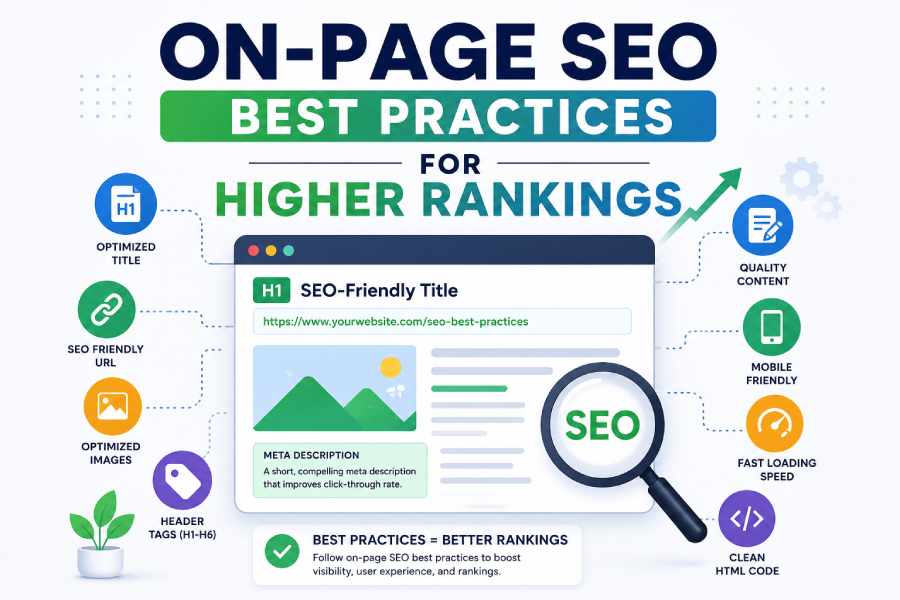
This complete guide covers the most effective on-page SEO best practices for 2026 and explains how to optimize every important element of your content for higher rankings and better user engagement.
Table of Contents
- What Is On-Page SEO?
- Why On-Page SEO Matters in 2026
- Best Practice #1: Search Intent Optimization
- Best Practice #2: Strategic Keyword Research
- Best Practice #3: SEO-Friendly Title Tags
- Best Practice #4: Optimized Meta Descriptions
- Best Practice #5: Proper Header Structure
- Best Practice #6: High-Quality Content Demonstrating EEAT
- Best Practice #7: Content Readability
- Best Practice #8: Optimize Images for SEO
- Best Practice #9: Strong Internal Linking Structure
- Best Practice #10: Optimize URL Structures
- Best Practice #11: Structured Data (Schema Markup)
- Best Practice #12: Optimize for Featured Snippets
- Best Practice #13: Improve User Engagement Signals
- Best Practice #14: Optimize for AI-Powered Search Results
- Best Practice #15: Build Topical Authority Through Content Clusters
- Best Practice #16: Optimize Content Freshness
- Best Practice #17: Improve Page Experience
- Best Practice #18: Strengthen Trust Signals
- The Ultimate On-Page SEO Checklist for 2026
- Frequently Asked Questions
- Internal Linking Opportunities for LotsDiary.com
- Google Discover Optimization Checklist
What Is On-Page SEO?
On-page SEO refers to the optimization of individual web pages to improve search engine rankings and user experience.
Unlike off-page SEO, which focuses on backlinks and external signals, on-page SEO involves elements that website owners can directly control.
These elements include content quality, keyword placement, title tags, meta descriptions, headings, images, internal links, and user experience factors.
Why On-Page SEO Matters in 2026
Google’s AI-powered ranking systems are becoming increasingly effective at understanding content quality and relevance.
Proper on-page optimization helps search engines determine:
- What a page is about.
- Which keywords it targets.
- How useful the content is.
- Whether it satisfies search intent.
- How it relates to other pages.
Strong on-page SEO improves both rankings and user satisfaction.
Best Practice 1: Optimize for Search Intent
Search intent remains one of the strongest ranking factors in modern SEO.
Before creating content, understand what users expect when searching a specific keyword.
Main Search Intent Categories
- Informational.
- Navigational.
- Commercial Investigation.
- Transactional.
Optimization Tips
- Analyze top-ranking pages.
- Identify user goals.
- Create matching content formats.
- Answer key questions clearly.
Pages aligned with search intent typically outperform pages that simply target keywords.
Best Practice 2: Perform Strategic Keyword Research
Keyword research remains the foundation of successful SEO campaigns.
The goal is not simply finding high-volume keywords but identifying terms that align with user needs and business objectives.
Keyword Types to Target
- Primary keywords.
- Secondary keywords.
- Long-tail keywords.
- Question-based keywords.
- Semantic keywords.
Modern SEO requires topical coverage rather than excessive keyword repetition.
Best Practice 3: Create SEO-Friendly Title Tags
Title tags remain one of the most important on-page SEO elements.
A well-written title helps search engines understand page topics while encouraging users to click.
Title Tag Best Practices
- Include the primary keyword.
- Keep titles compelling.
- Stay within recommended lengths.
- Communicate value clearly.
- Avoid keyword stuffing.
Strong title tags improve both rankings and click-through rates.
Best Practice 4: Write Optimized Meta Descriptions
Meta descriptions may not directly influence rankings, but they significantly affect click-through rates.
An engaging description encourages users to choose your result over competitors.
Meta Description Tips
- Include primary keywords naturally.
- Highlight benefits.
- Use action-oriented language.
- Maintain readability.
- Keep descriptions concise.
Higher click-through rates can improve overall search performance.
Best Practice 5: Use Proper Header Structure
Headers improve readability while helping search engines understand content organization.
Recommended Structure
- One H1 heading.
- Logical H2 sections.
- Supporting H3 and H4 headings.
- Clear topic hierarchy.
Well-structured content is easier for both users and search engines to navigate.
Best Practice 6: Create High-Quality Content That Demonstrates EEAT
In 2026, content quality remains the foundation of successful SEO. Google’s systems increasingly evaluate content through the lens of Experience, Expertise, Authoritativeness, and Trustworthiness (EEAT).
Websites that demonstrate genuine expertise and provide valuable information are more likely to achieve sustainable rankings.
Ways to Improve EEAT
- Show author credentials.
- Share real-world experience.
- Use accurate information.
- Cite trustworthy sources.
- Maintain transparency.
As AI-generated content becomes more common, authentic expertise becomes even more valuable.
Best Practice 7: Optimize Content Readability
Even comprehensive content can struggle if it is difficult to read.
Users prefer content that is easy to scan, understand, and navigate.
Readability Optimization Tips
- Use short paragraphs.
- Break up long sections.
- Use bullet points.
- Include descriptive headings.
- Write in clear language.
Improved readability increases engagement and encourages users to spend more time on your website.
Best Practice 8: Optimize Images for SEO
Images contribute to user experience, accessibility, and search visibility.
Proper image optimization can improve rankings in both traditional search and image search results.
Image SEO Checklist
- Use descriptive file names.
- Add meaningful alt text.
- Compress image files.
- Use WebP formats when possible.
- Specify image dimensions.
- Enable lazy loading.
Optimized images improve page speed and accessibility.
Best Practice 9: Build a Strong Internal Linking Structure
Internal links help search engines discover pages and understand relationships between topics.
They also encourage visitors to explore additional content.
Internal Linking Best Practices
- Link related articles together.
- Use descriptive anchor text.
- Build topic clusters.
- Update older content with new links.
- Eliminate orphan pages.
A strong internal linking strategy improves crawlability and topical authority.
Best Practice 10: Optimize URL Structures
SEO-friendly URLs make it easier for users and search engines to understand page content.
Simple and descriptive URLs often perform better than long, complex URLs.
URL Optimization Tips
- Keep URLs short.
- Use descriptive words.
- Include primary keywords naturally.
- Avoid unnecessary parameters.
- Use hyphens instead of underscores.
Clean URL structures support better usability and crawlability.
Best Practice 11: Add Structured Data (Schema Markup)
Schema markup helps search engines understand content more effectively.
While schema is not a direct ranking factor, it can improve visibility through rich results.
Useful Schema Types
- Article Schema.
- FAQ Schema.
- Organization Schema.
- Breadcrumb Schema.
- How-To Schema.
Schema can improve click-through rates by enhancing search listings.
Best Practice 12: Optimize for Featured Snippets
Featured snippets continue to provide valuable visibility in search results.
Google often selects concise, well-structured answers for snippet positions.
Featured Snippet Optimization Tips
- Answer questions directly.
- Use numbered lists.
- Create FAQ sections.
- Use clear headings.
- Structure information logically.
Featured snippets can significantly increase organic visibility and traffic.
Best Practice 13: Improve User Engagement Signals
User engagement plays an increasingly important role in modern SEO.
Pages that keep visitors engaged often perform better over time.
Ways to Improve Engagement
- Create useful content.
- Improve readability.
- Add visuals.
- Use internal links.
- Improve page speed.
Positive user experiences support stronger SEO performance.
Best Practice 14: Optimize for AI-Powered Search Results
Google’s AI-powered search experiences continue to reshape SEO in 2026. Search engines now analyze content more deeply and often generate summaries directly within search results.
Content that is well-structured, factual, and easy to understand has a better chance of appearing in AI-generated answers.
AI Search Optimization Tips
- Answer questions directly.
- Use clear section headings.
- Create comprehensive content.
- Include FAQs.
- Use structured data.
- Demonstrate expertise.
Pages designed for human readers while remaining easy for AI systems to interpret are likely to perform best.
Best Practice 15: Build Topical Authority Through Content Clusters
Topical authority has become one of the strongest indicators of expertise.
Instead of publishing isolated articles, successful websites build content clusters around important topics.
Example Content Cluster
If your main topic is SEO, supporting articles might include:
- Technical SEO Guides.
- Keyword Research Tutorials.
- Link Building Strategies.
- SEO Tools Reviews.
- Google Algorithm Updates.
- Content Marketing Guides.
Comprehensive topic coverage helps establish authority and trust.
Best Practice 16: Optimize Content Freshness
Google wants users to access current and relevant information.
Outdated content may gradually lose rankings as competitors publish fresher resources.
Content Refresh Checklist
- Update statistics.
- Add recent examples.
- Improve internal links.
- Expand weak sections.
- Replace outdated screenshots.
- Address new industry trends.
Refreshing existing content is often faster than creating entirely new content.
Best Practice 17: Improve Page Experience
User experience remains a major component of SEO success.
Visitors expect websites that load quickly, display properly on mobile devices, and provide easy navigation.
Page Experience Factors
- Mobile responsiveness.
- Fast loading speeds.
- Core Web Vitals.
- HTTPS security.
- Visual stability.
- Easy navigation.
Better experiences encourage engagement and improve user satisfaction.
Best Practice 18: Strengthen Trust Signals
Trustworthiness continues to influence rankings, especially in competitive niches.
Users and search engines prefer websites that demonstrate credibility.
Trust Signal Checklist
- Author information.
- Contact details.
- Privacy policy.
- About page.
- Editorial guidelines.
- Secure HTTPS connection.
Strong trust signals support both SEO performance and user confidence.
The Ultimate On-Page SEO Checklist
- Match search intent.
- Perform keyword research.
- Optimize title tags.
- Write compelling meta descriptions.
- Use proper header structures.
- Demonstrate EEAT.
- Improve readability.
- Optimize images.
- Strengthen internal linking.
- Create SEO-friendly URLs.
- Implement schema markup.
- Target featured snippets.
- Improve engagement.
- Optimize for AI search.
- Build topical authority.
- Refresh content regularly.
- Improve page experience.
- Strengthen trust signals.
Following this checklist can significantly improve rankings, organic traffic, and user satisfaction.
Frequently Asked Questions (FAQ)
What is on-page SEO?
On-page SEO refers to optimizing individual web pages to improve rankings, visibility, and user experience.
Is on-page SEO still important?
Yes. On-page SEO remains one of the most important ranking factors because it helps search engines understand content relevance and quality.
How important are title tags?
Title tags remain one of the strongest on-page SEO signals and significantly influence click-through rates.
Does schema markup improve rankings?
Schema markup helps search engines understand content and can improve visibility through enhanced search results.
What is the most important on-page SEO factor?
Search intent optimization and content quality are among the most important on-page SEO factors.
Google Discover Optimization Checklist
- Use original high-resolution images.
- Create compelling headlines.
- Publish expert-level content.
- Maintain strong EEAT signals.
- Optimize mobile experiences.
- Update content regularly.
- Improve page speed.
- Focus on user satisfaction.
Google Discover often rewards websites that consistently publish useful and trustworthy content.
Final Thoughts
On-page SEO remains one of the most controllable and effective ways to improve search performance.
While Google’s algorithms continue evolving through AI and machine learning, the fundamental goal remains the same: provide users with the most helpful and relevant content.
Website owners who focus on search intent, content quality, user experience, EEAT, and technical excellence will be best positioned for long-term success.
Rather than chasing short-term ranking tactics, invest in sustainable optimization practices that create real value for users.
The websites that consistently help users solve problems will continue to earn strong rankings, organic traffic, and long-term growth.