
Artificial Intelligence (AI) has become one of the most transformative technologies of the modern era. What was once considered a concept limited to science fiction is now influencing how people work, communicate, learn, shop, receive healthcare, and make decisions.
Businesses across industries are adopting artificial intelligence to automate processes, analyze massive amounts of data, improve customer experiences, and create innovative products and services.
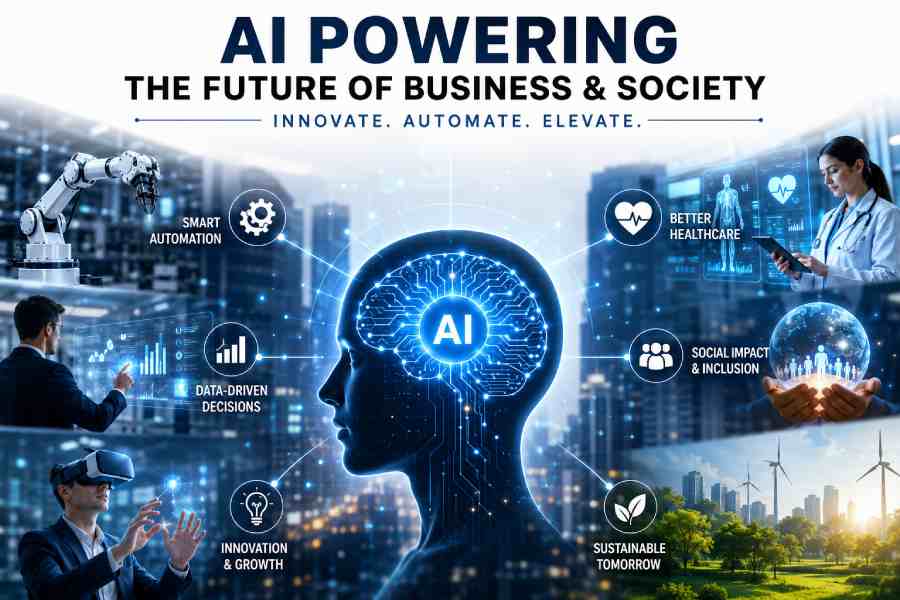
At the same time, AI is changing society by improving access to information, supporting scientific discoveries, enhancing education, and helping solve complex global challenges.
The future of artificial intelligence is not only about machines becoming smarter. It is about creating collaboration between humans and intelligent systems to improve productivity, creativity, and problem-solving.
From small businesses to global organizations, AI adoption is becoming a key factor in digital transformation. Companies that understand and implement AI responsibly can gain significant advantages in an increasingly competitive world.
Table of Contents
- What Is Artificial Intelligence?
- Why AI Is Becoming Essential for Businesses
- AI-Powered Business Automation
- AI Transforming Customer Experience
- AI in Healthcare and Medical Innovation
- AI in Finance and Banking
- AI in Marketing and Content Creation
- AI Transforming Education
- AI and the Future of Work
- AI in Manufacturing and Industry 4.0
- AI in Cybersecurity
- AI and Smart Decision-Making
- How Different Industries Are Adopting AI
- AI Ethics and Challenges
- Future AI Trends
- Preparing for an AI-Powered Future
- Frequently Asked Questions
1. What Is Artificial Intelligence?
Artificial Intelligence refers to computer systems designed to perform tasks that normally require human intelligence. These tasks include learning, reasoning, problem-solving, language understanding, image recognition, and decision-making.
Unlike traditional software that follows fixed instructions, AI systems can analyze data, identify patterns, and improve their performance over time.
Main Types of Artificial Intelligence
| AI Type | Description |
|---|---|
| Narrow AI | Designed to perform specific tasks such as recommendations, voice assistants, or image recognition. |
| Machine Learning | Systems that learn from data and improve automatically. |
| Deep Learning | Advanced AI using neural networks to process complex information. |
| Generative AI | Technology that creates text, images, audio, videos, and software code. |
Today, most AI applications are based on narrow AI and machine learning. However, continuous research is expanding AI capabilities across different fields.
2. Why AI Is Becoming Essential for Businesses
Artificial Intelligence has become a strategic priority for businesses because it helps organizations work faster, reduce costs, and make better decisions.
Companies generate enormous amounts of data every day. AI allows businesses to analyze this information quickly and discover valuable insights that humans may not identify manually.
Business Benefits of Artificial Intelligence
- Improved operational efficiency
- Faster decision-making
- Personalized customer experiences
- Automated repetitive tasks
- Better data analysis
- Reduced business costs
From startups to multinational companies, AI is becoming an important tool for improving competitiveness and innovation.
3. AI-Powered Business Automation
Automation is one of the biggest impacts of artificial intelligence on businesses. AI systems can handle repetitive tasks, allowing employees to focus on creative and strategic responsibilities.
Modern organizations use AI automation in customer support, accounting, human resources, supply chain management, software development, and administrative operations.
Examples of AI Automation
- Automated customer chat systems
- AI document processing
- Smart inventory management
- Automated reporting
- Workflow optimization
- AI-powered scheduling
AI automation does not simply replace manual work. It helps employees increase productivity by providing intelligent tools that support daily activities.
4. AI Is Transforming Customer Experience
Customer expectations are changing rapidly. People now expect faster responses, personalized recommendations, and seamless digital experiences.
Artificial Intelligence helps businesses understand customer behavior and provide more relevant services.
AI Customer Experience Applications
- AI chatbots and virtual assistants
- Personalized product recommendations
- Customer sentiment analysis
- Predictive customer support
- Voice-based services
Retail, banking, travel, and e-commerce companies are using AI to create more personalized interactions and improve customer satisfaction.
5. AI in Healthcare and Medical Innovation
Healthcare is one of the industries experiencing major transformation through artificial intelligence. AI technologies are helping doctors analyze medical information, improve diagnosis, and develop personalized treatment plans.
AI systems can analyze medical images, identify patterns in patient data, and assist healthcare professionals in making informed decisions.
AI Healthcare Applications
- Medical image analysis
- Drug discovery research
- Patient monitoring
- Healthcare automation
- Personalized medicine
- Virtual health assistants
The future of healthcare will increasingly combine human expertise with AI-powered tools to deliver faster and more accurate medical services.
6. AI in Finance and Banking Is Creating Smarter Financial Systems
The financial industry is one of the fastest adopters of Artificial Intelligence. Banks, investment companies, and financial platforms are using AI to improve security, automate services, analyze market trends, and provide personalized financial experiences.
Traditional banking systems often require manual processes for evaluating risks, detecting fraud, and assisting customers. AI helps financial organizations process large amounts of information quickly and make more accurate decisions.
How AI Is Transforming Finance
- Fraud Detection: AI systems monitor transactions in real time and identify unusual activities.
- Risk Assessment: Machine learning models analyze financial data to evaluate lending risks.
- AI Banking Assistants: Virtual assistants help customers manage accounts and receive instant support.
- Investment Analysis: AI tools analyze market information and support investment decisions.
- Automated Processing: AI reduces paperwork and improves operational efficiency.
| Financial Area | AI Application |
|---|---|
| Banking | Customer support automation and personalized services |
| Insurance | Risk prediction and faster claim processing |
| Investments | Market analysis and forecasting |
| Payments | Fraud prevention and transaction monitoring |
As financial technology continues to evolve, AI will help create faster, safer, and more accessible financial services.
7. AI in Marketing and Content Creation
Artificial Intelligence is transforming how companies attract customers, create content, and analyze marketing performance. Modern marketers use AI tools to understand audiences, personalize campaigns, and improve customer engagement.
Generative AI has introduced new possibilities for creating written content, images, videos, advertisements, and marketing strategies faster than traditional methods.
AI Marketing Applications
- Content generation and optimization
- Customer behavior analysis
- Personalized advertising
- Search engine optimization support
- Email marketing automation
- Social media analysis
AI does not replace creativity. Instead, it provides marketers with intelligent tools that help them generate ideas, analyze results, and make data-driven decisions.
| Marketing Task | How AI Helps |
|---|---|
| Content Creation | Generates drafts, ideas, and creative suggestions |
| SEO | Analyzes keywords and search trends |
| Advertising | Improves targeting and campaign performance |
| Customer Research | Identifies preferences and behavior patterns |
8. AI Is Transforming Education and Learning
Artificial Intelligence is changing education by creating personalized learning experiences and making knowledge more accessible to students worldwide.
Traditional education often follows the same approach for every learner. AI-powered education platforms can adapt lessons based on individual learning speed, strengths, and weaknesses.
AI Applications in Education
- AI tutoring systems
- Personalized learning programs
- Automated grading assistance
- Language learning tools
- Virtual classrooms
- Educational content creation
Teachers can use AI as a support tool to save time, analyze student performance, and create better learning experiences.
Benefits of AI in Education
- Improved access to learning resources
- Personalized education paths
- Faster feedback for students
- Support for teachers
- Interactive learning experiences
9. AI and the Future of Work
Artificial Intelligence is changing the workplace by automating routine activities and creating new ways for humans and machines to collaborate.
Many jobs are evolving as employees use AI tools to increase productivity, analyze information, and complete complex tasks more efficiently.
How AI Is Changing Workplaces
- Automated administrative tasks
- AI-assisted research
- Intelligent project management
- Data analysis support
- Software development assistance
- Creative collaboration tools
The future workplace will likely focus on human-AI collaboration, where technology handles repetitive processes while people focus on creativity, strategy, and decision-making.
| Human Skills | AI Support |
|---|---|
| Creativity | Idea generation and analysis |
| Decision Making | Data insights and predictions |
| Communication | Language processing assistance |
| Problem Solving | Pattern recognition and automation |
10. AI in Manufacturing and Industry 4.0
Manufacturing is experiencing a major transformation through AI-powered automation, robotics, and smart production systems. This movement is often called Industry 4.0.
Factories are using AI to improve quality control, predict equipment failures, optimize production processes, and reduce waste.
AI Applications in Manufacturing
- Smart robotics
- Predictive maintenance
- Automated quality inspection
- Supply chain optimization
- Production forecasting
- Inventory management
AI-powered factories can operate more efficiently while improving safety and reducing operational costs.
11. AI in Cybersecurity: Protecting the Digital World
As cyber threats become more advanced, Artificial Intelligence is becoming an important security solution. AI can analyze massive amounts of digital activity and identify suspicious behavior faster than traditional security methods.
Organizations use AI-powered cybersecurity systems to detect malware, prevent fraud, monitor networks, and respond to potential attacks.
AI Cybersecurity Benefits
- Real-time threat detection
- Automated security monitoring
- Faster incident response
- Behavior analysis
- Improved data protection
| Cybersecurity Challenge | AI Solution |
|---|---|
| Unknown threats | Pattern detection and anomaly analysis |
| Large data volumes | Automated monitoring |
| Fast attacks | Real-time response systems |
12. AI and Smart Decision-Making
One of the greatest advantages of Artificial Intelligence is its ability to analyze large amounts of data and provide valuable insights for better decision-making.
Businesses use AI analytics to understand customers, predict market changes, optimize operations, and identify new opportunities.
AI Decision-Making Applications
- Business forecasting
- Customer analytics
- Supply chain planning
- Market research
- Risk management
- Performance optimization
AI-powered decision-making allows organizations to move from reactive strategies to predictive approaches, helping them prepare for future challenges.
How Different Industries Are Adopting AI
| Industry | AI Impact |
|---|---|
| Healthcare | Better diagnosis, medical research, and patient care |
| Finance | Security, automation, and personalized services |
| Education | Personalized learning and digital classrooms |
| Marketing | Content creation and customer insights |
| Manufacturing | Smart factories and automation |
| Cybersecurity | Threat detection and protection |
13. AI Ethics and Challenges: Building Responsible Artificial Intelligence
While Artificial Intelligence provides enormous opportunities, it also creates important ethical and social challenges. As AI becomes more powerful and widely used, businesses, governments, and communities must ensure that these technologies are developed and applied responsibly.
Responsible AI focuses on creating systems that are transparent, fair, secure, and aligned with human values.
Major Challenges of Artificial Intelligence
| Challenge | Description |
|---|---|
| Data Privacy | AI systems require large amounts of data, creating concerns about personal information protection. |
| Algorithm Bias | AI decisions can be unfair if training data contains incorrect or unbalanced information. |
| Job Transformation | Automation may change certain roles and require workers to develop new skills. |
| Security Risks | AI systems can become targets for cyberattacks or misuse. |
| Transparency | People need to understand how AI systems make important decisions. |
How Organizations Can Use AI Responsibly
- Create strong data protection policies
- Regularly test AI systems for fairness
- Maintain human oversight in important decisions
- Train employees about AI usage
- Develop ethical AI guidelines
The future success of Artificial Intelligence depends not only on technological progress but also on responsible innovation.
14. Future AI Trends in 2026 and Beyond
Artificial Intelligence is continuing to evolve rapidly. Future AI systems will become more intelligent, personalized, and integrated into everyday activities.
Businesses and society are moving toward a future where AI will work as a collaborative partner, helping humans solve problems, create new ideas, and improve productivity.
Emerging AI Trends
- Generative AI Expansion: AI will continue creating text, images, videos, software, and digital experiences.
- AI Personal Assistants: Intelligent assistants will manage more personal and professional tasks.
- AI Healthcare Innovation: AI will support diagnosis, research, and personalized treatments.
- Autonomous Systems: AI-powered vehicles, robots, and smart devices will become more advanced.
- AI Security: Artificial intelligence will become essential for cybersecurity protection.
- Multimodal AI: Future AI systems will understand and process text, images, audio, and video together.
| AI Trend | Expected Future Impact |
|---|---|
| Generative AI | Faster creativity and content production |
| AI Automation | Higher business productivity |
| AI Healthcare | Improved medical research and patient care |
| AI Assistants | Personalized digital support |
| AI Robotics | Smarter machines and automation |
15. How Society Can Prepare for an AI-Powered Future
Artificial Intelligence will influence almost every part of society. Preparing for this future requires individuals, businesses, and governments to focus on education, digital skills, and responsible technology adoption.
Ways Individuals Can Prepare
- Learn basic AI concepts
- Develop digital skills
- Understand AI tools relevant to their work
- Improve creativity and problem-solving abilities
- Stay updated with technology changes
Ways Businesses Can Prepare
- Create AI adoption strategies
- Train employees on AI technologies
- Protect customer data
- Use AI to solve real business problems
- Maintain ethical AI practices
The organizations and individuals who adapt early will be better positioned to benefit from AI-driven opportunities.
Artificial Intelligence Benefits and Challenges Comparison
| Benefits of AI | Challenges of AI |
|---|---|
| Improves productivity | Requires responsible implementation |
| Automates repetitive work | May change job requirements |
| Provides faster data analysis | Creates privacy concerns |
| Enhances customer experiences | Requires strong cybersecurity |
| Supports scientific innovation | Needs ethical guidelines |
The Future Impact of AI on Business and Society
Artificial Intelligence will continue reshaping industries and daily life. Businesses will use AI to create smarter products, improve operations, and understand customers better. Society will benefit from improved healthcare, education, communication, and accessibility.
The most successful approach will be combining human creativity with machine intelligence. AI can analyze information and automate tasks, while humans provide empathy, innovation, strategic thinking, and ethical judgment.
Rather than replacing humanity, AI has the potential to enhance human capabilities and help solve some of the world’s biggest challenges.
Frequently Asked Questions About Artificial Intelligence
1. What is Artificial Intelligence?
Artificial Intelligence is a technology that enables computers and machines to perform tasks that normally require human intelligence, including learning, reasoning, analysis, and decision-making.
2. How is AI changing businesses?
AI is helping businesses automate processes, improve customer service, analyze data, reduce costs, and create better products and services.
3. What industries benefit most from AI?
Healthcare, finance, marketing, education, manufacturing, cybersecurity, transportation, and retail are among the industries experiencing major AI transformation.
4. Will AI replace human workers?
AI will automate some tasks, but it will also create new opportunities and change the way people work. Human skills such as creativity, communication, and critical thinking will remain valuable.
5. How does AI improve healthcare?
AI helps healthcare professionals analyze medical data, detect diseases, develop treatments, and provide personalized patient care.
6. Why is AI important for the future?
AI is important because it can improve productivity, accelerate innovation, solve complex problems, and support better decision-making across society.
7. What are the risks of Artificial Intelligence?
Major risks include privacy concerns, security threats, algorithm bias, ethical challenges, and the need for workforce adaptation.
8. How can businesses start using AI?
Businesses can begin by identifying repetitive tasks, improving data management, testing AI solutions, and training employees.
9. What is the future of AI technology?
The future of AI includes smarter assistants, advanced automation, AI-powered healthcare, autonomous systems, and more personalized digital experiences.
10. How can people learn about AI?
People can learn AI through online courses, technology blogs, practical tools, professional training programs, and hands-on experimentation.
Conclusion: Artificial Intelligence Is Shaping Tomorrow’s World
Artificial Intelligence is becoming one of the most influential technologies of the modern era. It is transforming businesses, improving services, supporting scientific discoveries, and changing how society interacts with technology.
From automated business operations and personalized healthcare to smarter education and advanced cybersecurity, AI is creating new possibilities across every sector.
The future of Artificial Intelligence will depend on responsible innovation, continuous learning, and collaboration between humans and intelligent systems.
Organizations that adopt AI strategically and individuals who develop AI-related skills will be better prepared for the digital future.