
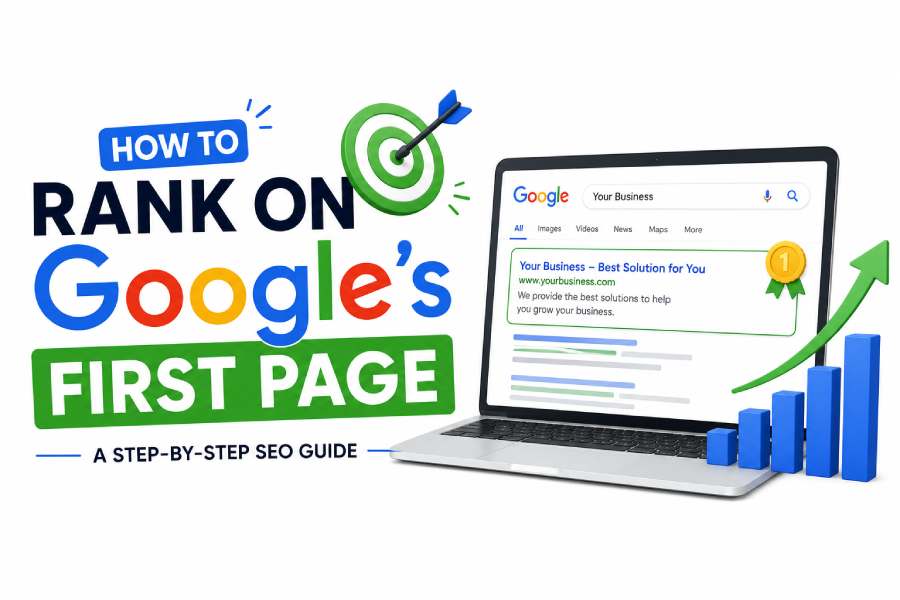
 Ranking on Google’s first page requires more than simply adding keywords to a webpage. Google’s ranking systems now evaluate content quality, user experience, topical authority, EEAT signals, technical SEO, and AI-driven relevance.
This comprehensive guide explains exactly how to rank on Google’s first page using proven SEO strategies that align with modern ranking factors.
Table of Contents
- Why Ranking on Google’s First Page Matters
- How Google Determines Rankings
- Step 1: Understand Search Intent
- Step 2: Perform Comprehensive Keyword Research
- Step 3: Analyze Top-Ranking Competitors
- Step 4: Create Exceptional Content
- Step 5: Optimize On-Page SEO
- Step 6: Improve Technical SEO
- Step 7: Improve Core Web Vitals
- Step 8: Build Topical Authority
- Step 9: Strengthen EEAT Signals
- Step 10: Build High-Quality Backlinks
- Common Reasons Websites Fail to Reach Page One
- Frequently Asked Questions
Why Ranking on Google’s First Page Matters
Google processes billions of searches every day. Most users click results appearing near the top of page one.
Benefits of First-Page Rankings
- More organic traffic.
- Higher brand visibility.
- Increased trust and credibility.
- Better lead generation.
- Higher conversion opportunities.
- Long-term marketing ROI.
First-page visibility can significantly impact business growth and online success.
How Google Determines Rankings
Google uses hundreds of ranking signals to evaluate webpages.
Major Ranking Factors in 2026
- Content quality.
- Search intent relevance.
- Backlink authority.
- Page experience.
- Technical SEO.
- EEAT signals.
- Topical authority.
- User engagement.
Successful SEO combines all these factors rather than focusing on a single tactic.
Step 1: Understand Search Intent
Search intent is the foundation of modern SEO.
Before creating content, determine what users expect when searching for a keyword.
Types of Search Intent
- Informational – seeking knowledge.
- Navigational – looking for a specific website.
- Commercial – comparing options.
- Transactional – ready to buy.
Matching search intent improves rankings and user satisfaction.
Step 2: Perform Comprehensive Keyword Research
Keyword research helps identify what users search for and how competitive those searches are.
Best Keyword Sources
- Google Autocomplete.
- People Also Ask.
- Google Search Console.
- Keyword research tools.
- Competitor analysis.
Keyword Selection Criteria
- Search volume.
- Keyword difficulty.
- User intent.
- Business relevance.
- Traffic potential.
Long-tail keywords often provide excellent ranking opportunities for newer websites.
Step 3: Analyze Top-Ranking Competitors
Before publishing content, study pages already ranking on Google’s first page.
Competitor Analysis Checklist
- Content length.
- Topic coverage.
- Heading structure.
- Images and media.
- Internal linking.
- Backlink profile.
Your goal is not to copy competitors but to create something more useful and comprehensive.
Step 4: Create Exceptional Content
Content quality remains one of the strongest ranking factors.
Google rewards content that solves problems, answers questions, and satisfies users.
High-Quality Content Characteristics
- Original insights.
- Accurate information.
- Clear formatting.
- Practical examples.
- Comprehensive coverage.
- Strong readability.
Publishing genuinely helpful content improves both rankings and user engagement.
Step 5: Optimize On-Page SEO
On-page SEO helps search engines understand page content.
Important On-Page Elements
- SEO title tag.
- Meta description.
- URL structure.
- H1 heading.
- H2 and H3 headings.
- Internal links.
- Image optimization.
Example of an Optimized SEO Structure
- URL:
/how-to-rank-on-googles-first-page/ - Title Tag: How to Rank on Google’s First Page in 2026
- Meta Description: Learn proven strategies to rank higher on Google and increase organic traffic.
- H1: How to Rank on Google’s First Page
This structure improves clarity and search relevance.
Step 6: Improve Technical SEO
Technical SEO provides the foundation that allows search engines to crawl, understand, and index your website effectively.
Even the best content may struggle to rank if technical issues prevent Google from accessing or evaluating your pages properly.
Technical SEO Checklist
- Use HTTPS security.
- Create an XML sitemap.
- Optimize robots.txt.
- Fix broken links.
- Improve crawlability.
- Eliminate duplicate content.
- Use canonical tags correctly.
A technically sound website creates a strong foundation for higher rankings.
Step 7: Improve Core Web Vitals
Core Web Vitals measure real-world user experience and remain important ranking signals.
Important Core Web Vitals Metrics
- LCP (Largest Contentful Paint): Loading performance.
- INP (Interaction to Next Paint): Responsiveness.
- CLS (Cumulative Layout Shift): Visual stability.
Ways to Improve Core Web Vitals
- Compress images.
- Use modern image formats.
- Reduce JavaScript.
- Enable caching.
- Upgrade hosting performance.
Faster websites often achieve better engagement and ranking performance.
Step 8: Build Topical Authority
Google increasingly rewards websites that demonstrate expertise across an entire topic rather than focusing on isolated keywords.
How to Build Topical Authority
- Create pillar pages.
- Publish supporting articles.
- Interlink related content.
- Cover topics comprehensively.
- Update content regularly.
Topical authority helps search engines trust your expertise within a niche.
Step 9: Strengthen EEAT Signals
Experience, Expertise, Authoritativeness, and Trustworthiness (EEAT) are increasingly important in Google’s ranking systems.
Ways to Improve EEAT
- Display author biographies.
- Show professional experience.
- Provide accurate information.
- Maintain transparency.
- Publish original research.
- Earn industry recognition.
Strong EEAT signals improve trust among both users and search engines.
Step 10: Build High-Quality Backlinks
Backlinks remain one of the strongest ranking signals because they act as votes of confidence from other websites.
Effective Backlink Strategies
- Guest posting.
- Digital PR.
- Resource page outreach.
- Original research studies.
- Expert interviews.
- Industry collaborations.
Focus on quality, relevance, and authority rather than acquiring large numbers of low-quality links.
Step 11: Optimize Internal Linking
Internal links help search engines understand content relationships while distributing authority across your website.
Benefits of Internal Linking
- Improves crawlability.
- Enhances navigation.
- Strengthens topic clusters.
- Passes link equity.
- Increases page views.
A strong internal linking strategy supports both SEO and user experience.
Step 12: Optimize Images for Search
Image optimization improves page performance and creates additional opportunities through image search results.
Image SEO Best Practices
- Use descriptive file names.
- Add keyword-relevant alt text.
- Compress images.
- Use responsive image sizes.
- Implement lazy loading.
Optimized images improve accessibility and search visibility.
Step 13: Optimize for Featured Snippets
Featured snippets appear above traditional search results and can generate substantial visibility.
Snippet Optimization Techniques
- Answer questions directly.
- Use numbered lists.
- Create FAQ sections.
- Write concise definitions.
- Use structured formatting.
Featured snippets often increase brand visibility and click-through rates.
Step 14: Optimize for AI Search and AI Overviews
AI-powered search experiences are changing how information is presented in search results.
AI Search Optimization Strategies
- Provide clear answers.
- Use logical headings.
- Create authoritative content.
- Demonstrate expertise.
- Maintain factual accuracy.
- Cover topics comprehensively.
Content that helps users solve problems often performs well in AI-generated search experiences.
Step 15: Focus on User Experience Signals
User satisfaction increasingly influences search performance.
Positive User Experience Factors
- Easy navigation.
- Fast page speed.
- Mobile responsiveness.
- Readable design.
- Helpful content.
Google wants to rank pages that provide value and positive experiences.
Step 16: Optimize for Mobile-First Indexing
Google primarily uses the mobile version of a website for indexing and ranking. A poor mobile experience can significantly reduce ranking potential.
Mobile SEO Best Practices
- Use responsive design.
- Improve mobile page speed.
- Ensure readable font sizes.
- Optimize touch elements.
- Reduce intrusive popups.
- Test usability regularly.
Mobile optimization is no longer optional. It is a core ranking requirement.
Step 17: Implement Schema Markup
Schema markup helps search engines understand your content and may improve eligibility for rich results.
Recommended Schema Types
- Article Schema.
- FAQ Schema.
- Breadcrumb Schema.
- Organization Schema.
- How-To Schema.
- Review Schema.
Structured data improves content understanding and search appearance.
Step 18: Update Existing Content Regularly
Google prefers fresh, accurate, and relevant information. Updating existing articles can often generate faster ranking improvements than publishing entirely new content.
Content Update Checklist
- Refresh statistics.
- Add new examples.
- Improve keyword coverage.
- Fix outdated information.
- Add internal links.
- Improve readability.
Step 19: Build Brand Authority
Brand signals are becoming increasingly important as Google seeks trustworthy sources.
Ways to Build Brand Authority
- Publish expert content.
- Earn media mentions.
- Build a social presence.
- Collect positive reviews.
- Create original research.
- Develop thought leadership.
Strong brands often rank more easily because they are recognized as trusted sources.
Step 20: Track and Improve Performance Continuously
SEO is an ongoing process rather than a one-time task.
Important Metrics to Monitor
- Organic traffic.
- Keyword rankings.
- Click-through rate (CTR).
- Conversions.
- Bounce rate.
- User engagement.
Continuous improvement helps maintain and strengthen rankings over time.
Common Reasons Websites Fail to Reach Page One
- Weak content quality.
- Poor keyword targeting.
- Technical SEO issues.
- Lack of backlinks.
- Weak EEAT signals.
- Slow page speed.
- Poor user experience.
Identifying and fixing these issues can significantly improve ranking potential.
Google’s First Page Ranking Timeline
| Website Type | Estimated Ranking Time |
|---|---|
| New Website | 6–12 Months |
| Established Website | 3–6 Months |
| Authority Website | 1–3 Months |
| Low Competition Keyword | Several Weeks |
| High Competition Keyword | 6–18 Months |
Results vary depending on competition, content quality, authority, and optimization efforts.
Frequently Asked Questions (FAQ)
How long does it take to rank on Google’s first page?
Most websites require several months of consistent SEO work, although low-competition keywords may rank faster.
Do backlinks still matter?
Yes. High-quality backlinks remain one of Google’s strongest authority signals.
Can AI-generated content rank?
Content can rank if it is helpful, accurate, original, and provides value. Quality matters more than the method used to create it.
What is the most important ranking factor?
There is no single ranking factor. Successful SEO combines content quality, authority, technical optimization, relevance, and user experience.
How often should content be updated?
Important pages should be reviewed regularly and updated whenever new information becomes available.
Google Discover Optimization Tips
- Publish original content.
- Use high-quality featured images.
- Create compelling headlines.
- Cover trending SEO topics.
- Build strong EEAT signals.
- Maintain content freshness.
- Focus on user value.
- Develop topical authority.
Google Discover can become a powerful source of additional traffic for authoritative websites.
Final Thoughts
Ranking on Google’s first page is achievable for websites that consistently follow proven SEO practices. Success comes from understanding user intent, creating outstanding content, building authority, optimizing technical performance, and continuously improving the user experience.
SEO in 2026 is no longer about shortcuts or tricks. It is about delivering the most valuable answer for users while making it easy for search engines to understand and trust your content.
By following the step-by-step process outlined in this guide, businesses, bloggers, and website owners can significantly improve their chances of earning first-page visibility and sustainable organic traffic growth.