
For years, SEO focused primarily on keywords, backlinks, and technical optimization. While these factors still matter, the future of SEO is increasingly centered around understanding user intent, delivering high-quality experiences, and creating content that AI systems can understand and trust.
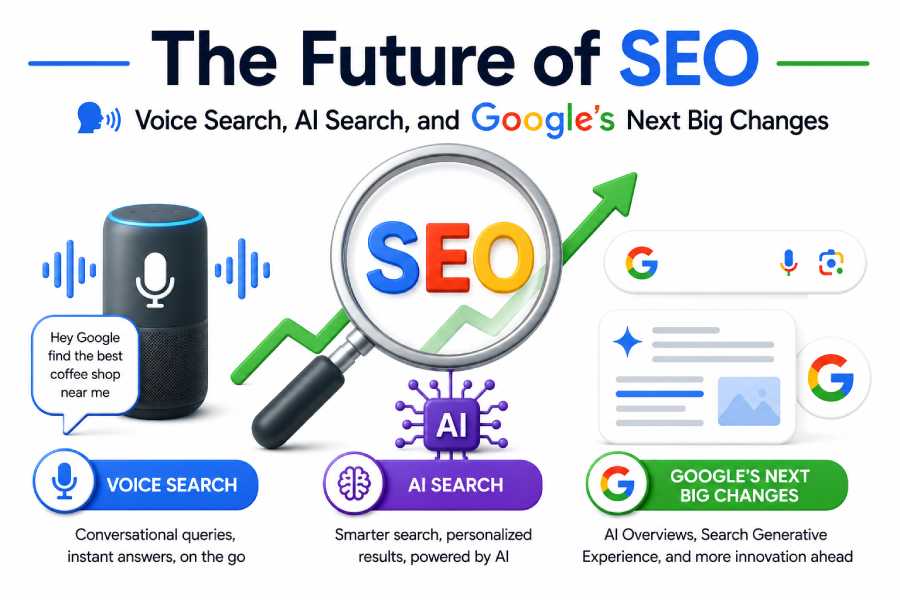
Website owners, bloggers, businesses, and digital marketers must adapt to these changes if they want to maintain visibility in search results throughout 2026 and beyond.
This guide explores the future of SEO, including voice search, AI search, Google’s evolving ranking systems, and the strategies needed to succeed in the next generation of search.
Table of Contents
- Why SEO Is Changing Faster Than Ever
- The Rise of AI Search
- Understanding Google’s AI Overviews
- Voice Search Continues to Grow
- How Voice Search Changes Keyword Research
- The Evolution of Search Intent
- The Shift Toward Conversational Search
- Entity-Based SEO Is Becoming More Important
- AI-Powered Ranking Systems Are Becoming Smarter
- EEAT Will Become Even More Important
- Topical Authority Will Replace Keyword-Only Strategies
- Technical SEO Remains Essential
- The Ultimate Future SEO Checklist
Why SEO Is Changing Faster Than Ever
Several major technological developments are accelerating changes in search behavior.
Key Drivers of SEO Evolution
- Artificial intelligence adoption.
- Voice assistant growth.
- Mobile-first search behavior.
- Generative AI search experiences.
- Improved natural language processing.
- Increasing user expectations.
Google’s goal remains the same: deliver the most helpful answer as quickly as possible.
However, the methods used to achieve that goal are evolving dramatically.
The Rise of AI Search
AI search is transforming how users interact with search engines.
Instead of simply displaying a list of blue links, search engines increasingly provide direct answers, summaries, recommendations, and conversational responses.
Characteristics of AI Search
- Conversational interactions.
- Context-aware responses.
- Multi-step reasoning.
- Personalized experiences.
- Direct answer generation.
Users now expect search engines to understand questions rather than simply match keywords.
Understanding Google’s AI Overviews
AI Overviews represent one of Google’s biggest search changes in recent years.
Instead of only displaying traditional search results, Google can generate AI-powered summaries that answer user questions directly within the search experience.
How AI Overviews Impact SEO
- Reduced click-through rates for some queries.
- Increased importance of authority signals.
- Greater focus on helpful content.
- More emphasis on expertise.
Content creators must optimize for both traditional rankings and AI-generated search experiences.
Voice Search Continues to Grow
Voice search is changing the way people interact with technology.
Smartphones, smart speakers, cars, and wearable devices have made voice interactions increasingly common.
Popular Voice Search Devices
- Smartphones.
- Smart speakers.
- Voice assistants.
- Connected vehicles.
- Wearable technology.
Voice queries tend to be more conversational than typed searches.
How Voice Search Changes Keyword Research
Traditional keyword strategies often focused on short phrases.
Voice searches frequently use natural language questions.
Traditional Search Example
best SEO tools
Voice Search Example
What are the best SEO tools for small businesses in 2026?
This shift requires content creators to target conversational and question-based keywords.
The Evolution of Search Intent
Search intent has always been important, but AI search systems understand intent more effectively than ever.
Google increasingly evaluates whether content solves a user’s problem rather than simply matching keywords.
Modern Search Intent Signals
- User behavior.
- Content engagement.
- Query context.
- Task completion.
- Information satisfaction.
Future SEO strategies must prioritize user outcomes over keyword density.
The Shift Toward Conversational Search
People increasingly search using complete questions and natural language.
Search engines now process queries similarly to human conversations.
Examples of Conversational Searches
- How do I improve website traffic?
- What’s the best laptop for students?
- How can I rank higher on Google?
- What causes slow website speed?
Content that directly answers these questions often performs better in modern search environments.
Entity-Based SEO Is Becoming More Important
Google increasingly understands entities rather than just keywords.
An entity can be a person, place, organization, product, or concept.
Benefits of Entity SEO
- Improved topical understanding.
- Better semantic relevance.
- Stronger AI interpretation.
- Enhanced knowledge graph visibility.
Building comprehensive topic coverage helps strengthen entity relationships.
AI-Powered Ranking Systems Are Becoming Smarter
Google’s ranking systems are increasingly powered by advanced artificial intelligence and machine learning technologies.
Modern search algorithms no longer rely heavily on simple keyword matching. Instead, they evaluate meaning, context, relevance, and user satisfaction.
What AI Ranking Systems Analyze
- Search intent.
- Content quality.
- User engagement.
- Page experience.
- Topic relevance.
- Authority signals.
As AI systems improve, content that genuinely helps users is likely to outperform content created primarily for search engines.
EEAT Will Become Even More Important
Experience, Expertise, Authoritativeness, and Trustworthiness (EEAT) continue to play a critical role in modern SEO.
AI-powered search systems need reliable signals to determine which content deserves visibility.
How to Improve EEAT
- Show author expertise.
- Publish original insights.
- Cite trustworthy sources.
- Maintain accurate information.
- Build industry authority.
- Display transparent contact details.
Strong EEAT signals help both traditional rankings and AI-generated search visibility.
Content Quality Will Matter More Than Content Quantity
For years, many websites focused on publishing large volumes of content.
The future of SEO favors comprehensive, accurate, and user-focused content rather than simply producing more pages.
Characteristics of High-Quality Content
- Original information.
- Clear explanations.
- Accurate facts.
- Useful insights.
- Strong structure.
- User-first approach.
AI systems increasingly identify content that provides genuine value.
Visual Search Is Expanding
Search behavior is no longer limited to text queries.
Users increasingly search using images, screenshots, and visual inputs.
Visual Search Opportunities
- Image optimization.
- Descriptive alt text.
- Structured data.
- High-quality visuals.
- Image search visibility.
Businesses that optimize visual content can capture additional search traffic.
Video SEO Will Continue Growing
Video consumption continues increasing across search engines, social platforms, and AI-powered experiences.
Google often surfaces videos directly within search results.
Video SEO Best Practices
- Create educational videos.
- Optimize titles.
- Write detailed descriptions.
- Use transcripts.
- Add timestamps.
- Include relevant keywords.
Video content often complements traditional written content and expands visibility opportunities.
Technical SEO Remains Essential
Despite advances in AI, technical SEO continues providing the foundation for search visibility.
Search engines must be able to crawl, understand, and index content efficiently.
Important Technical SEO Factors
- Core Web Vitals.
- Mobile friendliness.
- Structured data.
- HTTPS security.
- Site architecture.
- Page speed.
Strong technical performance supports both user experience and search visibility.
Future Ranking Factors Likely to Gain Importance
While Google uses hundreds of ranking signals, several factors appear increasingly important for the future.
Emerging Ranking Signals
- User satisfaction.
- Content originality.
- Author expertise.
- Brand authority.
- Engagement quality.
- Entity relationships.
Search engines are becoming better at evaluating content quality at scale.
How AI Search Changes Content Creation
Content creators must adapt to AI-powered search environments.
Future content strategies should focus on helping users complete tasks, solve problems, and make decisions.
Future Content Principles
- Answer questions directly.
- Provide expert insights.
- Cover topics comprehensively.
- Use structured formatting.
- Create unique value.
- Maintain factual accuracy.
Content designed for users often performs best in AI-powered search systems.
Common SEO Mistakes Businesses Must Avoid
- Publishing low-quality AI-generated content.
- Ignoring user intent.
- Over-optimizing keywords.
- Neglecting technical SEO.
- Failing to build authority.
- Ignoring mobile experiences.
- Creating duplicate content.
These mistakes may become even more damaging as search engines improve their ability to evaluate quality.
Predictions for the Future of SEO Beyond 2026
The search landscape will continue evolving rapidly as artificial intelligence becomes more integrated into everyday digital experiences.
While no one can predict every change, several trends are likely to shape the next generation of SEO.
Prediction 1: AI Search Will Become the Default Experience
Traditional search results will continue to exist, but AI-generated answers, summaries, and recommendations will become increasingly prominent.
Prediction 2: Search Will Become More Conversational
Users will interact with search engines using natural language, follow-up questions, and multi-step conversations.
Prediction 3: Authority Will Outrank Volume
Websites demonstrating genuine expertise will outperform sites that publish large amounts of low-value content.
Prediction 4: Brand Signals Will Matter More
Strong brands are easier for AI systems to trust, reference, and recommend.
Prediction 5: User Satisfaction Will Influence Rankings
Search engines will become even better at measuring whether users find answers quickly and effectively.
How Businesses Should Prepare for Future SEO Changes
Businesses that adapt early often gain significant competitive advantages.
Future-Proof SEO Strategies
- Create expert-driven content.
- Build topical authority.
- Strengthen brand recognition.
- Improve technical SEO.
- Optimize for AI search experiences.
- Focus on user satisfaction.
- Develop multimedia content.
- Enhance trust signals.
Future SEO success will depend on delivering genuine value rather than attempting to manipulate ranking systems.
How to Optimize for Voice Search in 2026
Voice search optimization requires understanding how people naturally speak.
Voice Search SEO Checklist
- Target question-based keywords.
- Create FAQ sections.
- Use conversational language.
- Optimize local SEO profiles.
- Improve mobile usability.
- Provide concise answers.
- Use structured data markup.
Voice searches frequently seek quick and direct answers, making clarity especially important.
How to Optimize for AI Search Engines
AI-powered search systems prioritize content that is reliable, comprehensive, and easy to understand.
AI Search Optimization Best Practices
- Answer questions directly.
- Provide original insights.
- Use clear headings.
- Build topical authority.
- Improve EEAT signals.
- Publish trustworthy content.
- Maintain factual accuracy.
AI search optimization often overlaps with best practices already recommended for traditional SEO.
The Ultimate Future SEO Checklist
- Focus on user intent.
- Create expert content.
- Build topical authority.
- Improve EEAT signals.
- Optimize technical SEO.
- Improve Core Web Vitals.
- Target conversational keywords.
- Optimize for voice search.
- Prepare for AI Overviews.
- Use structured data.
- Create visual content.
- Publish video content.
- Strengthen brand authority.
- Monitor search trends.
- Update content regularly.
This checklist helps businesses remain competitive as search technologies evolve.
Frequently Asked Questions (FAQ)
Will AI replace traditional SEO?
No. AI is changing SEO rather than replacing it. SEO will continue focusing on helping users find valuable information.
Is voice search still important?
Yes. Voice search continues growing, particularly on mobile devices, smart speakers, and connected technologies.
What is Google’s AI Overview?
AI Overviews are AI-generated summaries that help answer search queries directly within Google search results.
Will keywords still matter in the future?
Yes. Keywords remain important, but understanding intent and topic relevance is becoming even more important.
What is the biggest SEO trend for 2026?
The integration of AI into search experiences is one of the most significant developments shaping the future of SEO.
Google Discover Optimization for the Future
- Create original content.
- Publish expert insights.
- Use high-quality images.
- Cover emerging trends.
- Build topical authority.
- Maintain strong EEAT signals.
- Focus on audience interests.
- Update content frequently.
Google Discover increasingly rewards authoritative content that provides unique value and strong user engagement.
Final Thoughts
The future of SEO is not about abandoning traditional optimization practices. Instead, it is about adapting those practices to a rapidly evolving search environment.
Voice search, AI search, conversational interfaces, and advanced ranking systems are changing how users discover information online. Businesses that focus on expertise, authority, trust, and user satisfaction will be best positioned for success.
While technologies will continue evolving, one principle remains constant: search engines want to provide users with the most helpful answers possible.
Organizations that consistently create valuable content, optimize technical performance, and prioritize audience needs will continue earning visibility regardless of how search evolves.
The future belongs to websites that build trust, demonstrate expertise, and genuinely help people solve problems.