
While E-E-A-T is not a direct ranking factor in the traditional sense, it influences how Google assesses content quality, website credibility, and overall search value.
In 2026, websites that demonstrate strong E-E-A-T signals are more likely to earn higher rankings, greater visibility, and stronger user trust.
This guide explains E-E-A-T in detail and shows practical ways to improve these signals across your website.
Table of Contents
What Is E-E-A-T?
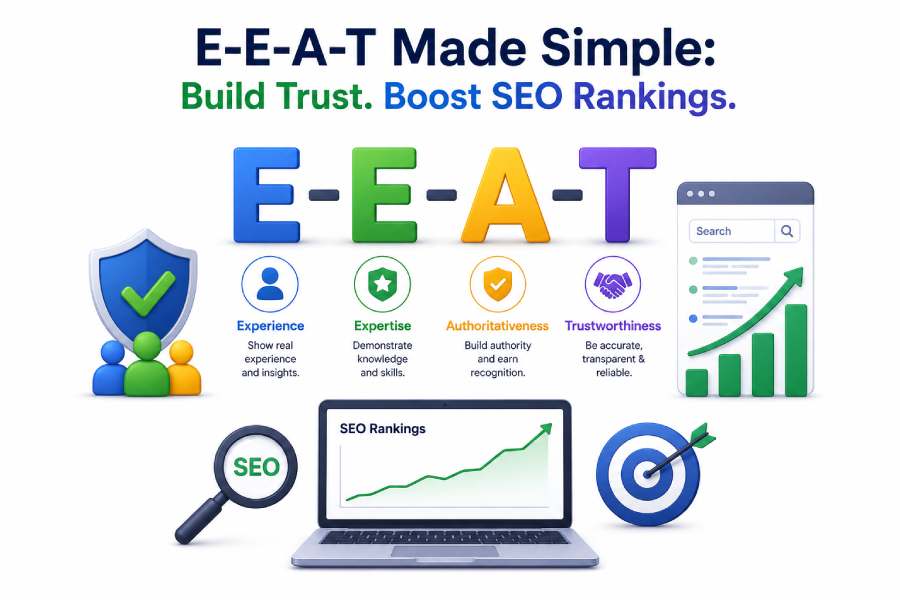
E-E-A-T is a framework Google uses to assess content quality and credibility.
The acronym stands for:
- Experience
- Expertise
- Authoritativeness
- Trustworthiness
These principles originate from Google’s Search Quality Evaluator Guidelines and help determine whether content provides genuine value to users.
Why E-E-A-T Matters for SEO
Google’s goal is to deliver the most reliable and helpful results for every search query. Strong E-E-A-T signals help search engines identify trustworthy content creators and authoritative websites.
Benefits of Strong E-E-A-T
- Higher search visibility on Google.
- Improved rankings for competitive head keywords.
- Greater user trust and lower bounce rates.
- Better user engagement metrics.
- Increased organic backlink opportunities.
- Stronger brand authority across your industry niche.
Understanding the Four Components of E-E-A-T
1. Experience
Experience refers to first-hand knowledge gained through direct involvement with a topic.
Google wants content created by people who have actually used, tested, visited, experienced, or worked with the subject being discussed.
Examples of Experience
- Product reviews based on actual hands-on use.
- Travel guides generated from personal visits and original photos.
- Tutorials based on real-world workflow implementation.
- Case studies showcasing data from actual professional projects.
2. Expertise
Expertise measures knowledge and skill within a specific subject area. Content demonstrating deep understanding often performs better than superficial coverage.
Examples of Expertise
- In-depth industry knowledge.
- Professional qualifications and certifications.
- Research-backed content with external credible references.
- Specialized insights from credentialed subject experts.
3. Authoritativeness
Authority refers to your reputation and recognition within an industry or niche. Websites and authors frequently cited by others often develop stronger authority signals.
Authority Indicators
- High-quality contextual backlinks.
- Natural industry mentions and citations.
- Media coverage from authoritative news websites.
- Expert quotes and collaborative insights.
- Growing brand recognition.
4. Trustworthiness
Trustworthiness is widely considered the most critical aspect of the E-E-A-T framework. Even experienced experts may struggle to rank if users cannot verify their business trust signals.
Trust Signals
- Accurate, up-to-date information.
- Transparent company policies (Privacy Policy, Terms).
- Secure website browsing environment (HTTPS).
- Clear author background and credential details.
- Accessible corporate contact information.
- Fact-checked editorial content.
How Google Evaluates E-E-A-T
Google does not use a single automated E-E-A-T metric or score. Instead, various independent algorithm components look for tangible trust signals across your domain.
Signals That Support E-E-A-T
- Verified author credentials and detailed bio pages.
- Comprehensive, deeply researched content quality.
- A clean, authoritative backlink profile.
- Unlinked brand mentions across trusted platforms.
- Positive user satisfaction and engagement.
- Website operational transparency.
- Regular updates ensuring content freshness.
How to Build Strong Experience Signals
Experience became an official part of Google’s quality ecosystem because first-hand knowledge provides irreplaceable unique value that AI cannot replicate.
Ways to Demonstrate Experience
- Share personal case studies with raw internal data.
- Use unique, original images instead of generic stock photos.
- Provide real-world step-by-step examples.
- Document step-by-step testing processes transparently.
- Include practical insights from your daily workflow.
- Show clear results, metrics, and project outcomes.
Original experiences help differentiate your content from generic articles flooding search engine results pages.
Example of Strong Experience Content
Instead of writing a generic article about SEO tools, explain exactly which tools you used, how you configured them, and what specific organic traffic results you achieved. This creates stronger credibility and provides actionable value for readers.
How to Build Expertise Signals
Expertise demonstrates that content creators possess the required background knowledge and skills necessary to provide accurate, reliable information.
Ways to Demonstrate Expertise
- Create comprehensive content covering long-tail query variations.
- Link out to reliable external sources (government sites, research papers).
- Provide data-driven, accurate information.
- Share professional insights gained over years in the field.
- Publish original proprietary research.
- Update outdated content regularly to match industry shifts.
Create Detailed Author Profiles
Author pages help search engines and users understand exactly who is responsible for content creation.
What to Include in Author Bios
- Professional career background.
- Years of niche industry experience.
- Relevant educational qualifications or certifications.
- Key professional achievements.
- Links to other trusted published works.
- Verified professional social media profiles (e.g., LinkedIn).
Earn High-Quality Backlinks
Backlinks remain one of the strongest offline authority indicators in modern search engine optimization.
Effective Link Building Methods
- High-quality contextual guest blogging.
- Digital PR campaigns targeted at industry publications.
- Publishing original research studies that others link to naturally.
- Industry collaborations and co-authored case studies.
- Participating in expert interviews.
- Resource page outreach for curated niche topics.
Build Brand Mentions Across the Web
Google increasingly tracks brands as standalone entities beyond hypertext backlinks. Mentions of your website, business, or authors across trusted platforms strengthen authority signals.
Sources of Brand Mentions
- Industry publications and niche digital magazines.
- Guest appearances on business podcasts.
- Local or national news websites.
- Active participation in professional community forums.
- Social media platform visibility.
How to Improve Trustworthiness
Trust is the foundation of the E-E-A-T framework. Without trust, expertise and authority lose their value for search ranking purposes.
Trust Building Essentials
- Enforce sitewide HTTPS encryption with a valid SSL certificate.
- Display clear corporate contact information including a physical address.
- Create a dedicated, transparent About Us page.
- Publish accessible Privacy Policy and Terms of Service pages.
- Disclose sponsorships, affiliations, and commercial relationships.
- Correct factual errors promptly with an editorial update note.
Improve Content Accuracy
Accurate information is essential for long-term credibility with Google’s Quality Evaluators.
Content Accuracy Checklist
- Verify old statistics and update them with recent data.
- Link directly to highly reputable original references.
- Prune or update outdated programmatic facts.
- Avoid hyper-promotional or misleading claims.
- Review your entire content vault regularly for accurate guidance.
Use Original Research and Data
Original research establishes both expertise and authority while naturally earning authoritative inbound links.
Examples of Original Content
- Annual industry benchmark surveys.
- In-depth proprietary case studies.
- Rigorous software or hardware performance tests.
- Data analysis from large open-source datasets.
- Direct consumer or client research data.
Improve User Experience (UX) Signals
User experience contributes directly to perceived E-E-A-T by influencing real-time visitor interaction patterns.
UX Improvements
- Optimize Page Speed to satisfy Core Web Vitals.
- Ensure flawless mobile responsiveness and touch-friendly navigation.
- Maintain clean layout readability with balanced white space.
- Design clear, logical site architecture navigation.
- Ensure web accessibility compliance for all user types.
Demonstrate Operational Transparency
Transparency helps visitors instantly understand who created the content and the intent behind it.
Transparency Elements
- Clear author disclosures right below titles.
- Publicly accessible editorial guidelines.
- Explicit affiliate tracking disclosures.
- Verifiable company registration information.
- A structured correction policy page.
E-E-A-T for Different Website Types
Blogs
- Show personal experience and individual voice.
- Provide detailed author bios connecting to personal brands.
- Publish original, non-rehashed content insights.
Business Websites
- Display verifiable company credentials, awards, and licenses.
- Show authentic customer reviews and enterprise testimonials.
- Highlight case studies showing problem-solving expertise.
E-commerce Websites
- Display verified purchase customer reviews.
- Provide clear shipping, returns, and refund policies.
- Show clear trust badges and secure checkout payment gateways.
Common E-E-A-T Mistakes to Avoid
- Publishing anonymous content without clear authorship tracking.
- Generating thin articles that lack unique analytical depth.
- Letting informational content sit with outdated statistics.
- Hiding corporate contact details or customer service avenues.
- Poor source verification leading to factual inaccuracies.
- Using misleading headlines that cause user dissatisfaction.
The Complete E-E-A-T SEO Checklist
Use this comprehensive checklist to evaluate and strengthen your website’s search engine signals:
- Create original, experience-based content blocks.
- Add detailed author biographies across all editorial pieces.
- Display professional credentials and industry accolades prominently.
- Publish comprehensive content that covers user search intent.
- Fact-check all outbound statistical information.
- Link out to highly reliable primary sources.
- Maintain historical content freshness via regular revisions.
- Build out clean topical authority content structures.
- Earn editorially-given quality backlinks.
- Increase natural unlinked brand mentions across the web.
- Implement strict HTTPS security standards.
- Design an informative and transparent About Us page.
- Keep corporate Privacy Policies updated.
- Add a transparent and accessible Contact Us page.
- Improve page load speeds to meet technical SEO benchmarks.
- Optimize mobile usability profiles.
- Integrate original schema-validated images.
- Showcase data-led case studies.
- Publish proprietary research papers or data findings.
- Maintain transactional and editorial transparency.
How E-E-A-T Supports Modern SEO
Google’s ranking systems continue evolving toward evaluating overall content quality rather than relying solely on legacy signals like keyword density and basic backlink count. E-E-A-T helps search engine algorithms map whether a URL deserves prominent index positioning.
E-E-A-T and AI-Generated Content
AI-assisted content can rank successfully when it demonstrates total accuracy, usefulness, and unique value. However, automated content without human verification often fails to build sustainable E-E-A-T signals.
Best Practices for AI Workflows
- Subject all drafts to thorough expert human review.
- Verify every factual data point and date manually.
- Inject unique personal insights and stylistic nuances.
- Provide unique perspectives missing from competing articles.
- Demonstrate real-world experience via customized case snapshots.
E-E-A-T and YMYL Websites
YMYL stands for “Your Money or Your Life” topics. These include subjects that can significantly affect a person’s health, financial stability, physical safety, or happiness.
Examples of YMYL Topics
- Medical advice, symptoms, and health treatments.
- Financial planning, tax advice, and investments.
- Legal guidance and corporate structural compliance.
- News and current global political events.
Google applies strict, uncompromising algorithmic quality standards to YMYL categories.
How Long Does It Take to Build E-E-A-T?
E-E-A-T is built gradually through consistent data-driven publishing, network networking, and brand building. Most new websites see stronger organic authority authority signals after months of consistent effort and strategic outreach.
Future of E-E-A-T and Beyond
As large language models increase content generation speed across the web, trust and verifiable ownership signals are expected to become the ultimate organic search differentiators.
Emerging Technical Trends
- Entity-based graph SEO optimization.
- Stronger tracking of individual author reputation footprints.
- Algorithmic preference for experience-driven media formatting.
- Deep brand entity validation inside Google’s Knowledge Graph.
- AI content watermarking and source verification checks.
Frequently Asked Questions (FAQ)
What does E-E-A-T stand for?
E-E-A-T stands for Experience, Expertise, Authoritativeness, and Trustworthiness.
Is E-E-A-T a direct ranking factor?
E-E-A-T is not an individual direct ranking factor with an algorithmic score. It is an overall conceptual quality evaluation framework used by Google to evaluate content viability.
Which part of E-E-A-T is most important?
Trustworthiness is the core pillar of E-E-A-T. A lack of trust causes experience, expertise, and authority signals to break down completely.
Can new websites build E-E-A-T?
Yes. New domains can foster E-E-A-T signals quickly by maintaining hyper-transparent authorship, citing industry authorities, and avoiding low-quality programmatic content blocks.
Does E-E-A-T affect all websites?
Yes, it covers all indexed entities, though it remains mission-critical for YMYL niches like health, e-commerce, legal services, and finance platforms.
Google Discover Optimization Tips
- Publish timely, original insights not covered elsewhere.
- Lead with explicit real-world experience proof points.
- Incorporate high-resolution semantic images matching the topic.
- Ensure clean Core Web Vitals profiles for fast rendering.
- Craft highly engaging, non-clickbait titles.
Final Thoughts
E-E-A-T aligns perfectly with Google’s mission statement: organizing the world’s information and presenting the most trustworthy versions available. By treating your website as a professional brand entity rather than a basic content source, you naturally build the signals Google wants to reward over the long term.