

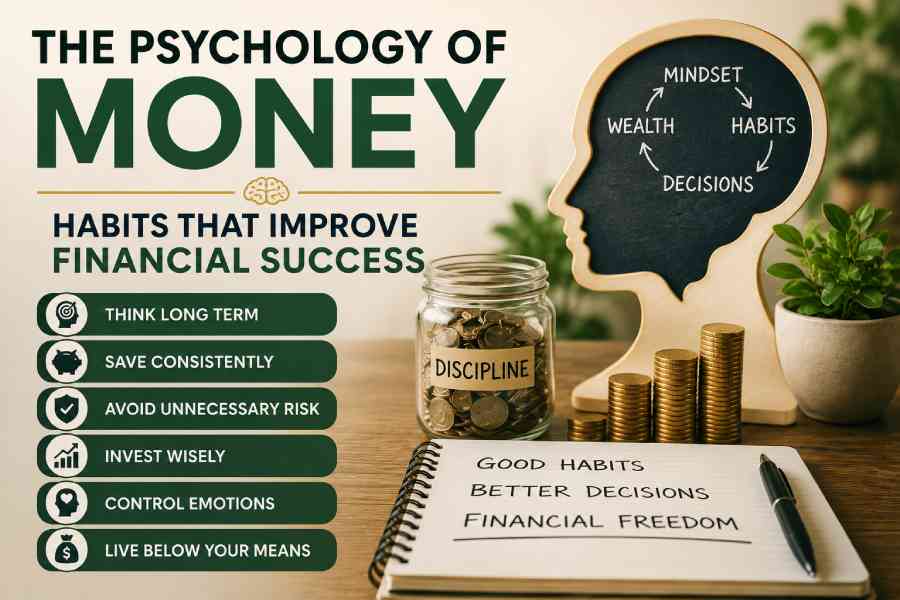
By improving financial habits, individuals can build long-term stability, reduce stress, and increase wealth potential.
Why Psychology Matters in Personal Finance
Money decisions are often emotional rather than logical. Emotional triggers shift cognitive execution, creating clear friction profiles:
- Fear: Can lead to poor investment choices or sudden panic liquidations.
- Greed: Often drives speculative risk-taking and asset bubble participation.
- Impatience: Systematically reduces long-term cumulative compounding returns.
- Overconfidence: Results in underestimating risks and securing significant capital losses.
Recognizing these internal behavioral triggers is the primary step toward structural financial decision-making.
Core Principles of Money Psychology
The psychology of money is based on systematic behavioral patterns rather than strict mathematical equations:
- People instinctively prioritize short-term consumption over long-term financial security.
- Baseline money frameworks and habits are formed very early in life.
- Social peer comparison heavily dictates daily variable spending behavior.
- Maintaining rigorous emotional control drastically improves investment yields.
Key Habits That Improve Financial Success
Habit 1: Live Below Your Means
Spending less than you earn creates an essential surplus that can be deployed into savings and investments. Individuals who protect this structural cash gap are significantly more likely to lock in long-term financial independence.
Habit 2: Avoid Lifestyle Inflation
Lifestyle inflation occurs when your luxury expenditure expands at the exact same rate as income growth. Controlling lifestyle creep ensures your savings velocity scales cleanly with your career promotions.
Habit 3: Delay Gratification
Prioritizing long-term stability over short-term reward is closely linked to wealth preservation. It helps eliminate impulse purchasing behavior and anchors focus on structural milestones.
Habit 4: Build Financial Awareness
Financial awareness demands an unfiltered understanding of cash inflows, liability frameworks, and investment allocations. Tracking balance-sheet adjustments eliminates systemic economic anxiety.
Habit 5: Automate Financial Decisions
Automation cleanly bypasses emotional bias. Setting up automated recurring savings, direct index mutual fund investments, and bill sweeps locks in baseline financial discipline effortlessly.
Habit 6: Understand Emotional Investing
Many active retail market participants execute trades driven purely by panic during macroeconomic downturns or euphoria during intense bull cycles. This cycle triggers the catastrophic pattern of buying market tops and selling market bottoms.
Habit 7: Develop a Saving Identity
When you transform saving into a core personal identity trait rather than a restrictive chore, capital accumulation becomes a natural baseline behavior pattern.
Habit 8: Track Spending Patterns
Small, unmonitored outflows—like daily premium food delivery, forgotten app trials, and routine impulse retail buying—gradually erode monthly cash flow metrics if left unvetted.
Habit 9: Avoid Comparison Spending
Financing an inflated lifestyle to project success to peers or match social media curated feeds injects major financial pressure. True wealth protection requires prioritizing security over appearances.
Habit 10: Build Long-Term Thinking
Adopting an extended temporal framework encourages patience, controls erratic financial pivots, and helps you appreciate asset performance horizons.
Habit 11: Practice Consistent Investing
Consistent systematic investing outperforms erratic attempts at timing macro market cycles. Strategies like automated monthly index contributions help average asset entry valuations cleanly.
Habit 12: Control Impulse Buying
Impulse purchasing thrives on rapid dopamine hits engineered by marketing funnels. Forcing a strict cooling-off period on non-essential buys safely targets this exposure.
Habit 13: Strengthen Financial Discipline
Discipline ensures that your strategic financial plans are executed uniformly across various economic environments, regardless of current motivation levels.
Habit 14: Reduce Debt Psychology Pressure
High-interest revolving debt introduces significant psychological strain and emotional anxiety. Executing targeted paydown roadmaps immediately cleanses intellectual bandwidth and unlocks active cash lines.
Habit 15: Build a Positive Money Mindset
A positive financial mindset shifts emphasis toward continuous skill upgrading, long-term capital efficiency, and persistent proactive financial development.
The Fear vs Greed Cycle in Money Psychology
The perpetual balance between fear and greed governs the majority of retail investment decisions:
- Fear: Triggers aggressive panic liquidations during standard market corrections, transforming temporary paper fluctuations into permanent losses.
- Greed: Encourages late-stage chasing of overvalued assets during market tops, ignoring risk boundaries.
Overcoming this internal cycle is what separates sound wealth accumulators from reactive speculators.
Common Behavioral Finance Mistakes
Avoid these classic psychological money pitfalls to maximize balance sheet efficiency:
- Chasing immediate, unverified profits through speculative trends.
- Operating without an integrated, multi-decade retirement roadmap.
- Allowing short-term news cycles to dictate long-term portfolio configuration.
- Neglecting savings rate consistency immediately after securing income raises.
Financial Success Roadmap Based on Money Psychology
Transitioning from behavioral theory to asset creation requires a structured action blueprint:
- Audit Your Current Behavior: Explicitly log all income flows, transaction patterns, and emotional spending windows.
- Map Behavioral Triggers: Recognize the exact emotional profiles (boredom, peer environments, stress) that drive luxury spending.
- Establish Clear Objectives: Secure measurable, time-bound targets for liquidity buffers, asset goals, and retirement accounts.
- Deploy Habit Automation: Set automated transfers for investments and core savings tools to outpace human decision friction.
- Commit to Ongoing Learning: Regularly refine your comprehension of investment mechanics and economic concepts.
Featured Snippet: What is the Psychology of Money?
The psychology of money refers to the complex study of how human emotions, behavioral tendencies, and cognitive mindsets systematically dictate financial choices. It clarifies why individuals manage capital differently under similar economic conditions. Mastering money psychology allows savers to neutralize emotional mistakes, curb impulse spending, and unlock long-term financial success.
Frequently Asked Questions (FAQs)
Why is psychology important in money management?
Because financial actions are fundamentally driven by psychological biases and emotional states rather than strict mathematical balance sheets, mastering mindset is vital for wealth preservation.
How can I improve my financial habits?
You can optimize your habits by tracking expenditures, removing human choice friction via savings automation, practicing delayed gratification, and identifying behavioral spending traps.
What is the biggest mistake in personal finance?
The most damaging personal finance mistake is executing emotional financial strategies, such as engaging in panic market sales or matching lifestyle choices with peer circles.
Can mindset really affect wealth?
Yes. Mindset directly influences personal consistency, saving thresholds, and risk management parameters, which fundamentally govern long-term wealth trajectories.
How do I build a wealth mindset?
A wealth mindset is cultivated by improving your core financial literacy, defending long-term strategies, maintaining strict lifestyle guardrails, and investing systematically.
Conclusion
While external market conditions and overall income levels influence wealth trajectories, individual behavior and internal mindsets determine sustainable long-term financial outcomes. True financial success requires a commitment to managing behaviors and emotions wisely over extended periods.