
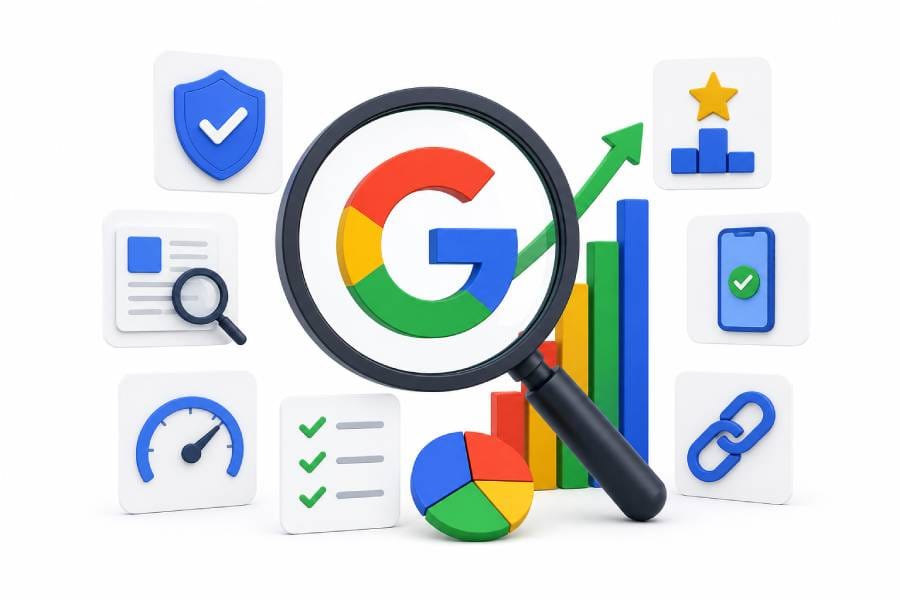
Google relies heavily on advanced artificial intelligence systems, multi-layered semantic graphs, user execution data, and automated quality filters to isolate which documents deserve top-tier real estate. For web operators, bloggers, and scaling brands, maintaining a clean grasp of these mechanics is critical to protect organic traffic streams.
This data-driven guide breaks down the essential Google ranking signals dominating 2026, giving you a transparent blueprint to build lasting organic growth.
How Google Rankings Work in 2026
Google coordinates hundreds of micro-signals using autonomous algorithmic systems. Instead of matching keywords on a linear scale, modern systems cross-examine quality layers, contextual signals, platform authority matrices, and technical infrastructure variables simultaneously.
Artificial intelligence assists Google in parsing web documents much like an expert analyst. This means the algorithm scores pages based on their overall problem-solving capacity rather than trivial keyword repetition thresholds. The ultimate objective is stable: providing users with direct, highly structured, and authentic information experiences.
Ranking Factor #1: High-Quality Content
Exemplary content remains the bedrock of sustainable visibility. If your page features shallow, derivative commentary, no amount of advanced technical engineering or backlink acquisition will secure target position maps.
Modern algorithmic iterations heavily reward documents that offer significant Information Gain—meaning the text provides original research, direct statistics, or unique analytical data that does not exist in the current search index index footprint.
Core Characteristics of High-Value Content:
- Exhaustive coverage of primary and secondary problem-solving vectors.
- Flawless factual accuracy with explicitly cited data source layers.
- Unique perspectives or proprietary research absent from competitor spaces.
- Scannable structural formatting with intuitive reading hierarchies.
Ranking Factor #2: Search Intent Alignment
Absolute alignment with search intent is an immutable requirement for on-page optimization. Google prioritizes document layouts that mirror the precise consumption intent indicated by the target query.
If an audience query points heavily to immediate commercial comparisons, attempting to force a lengthy biographical narrative will trigger immediate ranking drop-offs due to poor user matching paths.
The Four Fundamental Intent Nodes:
- Informational: Deep guides, calculations, and structured reference material.
- Navigational: Direct corporate URLs or branded gateway platforms.
- Commercial Investigation: Evaluative product roundups, comparison tables, and review matrices.
- Transactional: Immediate conversion routes, transactional links, and product buy gateways.
Ranking Factor #3: EEAT Signals
The E-E-A-T (Experience, Expertise, Authoritativeness, Trustworthiness) framework serves as a core qualitative scoring engine. As automated content generation drops publication barriers, verification indicators act as a primary index filter.
EEAT Priority Note: Websites presenting transparent real-world usage data, certified subject-expert authorship, and clean source citation layers consistently bypass traditional ranking volatility profiles.
Optimize your footprint by connecting verified author profile nodes across schemas, embedding primary case-study references, and keeping editorial transparency elements clean on corporate data landing hubs.
Ranking Factor #5: User Experience
Page layout and interaction accessibility play an important role in search scoring equations. Google expects domains to load seamlessly and allow consumers to access helpful textual solutions without facing disruptive layout hurdles.
Core elements such as clean, readable typography choices, logical navigational path frameworks, and the absence of aggressive, intrusive marketing interstitial popups are critical vectors that preserve organic rankings over long periods.
Ranking Factor #6: High-Quality Backlinks Still Matter
Inbound links remain an effective measure of digital authority inside Google’s ranking network, but the optimization metrics have shifted. Volume plays a secondary role to clean contextual value.
A small number of editorial link footprints earned from historically authoritative, high-traffic industry platforms provide more algorithmic value than thousands of low-grade, programmatic directory networks. AI pattern matching engines identify and filter out synthetic link manipulations with immense accuracy, making natural, resource-driven authority building the only safe path forward.
Ranking Factor #7: Technical SEO Remains Essential
Technical SEO shapes the foundational framework that allows automated search crawlers to access, interpret, and accurately index your content assets. Exceptional prose will fail to rank if underlying structural bugs break crawling efficiencies.
Critical Technical Optimization Targets:
- Clean, perfectly configured XML Sitemaps mapped cleanly inside search consoles.
- Secure, sitewide HTTPS encryption protocols.
- Flawless indexation control directives with clean canonical designations.
- Highly optimized internal crawl pathways that eliminate dead-end link nodes.
Ranking Factor #8: Core Web Vitals and Page Speed
Platform loading speeds directly dictate immediate user satisfaction. Slow page generation metrics trigger sudden bounce behaviors, which degrade search positioning metrics across high-intent queries.
The Three Core Web Vitals Benchmarks:
- Largest Contentful Paint (LCP): Measures perceived loading velocity, tracking when main content elements render fully.
- Interaction to Next Paint (INP): Assesses real-time user interface responsiveness during interaction steps.
- Cumulative Layout Shift (CLS): Evaluates visual structural stability to prevent unexpected page item movements.
Ranking Factor #9: AI Search Readiness
Generative answers and structural overview boxes now populate at the absolute apex of modern SERP interfaces. To maintain organic visibility, your document formatting must be built to be easily interpreted by these generative AI indexing engines.
Structure your content to state key answers directly, introduce data-backed information rows, implement cleanly targeted FAQ block structures, and use highly descriptive semantic headings across every single publication layer.
Ranking Factor #10: Content Freshness & Decay Management
Information parameters change rapidly across high-volatility markets. Google tracks document updates to ensure users are not reading obsolete data structures.
Build disciplined content management workflows to systematically swap out aged statistics, introduce modern case examples, fix broken links, and update screenshots to preserve high rank positioning over multi-year periods.
Ranking Factor #12: Internal Linking Architecture
Internal link distributions act as the internal roadmap guiding web crawlers through your asset database. A clean, descriptive contextual internal link layout passes page authority efficiently while grouping relevant concepts logically.
Ensure every premium hub layout distributes descriptive anchor-text links to its supporting long-tail documents, and link those sub-assets right back to the root hub to maximize topical authority signals.
Ranking Factor #13: Mobile-First Optimization
Google evaluates and ranks web properties based on mobile viewport profiles. If your desktop version operates cleanly but your mobile rendering features truncated text layouts or clunky buttons, your search rankings will suffer.
Test your site across multiple mobile screen profiles, ensure touch targets are easily clickable, compress asset files to match mobile data bounds, and ensure full feature parity between mobile and desktop setups.
Ranking Factor #14: Entity SEO and Semantic Relevance
Modern algorithmic crawlers do not see pages as plain text string lists. They map pages as clusters of verified entities—concepts, locations, brands, and real people connected within their Knowledge Graph models.
To establish deep semantic relevance, your copy must address terms, entities, and naturally related context markers that correlate with the core topic space, effectively moving past legacy literal match mechanics.
Ranking Factor #15: User Engagement Signals
User engagement indicators provide real-time validation of content value. While direct click tracking may vary across queries, long-term user satisfaction remains an essential health indicator for high rankings.
Focus heavily on expanding average session depth, generating real content interactions, encouraging returning visitor metrics, and reducing rapid search adjustments by giving readers exhaustive answers right away.
Ranking Factor #16: Structured Data and Schema Markup
Structured schema scripts clarify your data context for automated search engine systems. By serving clean, standardized machine code, you reduce algorithm tracking errors while increasing your eligibility to claim rich snippet layouts.
Deploy appropriate code configurations—specifically rich Article, FAQ, Review, and Organization Schemas—to ensure machine processors instantly read your business profile data correctly.
Ranking Factor #17: Conversational & Voice Search Optimization
As voice assistants and conversational AI interfaces expand across personal devices, a significant share of search queries use longer, more casual phrasing profiles.
Capture this audience by using natural, conversational language patterns inside your copy. Make it a priority to answer question-based searches directly using clear, un-convoluted sentences.
Ranking Factor #18: Platform Trust and Website Credibility
Digital trust forms a crucial defense layer against modern search ranking penalties. In an ecosystem filled with automated information paths, platform reliability factors are highly valued by human raters and machine classifiers alike.
Secure this asset by displaying transparent editorial ownership details, providing robust legal data disclosures, using secure web frameworks, and providing accurate fact-checking verification across all output channels.
The Core Google Ranking Factors in 2026: The Prioritized Blueprint
To help you focus your efforts, this structured table outlines the most impactful ranking components in 2026, categorized by priority and main focus areas:
| Priority Level | Core Ranking Factors | Primary Optimization Objective |
|---|---|---|
| Critical Priority | Content Quality & Search Intent | Provide unmatched user value and align layouts to user intent. |
| High Priority | EEAT Signals & Topical Authority | Verify author credentials and build comprehensive content hubs. |
| Technical Priority | Technical SEO & Core Web Vitals | Maximize crawl efficiency, improve mobile layouts, and boost speed. |
| Growth Priority | AI Search Readiness & Entity SEO | Format text clearly for easy data parsing by machine learning systems. |
Google Discover Optimization Checklist
Google Discover relies heavily on predictive machine learning models to surface fresh content streams directly to user feeds. Optimize for this channel using these key steps:
- Incorporate high-resolution, compelling visual feature assets (minimum 1200px wide).
- Craft punchy, highly engaging headlines that avoid manipulative clickbait traps.
- Publish timely, highly relevant updates aligned with trending cultural or market patterns.
- Maintain strong sitewide entity trust, author clarity, and platform authority signals.
Frequently Asked Questions
What is the most important Google ranking factor in 2026?
Comprehensive content quality coupled with absolute search intent alignment remains the single most dominant ranking foundation in 2026.
Do backlinks still matter in 2026?
Yes. High-quality, contextually relevant backlinks from authoritative, real-traffic sites remain an effective measure of digital authority.
Is technical SEO still important?
Absolutely. Technical SEO ensures search engine crawlers can seamlessly find, crawl, and interpret your web architecture without hitting code errors.
How important is EEAT?
EEAT is a core part of Google’s search scoring systems, used to verify information accuracy and author credibility across the web.
Does AI affect Google rankings?
Yes. AI shapes how search engines interpret context, evaluate source trust, score content depth, and compile conversational search overviews.